

If Israel’s longtime leader Benjamin Netanyahu loses in the upcoming elections, some hope that his removal will pave the way for peace. But there are several reasons why that’s not likely.

By Dr. Dov Waxman
Director of the UCLA Y&S Nazarian Center for Israel Studies
The Rosalinde and Arthur Gilbert Foundation Chair in Israel Studies
University of California, Los Angeles
After a decade in office, Benjamin Netanyahu’s long tenure as Israel’s prime minister may soon be ending.
Whether his Likud Party loses power following Israel’s election on April 9, or he’s forced to resign the premiership after being indicted on multiple corruption charges, Netanyahu’s downfall appears imminent.
Without the hawkish Netanyahu – who opposes full Palestinian statehood – at Israel’s helm, what are the chances for peace between Israelis and Palestinians?
Not good. Even an Israel-friendly peace plan, like the one expected to be proposed by the Trump administration, has little chance of success in a post-Netanyahu world.
No domestic pressure for peace talks
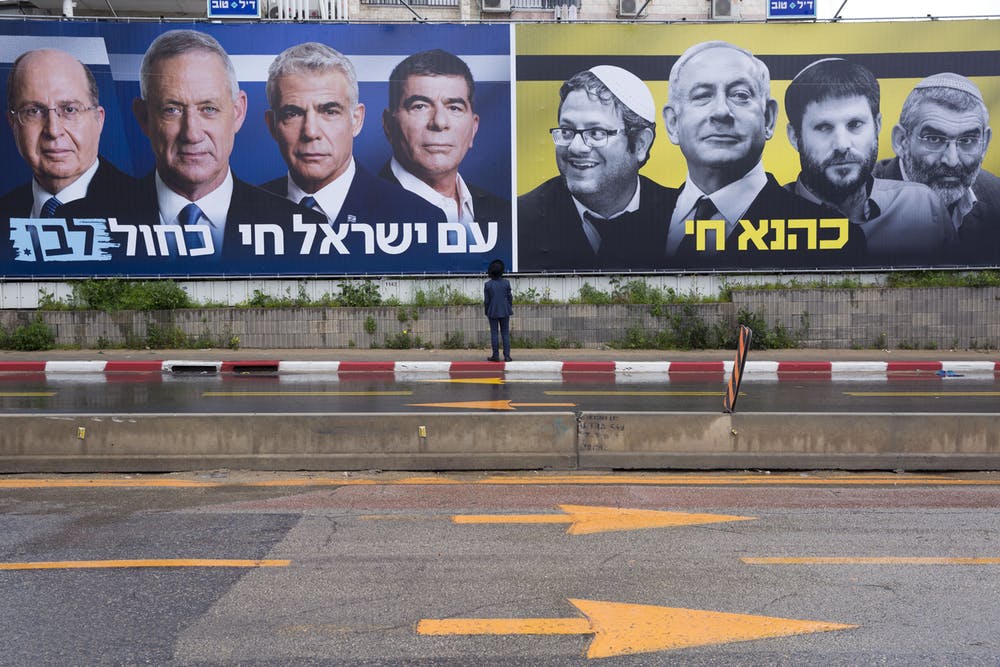
If the popular political newcomer Benny Gantz, who heads the recently formed “Blue and White” centrist alliance along with Yair Lapid, becomes Israel’s next prime minister, he is unlikely to prioritize peace talks with the Palestinians.
Although the official platform of the Blue and White alliance expresses a willingness to enter negotiations with the Palestinians, Gantz will be in no hurry because there’s no public pressure for peace talks.
Most Israelis, like most Palestinians, have concluded that they have no partner for peacemaking and they’ve given up on the peace process.
Israelis are more concerned with their economy and their security. Though they would like to resolve their long-running conflict with the Palestinians, or at least “separate” themselves from Palestinians and stop ruling over them in the West Bank, most Israelis see no safe or easy way to do so. However unsatisfactory it is, the status quo is bearable for them.
Major concessions unlikely
Even if peace talks do eventually get underway, an Israeli government led by the Blue and White alliance would be only slightly more amenable to compromise than Netanyahu’s governments have been.
Blue and White’s platform rejects many of the concessions that Israel would probably have to make to reach a peace agreement with the Palestinians. In my forthcoming book, “The Israeli-Palestinian Conflict: What Everyone Needs to Know,” I explain what concessions each side would have to make on highly controversial issues like the future of Jerusalem and the right of return for Palestinian refugees.

The party’s platform rules out any division of Jerusalem as part of a peace agreement. And it calls for Israel to keep all the large Jewish settlement blocs in the West Bank as well as for Israel to retain control over the Jordan Valley. The Palestinians have previously rejected Israel’s demand for an indefinite military presence in the Jordan Valley, deep inside the West Bank.
The platform also explicitly rejects a unilateral withdrawal – like Israel’s 2005 so-called “disengagement” from Gaza – from anywhere in the West Bank.
And, although it promises to “deepen the process of separation from the Palestinians,” it makes no mention of Palestinian statehood or a two-state solution. This is hardly a recipe for peace.
Hawks, not doves
It may be tempting to believe that this is all just electioneering, and that in its effort to appeal to right-wing voters, the Blue and White alliance is disguising its dovish intentions.
Indeed, this is what Netanyahu has been repeatedly telling Israelis, claiming that Blue and White is really run by “leftists.” In current Israeli political discourse, that is about the worst offense imaginable – “leftist” has basically become a byword for traitor.
The candidates on Blue and White’s slate, however, are far from peaceniks.
Former military generals dominate the list, including Netanyahu’s onetime defense minister Moshe Ya’alon, who is number three on the party list. Ya’alon is even more right-wing than Netanyahu, who was at least willing to consider the eventual possibility of a Palestinian state – albeit only a “state-minus” as he put it.
Like Ya’alon, Gantz was also once the chief of staff of the Israel Defense Forces. He has been reticent, if not enigmatic, in expressing his views on the Israeli-Palestinian conflict.
But whatever his personal opinions might be, for the sake of his leadership and the survival of his political alliance, Gantz will have to be attentive, if not responsive, to the views of the alliance’s right-wing members and voters.
Coalition politics
Because of Israel’s proportional representation electoral system, no party ever wins a majority of seats in Israel’s parliament, the Knesset. So, the Blue and White alliance will have to depend on other parties in order to form and maintain a governing coalition. That means getting the support of more than half of the 120 Knesset members.
The alliance might be able to rely upon the parliamentary support of Arab parties – as Yitzhak Rabin’s Labor Party did in the early 1990s when it began the Oslo peace process. But it is more likely to avoid doing so, as every other Israeli government in history has done.
That’s because relying upon Arab parties risks delegitimizing the government in the eyes of Israeli Jews, many of whom perceive the Arab parties as radical and disloyal, a “fifth column” in Israel’s conflict with the Palestinians.
Instead of assembling a center-left parliamentary bloc that includes Arab parties, I believe the Blue and White alliance is more likely to form a “national unity” government with Zionist parties to its left and right. This coalition may well include the right-wing Likud Party, especially if Netanyahu no longer leads it.
Typically, such national unity governments, containing a range of views from the left and right, are politically paralyzed when it comes to pursuing peace with the Palestinians.
A more centrist Israeli government than the current one, which is dominated by right-wing parties, would surely take a more moderate approach to the Palestinian issue. Israel’s relations with the Palestinian Authority would probably improve, the growth of Jewish settlements in the heart of the West Bank might slow, and Israel could further ease its blockade of the Gaza Strip.
All of this would reduce the risk of Israeli-Palestinian violence. But, sadly, peace will remain a distant prospect.
Originally published by The Conversation, 03.20.2019, under the terms of a Creative Commons Attribution/No derivatives license.