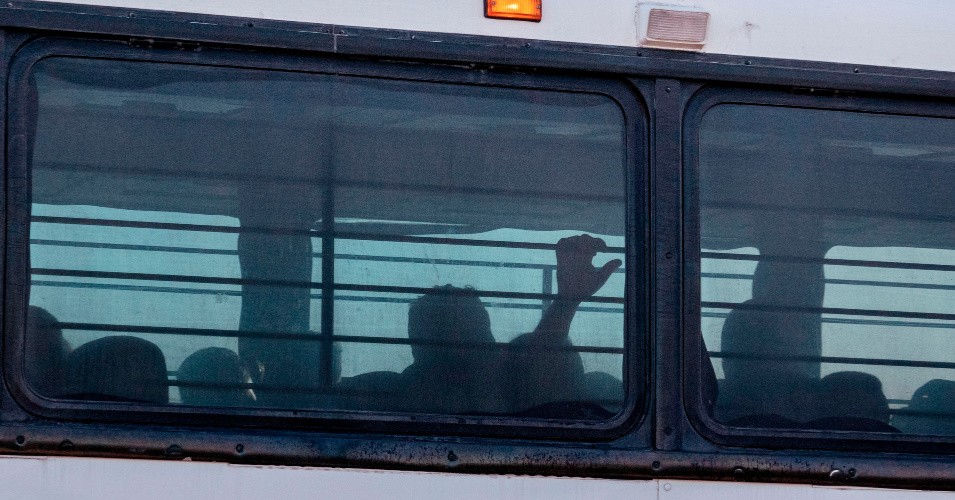

No, they are not death camps. But, I fear, they are evolving.

By Robert C. Koehler
“These aren’t people. These are animals.”
These words alone set off the alarm — the fascism alarm, you might say. Donald Trump is by no means the sole source of America’s democracy nosedive, but he’s its current, deeply troubling manifestation.
Should I write this week about the wars he wants to wage or the refugee border cages he continues to fill? They’re all connected, by their domination and punishment mindset, their subservience to war profiteering and the geopolitics of empire, their ignorant certainty that American exceptionalism is the cornerstone of national security, their indifference to human suffering and need.
“We were in American concentration camps. We were held under indefinite detention. We were without due process of law. We were charged without any evidence of being a threat to national security, that we were in an unassimilable race, that we would be a threat to the economy.”
The speaker is Satsuki Ina, a woman who spent part of her childhood at a Japanese-American internment camp during World War II and who, with fellow childhood internees, recently stood in protest at Fort Sill, Oklahoma, a U.S. military base slated to become a detention center for 1,400 immigrant children.
“We hear these exact words today regarding innocent people seeking asylum in this country,” she went on. “And unlike 1942, when America turned their back on us while we were disappearing from our homes, our schools, our farms and our jobs, we are here today to speak out, to protest the unjust incarceration of innocent people seeking refuge in this country. We stand with them, and we are saying, ‘Stop repeating history.’”
The only way to avoid repeating history is to face it squarely and atone for it. There’s a hell of a lot of history this country has not yet faced, but the Trump administration, with its blatant disregard for political correctness, is making it front-page news.
Indeed, you might say that Trump the blowhard is at best an amateur fascist, failing, as he so often does, to hide U.S. aggression behind established clichés. Thus, during the Obama administration, border internment wasn’t news at all, but Trump has managed to expose the hellish conditions and the ripped-apart families to the world.
Recently, for instance, Rep. Alexandria Ocasio-Cortez generated some indignant outrage when she tweeted, referencing an article in Esquire, that the United States has created a system of concentration camps to detain the asylum seekers flooding into the country from Central America. That was too much for Liz Cheney, who counter-tweeted: “Please @AOC do us all a favor and spend just a few minutes learning some actual history. 6 million Jews were exterminated in the Holocaust. You demean their memory and disgrace yourself with comments like this.”
But in point of fact, these are concentration camps. Historian Andrea Pitzer, quoted by Jack Holmes in the Esquire article that AOC cited, defines “a concentration camp system” simply and logically enough as “mass detention of civilians without trial.”
That doesn’t mean they’re the equivalent of Nazi death camps, but the term’s reverberations are legitimately troubling, because the process it defines is the same: dehumanizing a group of people based on race, religion, ethnicity or whatever (“These aren’t people. These are animals”); fomenting fear that their presence constitutes a “national emergency”; conducting mass roundups and detaining the arrestees indefinitely.
What could go wrong?
As Pitzer writes in her book, One Long Night: A Global History of Concentration Camps: “There’s this crystallization that happens. The longer they’re there, the worse conditions get. That’s just a universal of camps.”
Some of these declining conditions were recently described on Democracy Now! by lawyer Warren Binford, who interviewed children at a detention facility in Clint, Texas: “(V)irtually no one is taking care of these children directly . . . they are locked up in these cells 24 hours a day. There are open toilets in many of these cells. There’s no soap, no way to wash their hands. . . . And many of them are being forced to sleep on concrete because of a shortage of beds and mats and sleeping space. Children described sleeping on concrete floors. They described sleeping on cement blocks.”
And, my God, when the children get sick, they’re placed in quarantine under conditions that are “just horrendous. These very sick children, with high fevers . . . being put on the floor, on mats, largely unsupervised, locked up together for days at a time.”
And Holmes points out: “Another issue is that these camp systems, no matter where they are in the world, tend to fall victim to expanding criteria. The longer they stay open, the more reasons a government finds to put people in them. That’s particularly true if a new regime takes control of an existing system, as the Trump administration did with ours.”
Thus, asylum seekers once had legal rights, but not anymore. As their numbers increased, due primarily to worsening conditions in Guatemala, El Salvador and Honduras (countries the United States helped ravage politically), virtually all the refugees started getting treated as “illegals.” And, writes Holmes: “There is reason to believe the criteria will continue to expand.”
These are American concentration camps, not simply in the tradition of the Japanese-American internment camps of World War II, but in that other tradition as well, across the ocean. They’re not death camps, but they’re evolving, I fear, in much the same moral and political void.
Published by Common Dreams, 06.27.2019, under the terms of a Creative Commons Attribution-Share Alike 3.0 license.