
Trump’s businesses made themselves appear more profitable to lenders and less profitable to tax officials.

By Heather Vogell
Documents obtained by ProPublica show stark differences in how Donald Trump’s businesses reported some expenses, profits and occupancy figures for two Manhattan buildings, giving a lender different figures than they provided to New York City tax authorities. The discrepancies made the buildings appear more profitable to the lender — and less profitable to the officials who set the buildings’ property tax.
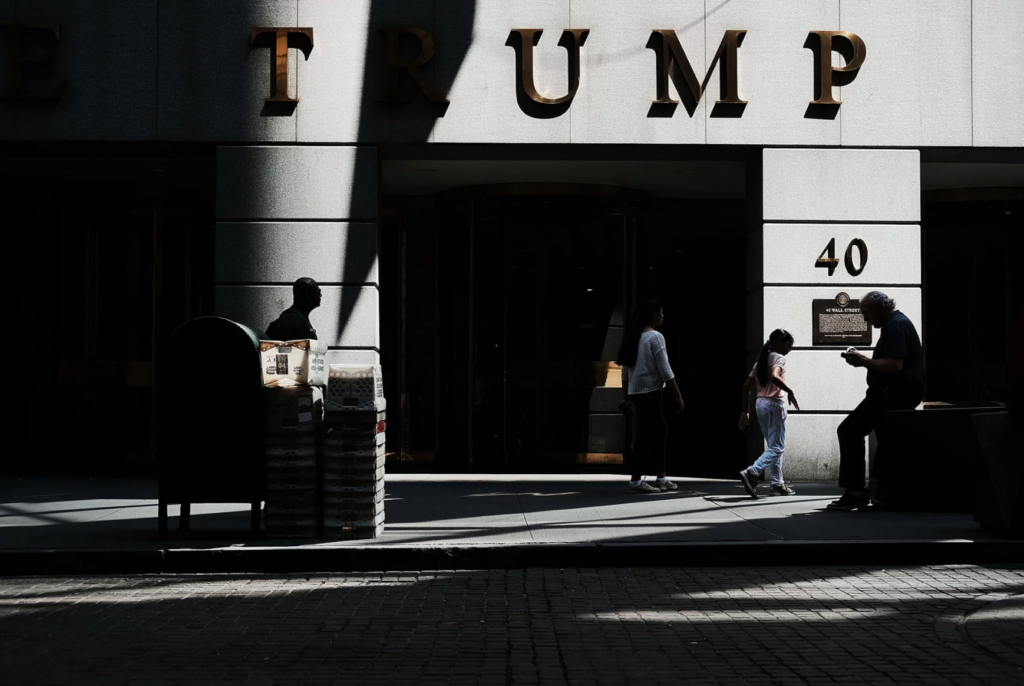
For instance, Trump told the lender that he took in twice as much rent from one building as he reported to tax authorities during the same year, 2017. He also gave conflicting occupancy figures for one of his signature skyscrapers, located at 40 Wall Street.
Lenders like to see a rising occupancy level as a sign of what they call “leasing momentum.” Sure enough, the company told a lender that 40 Wall Street had been 58.9% leased on Dec. 31, 2012, and then rose to 95% a few years later. The company told tax officials the building was 81% rented as of Jan. 5, 2013.
A dozen real estate professionals told ProPublica they saw no clear explanation for multiple inconsistencies in the documents. The discrepancies are “versions of fraud,” said Nancy Wallace, a professor of finance and real estate at the Haas School of Business at the University of California-Berkeley. “This kind of stuff is not OK.”
New York City’s property tax forms state that the person signing them “affirms the truth of the statements made” and that “false filings are subject to all applicable civil and criminal penalties.”
The punishments for lying to tax officials, or to lenders, can be significant, ranging from fines to criminal fraud charges. Two former Trump associates, Michael Cohen and Paul Manafort, are serving prison time for offenses that include falsifying tax and bank records, some of them related to real estate.
“Certainly, if I were sitting in a prosecutor’s office, I would want to ask a lot more questions,” said Anne Milgram, a former attorney general for New Jersey who is now a professor at New York University School of Law.
Trump has previously been accused of manipulating numbers on his tax and loan documents, including by his former lawyer, Cohen. But Trump’s business is notoriously opaque, with records rarely surfacing, and up till now there’s been little documentary evidence supporting those claims.
That’s one reason that multiple governmental entities, including two congressional committees and the office of the Manhattan district attorney, have subpoenaed Donald Trump’s tax returns. Trump has resisted, taking his battles to federal courts in Washington and New York. And so the question of whether different parts of the government can see the president’s financial information is now playing out in two appeals courts and seems destined to make it to the U.S. Supreme Court. Add to that a Washington Post account of an IRS whistleblower claiming political interference in the handling of the president’s audit, and the result is what amounts to frenetic interest in one person’s tax returns.
ProPublica obtained the property tax documents using New York’s Freedom of Information Law. The documents were public because Trump appealed his property tax bill for the buildings every year for nine years in a row, the extent of the available records. We compared the tax records with loan records that became public when Trump’s lender, Ladder Capital, sold the debt on his properties as part of mortgage-backed securities.
ProPublica reviewed records for four properties: 40 Wall Street, the Trump International Hotel and Tower, 1290 Avenue of the Americas and Trump Tower. Discrepancies involving two of them — 40 Wall Street and the Trump International Hotel and Tower — stood out.
There can be legitimate reasons for numbers to diverge between tax and loan documents, the experts noted, but some of the gaps seemed to have no reasonable justification. “It really feels like there’s two sets of books — it feels like a set of books for the tax guy and a set for the lender,” said Kevin Riordan, a financing expert and real estate professor at Montclair State University who reviewed the records. “It’s hard to argue numbers. That’s black and white.”
The Trump Organization did not respond on the record to detailed questions provided by ProPublica. Robert Pollack, a lawyer whose firm, Marcus & Pollack, handles Trump’s property tax appeal filings with the city, said he was not authorized to discuss the documents. A spokeswoman for Mazars USA, the accounting firm that signed off on the two properties’ expense and income statements, said the firm does not comment on its work for clients. Executives with Trump’s lender, Ladder Capital, declined to be quoted for the story.
In response to ProPublica’s questions about the disparities, Laura Feyer, deputy press secretary for New York Mayor Bill de Blasio, said of the Trump International Hotel and Tower, “The city is looking into this property, and if there has been any underreporting, we will take appropriate action.”
Taxes have long been a third rail for Trump. Long before he famously declined to make his personal returns public, a New York Times investigation concluded, Trump participated in tax schemes that involved “outright fraud,” and that he had formulated “a strategy to undervalue his parents’ real estate holdings by hundreds of millions of dollars on tax returns.” Trump’s former partners in Panama claimed in a lawsuit, which is ongoing, that Trump’s hotel management company failed to pay taxes on millions in fees it received. Spokespeople for Trump and his company have denied any tax improprieties in the past.
In February, Cohen told Congress that Trump had adjusted figures up or down, as necessary, to obtain loans and avoid taxes. “It was my experience that Mr. Trump inflated his total assets when it served his purposes,” Cohen testified, “and deflated his assets to reduce his real estate taxes.”
The two Trump buildings with the most notable discrepancies shared a financial trait: Both were refinanced in 2015 and 2016 while Trump was campaigning for president. The loan for 40 Wall Street — $160 million — was then the Trump Organization’s biggest debt.
The fortunes of 40 Wall Street have risen and fallen repeatedly since it was constructed in 1930. Once briefly in the running to become the world’s tallest skyscraper (before being eclipsed by the Chrysler Building and then others), the 71-story landmark had an illustrious history before falling into disrepair as it changed hands multiple times.
Trump says in his book “Never Give Up” that he took over 40 Wall Street for $1 million during a down market in 1995. Others have reported the price as $10 million. Trump gave the property his signature treatment, decking out the lobby in Italian marble and bronze and christening it “The Trump Building.” Tenants such as American Express moved in.
But the rent rolls suffered when big-name tenants fled to Midtown in the years after the Sept. 11 attacks. Less blue-chip operations replaced them. In recent years, there were more setbacks. About two years ago, for example, high-end food purveyor Dean & Deluca canceled plans to locate an 18,500-square-foot emporium on the higher-priced first floor. The space remains empty.
The building at 40 Wall was underperforming, charging below-market rents, according to credit-rating agency Moody’s. Its profits were lagging.
Trump’s company, which has sometimes struggled to obtain credit because of his history of bankruptcies and defaults, turned for relief to a financial institution where Donald Trump had a connection: Ladder Capital, which employs Jack Weisselberg, the son of the Trump Organization’s longtime CFO, Allen Weisselberg. Ladder is a publicly traded commercial real estate investment trust that reports more than $6 billion in assets. In 2015, and still today, Jack Weisselberg was an executive director whose job was to make loans.
Trump and Jack Weisselberg had history together. Jack was at UBS, in its loan origination department, in 2006, when the Swiss bank loaned Trump $7 million for his piece of the Trump International Hotel and Tower. Allen Weisselberg had bought a condo from Trump in one of his buildings for a below-market price of $152,500 in 2000. He deeded it to Jack three years later for about $148,000. Jack sold the unit for more than three times as much in 2006. (Jack Weisselberg declined to comment on Ladder’s loans or his relationship with the Trump Organization.)
Even with a sympathetic lender, the struggles at 40 Wall Street would normally raise questions. Trump’s representatives needed to demonstrate signs of the building’s financial health if they wanted a new loan with a lower interest rate.
They had a compelling piece of data, it seemed. Trump’s team told Ladder that occupancy was rebounding after registering a lackluster 58.9% on Dec. 31, 2012. Since then, Trump representatives reported, the building had signed new tenants. Income from them hadn’t fully been realized yet, largely because of free-rent deals, they said. But after 2015, they predicted, revenues would surge.
“That’s a selling point for people in the business,” said Riordan, who was previously the executive director of the Rutgers Center for Real Estate. Borrowers “want to show tremendous leasing momentum.” The steepness of such a rise in occupancy at the Trump building was unusual, Riordan and other experts said.
Documents submitted to city property tax officials show no such run-up. Trump representatives reported to the tax authorities that the building was already 81% leased in 2012.
“What is bizarre is that you have these tax filings that are totally different,” Riordan said. A gap of at least 10 percentage points between the two occupancy reports persisted for the next two years, before the figures in the tax and loan reports synced in January 2016.
The portrayal of a rapid rise in occupancy, and the explanation that income would soon follow, were critical for the refinancing. Indeed, Ladder’s underwriters were predicting that 40 Wall Street’s profits would more than double after 2015. Having reviewed Trump’s financial statements and rent roll, they estimated the building would clear $22.6 million a year in net operating income.
Ladder needed credit ratings agencies like Moody’s and Fitch to endorse its income expectations and give the loan a favorable rating, which would in turn make it easier for the next step of the plan: to package the loan as part of a bond, a so-called commercial mortgage-backed security, and sell it to investors. Without the expected rise in income, Riordan said, the loan size or terms would likely have needed to be renegotiated to satisfy the ratings agencies and investors, which would mean less favorable terms for Trump and Ladder. “There was a story crafted here,” Riordan said. “It’s contradicted by what we see in the tax filings.”
Wallace, the University of California professor, added: “Especially in underwriting loans, you are supposed to truthfully report.” Both the lender and the borrower are required to supply accurate information, she said.
Moody’s and Fitch analysts found the underwriter’s projections slightly too rosy, but Fitch conferred an investment-grade rating on the loan, allowing it to proceed as planned. Trump ultimately received a 10-year loan with a lower interest rate than the building previously had as well as terms that would allow him to defer paying off much of the principal until the end of the loan.
Once granted, the loan to 40 Wall Street ran into trouble: The year after it went through, the loan servicer put it on a “watch list” because of concerns that the building wasn’t making sufficient profit to pay the debt service with enough of a margin. It stayed on the list for three months. (Trump’s company has continued making payments.)
As of 2018, the most recent year available, the building had never met the underwriters’ profit expectations, trailing by more than 8%, according to data from commercial real estate research service Trepp. Experts say that, given the amount of research underwriters do, a property typically meets their expectations fairly quickly.
The 40 Wall Street documents contain discrepancies related to costs as well as to occupancy. Generally, there are “more opportunities to play games on the expense side,” said Ron Shapiro, an assistant professor at Rutgers Business School and a former bank senior vice president, “particularly because there are many more kinds of expenses.”
Comparing specific expense items in both sets of records is challenging, because accountants may group categories differently in reports to tax and loan officials. But some differences on 40 Wall Street documents elicit head-scratching.
For example, insurance costs in 2017 were listed as $744,521 in tax documents and $457,414 in loan records.
Then there was the underlying lease. Trump technically doesn’t own 40 Wall Street. He pays the wealthy German family that owns the property for the right to rent the building to tenants. In 2015, both Trump’s report to tax authorities and a key loan disclosure document asserted that Trump’s company paid $1.65 million for these rights that year. But a line-by-line income and expense statement, which Trepp gathered from what the company reported to the loan servicer, reported the company paid about $1.24 million that year.
“I don’t know why that would be off,” said Jason Hoffman, who is chair of the real estate committee for a professional association of certified public accountants in New York state. Like other experts, he said there are legitimate reasons why tax and loan filings might not line up perfectly. But Hoffman said the firm where he works makes sure the numbers match when it prepares both tax and loan documents for a client — or that it can explain why if they don’t.
Financial information for the Trump International Hotel and Tower raises similar questions. Trump owns only a small portion of the building, which is located on Columbus Circle: two commercial spaces, which he rents out to a restaurant and a parking garage. Trump’s company told New York City tax officials it made about $822,000 renting space to commercial tenants there in 2017, records show. The company told loan officials it took in $1.67 million that year — more than twice as much. In eight years of data ProPublica examined for the Columbus Circle property, Trump’s company reported gross income to tax authorities that was typically only about 81% of what it reported to the lender.
Trump appeared to omit from tax documents income his company received from leasing space on the roof for television antennas, a ProPublica review found. The line on tax appeal forms for income from such communications equipment is blank on nine years of tax filings, even as loan documents listed the antennas as major sources of income.
Trump has an easement to lease the roof space; he doesn’t own it. But three tax experts, including Melanie Brock, an appraiser and paralegal who has worked on hundreds of New York City tax cases, told ProPublica that the income should still be reported on the tax appeals forms.
It’s hard to guess what might explain every inconsistency, said David Wilkes, a New York City tax lawyer who is chair of the National Association of Property Tax Attorneys. But, he added, “My gut reaction is it seems like there’s something amiss there.”
Tax records for Trump personally and for his business continue to be subjects of contention in multiple investigations. The Justice Department has intervened in the investigation by the Manhattan district attorney, whose office has sought Trump’s personal tax returns. Congressional lawmakers investigating his business dealings have sought documents from his longtime accountant, Donald Bender, a partner at Mazars. Trump is fighting the subpoenas in court. (Bender did not respond to requests for comment.)
Rep. Elijah Cummings, D-Md., chairman of the House Oversight Committee, has said the committee is seeking to determine if Cohen’s testimony about Trump inflating and deflating his assets was accurate. Cummings asked for Mazars’ records related to Trump entities, as well as communications between Bender and Trump or Trump employees since 2009.
Such communications, the subpoena stated, should include any related to potential concerns that information Trump or his representatives provided his accountants was “incomplete, inaccurate, or otherwise unsatisfactory.”
Originally published by ProPublica, 10.16.2019, under a Creative Commons Attribution-NonCommercial-NoDerivs 3.0 United States license.