

By Rose Himber Howse
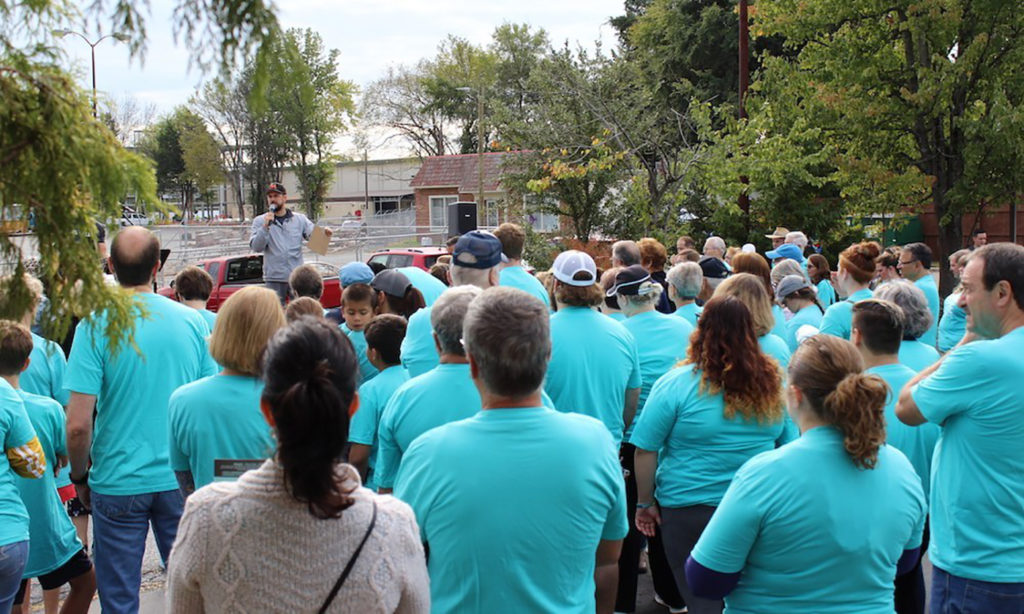
It’s my first day as an escort at A Woman’s Choice, the lone abortion clinic in Greensboro, North Carolina. At 7 in the morning, it feels like I’ve stumbled onto a block party. At least 50 people are gathered in the parking lot, a space designed for 20 cars, and a guitarist with an amp is strumming and crooning.
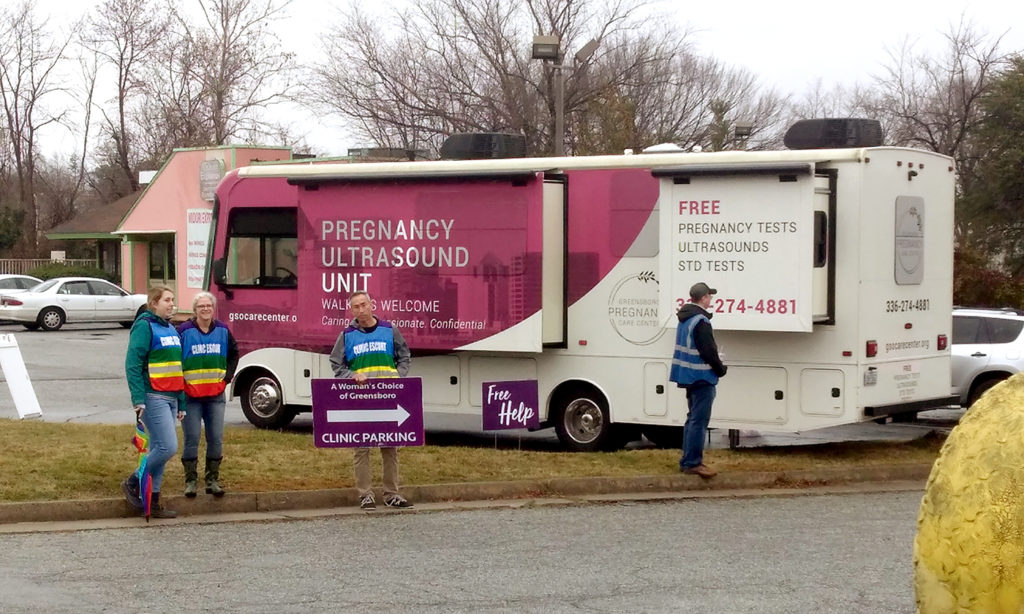
Blocking the view of the actual clinic is the Greensboro Pregnancy Care Center’s mobile unit: a pink and white van that serves as the mother ship for six anti-abortion activists also wearing pink. The layout is a nightmare for patients who have to navigate a series of turnoffs that lead them past the van and through the parking lot where these protesters set up camp each morning.
I learn quickly that the pink-vested activists won’t hesitate to exploit the confusion. They swarm as a car drives in, with two of our more experienced escorts racing to catch up. I’m on crutches, and before I can reach that first car, another is pulling into the entrance. I hobble over, reaching it just behind a man in pink.
“Where do I park for the clinic?” the driver asks. “I have an appointment.”
“Just right ahead,” he lies. “Follow me.”
I call out, “Excuse me. They’re just protesters. That’s not the clinic.” But she’s already driving down the hill toward the van.
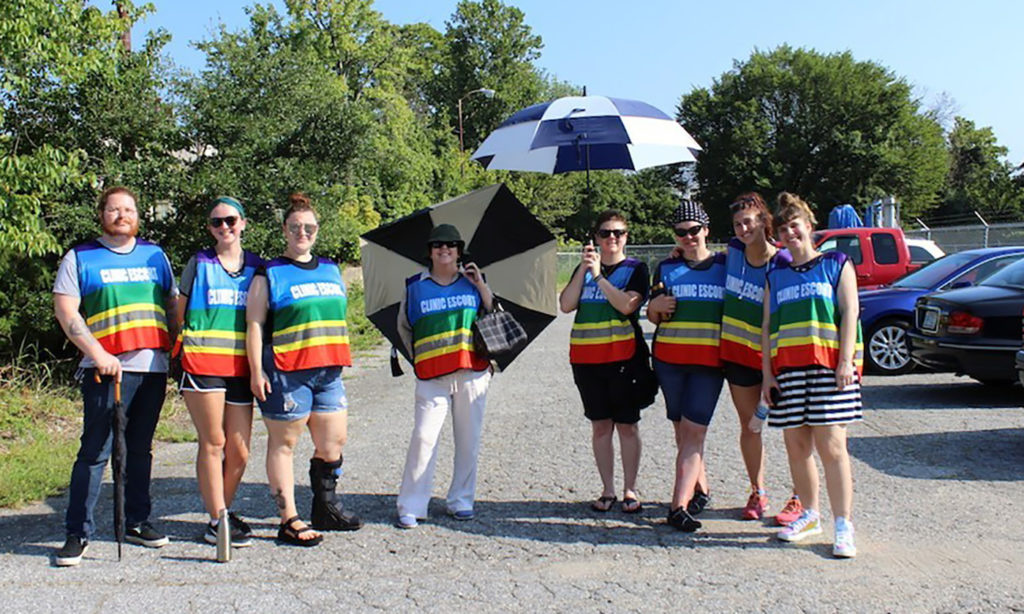
This dramatic scene plays out several days each week. On Saturdays, the group of protesters grows to a near-mob, as eight volunteer escorts run interference for clinic patients.
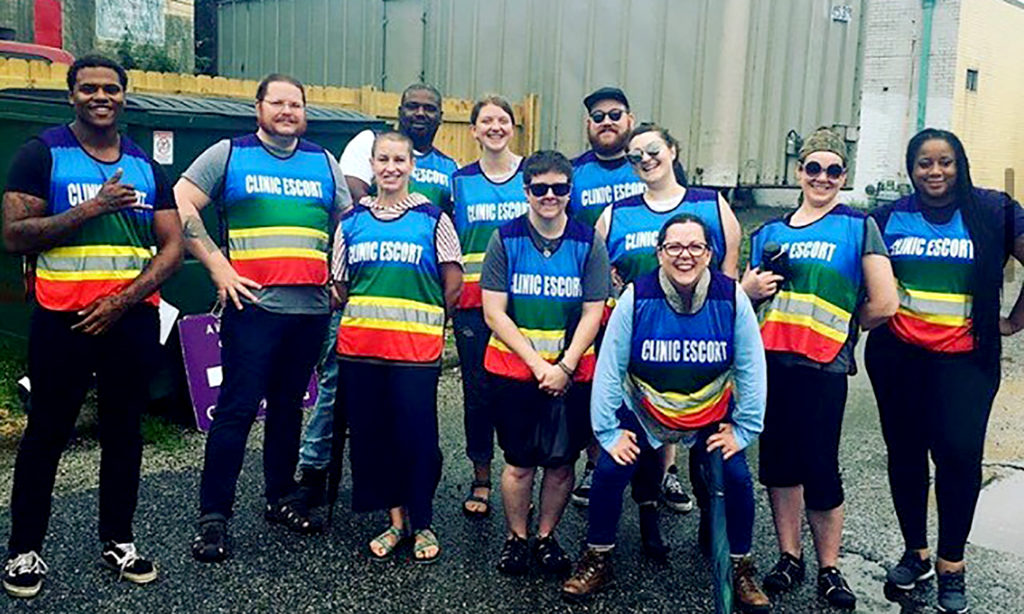
Since it was founded in 2015, A Woman’s Choice has provided comprehensive abortion services, as well as free contraception, to more than 6,000 people. Most are women of color, many of whom drive long distances from rural parts of the state to access care. The clinic also offers ultrasounds, testing and treatment for sexually transmitted infections and HIV, emergency contraception, and financial assistance for those who need it, says Terry Sallas Merritt, an executive team member of A Woman’s Choice.
The pink van first began appearing about two years ago, and Merritt says women who visit the crisis pregnancy center have, “come in crying and angry because it takes a while to catch on to what is happening.”
“Often people [who visit the mobile unit] are told [incorrectly] that their pregnancy tests are inconclusive, and that they should wait and come back in a few weeks,” she tells me. This can sometimes lead to the need for a more expensive, later-term abortion, or even force a patient to run out of time for the procedure at all.
This deception is highly calculated. Other escorts describe how the pink van protesters once stole a “Clinic Parking” sign from the actual clinic’s dumpster and put it up to further the confusion. And Merritt says that patients waylaid by the crisis center van have reported phone harassment by care center staff or volunteers who threaten to call the numbers listed for loved ones or employers.
I first learned of the clinic’s need for volunteer escorts at a lecture about reproductive rights and racial justice, where organizer Brandi Lynnell Collins-Calhoun described how predominantly White protesters often hurl racist epithets at patients and escorts of color to intimidate them.
Collins-Calhoun helped to build the escort service from around 10 members two years ago to an estimated 50 now, including about 20 regulars, including students from nearby North Carolina A&T State University. She wanted to ensure that the patients of color coming into the clinic wouldn’t feel isolated and alone.
“The current political state definitely played a role in mobilizing volunteers,” she says. “These were conversations and groundwork that myself and other organizers had mobilized around for years, but there was a universal fear that our community felt around reproductive access over the last few years,” she says. “And while the political climate certainly helped us, it also mobilized protesters and antis to use racism and hate as a platform.”
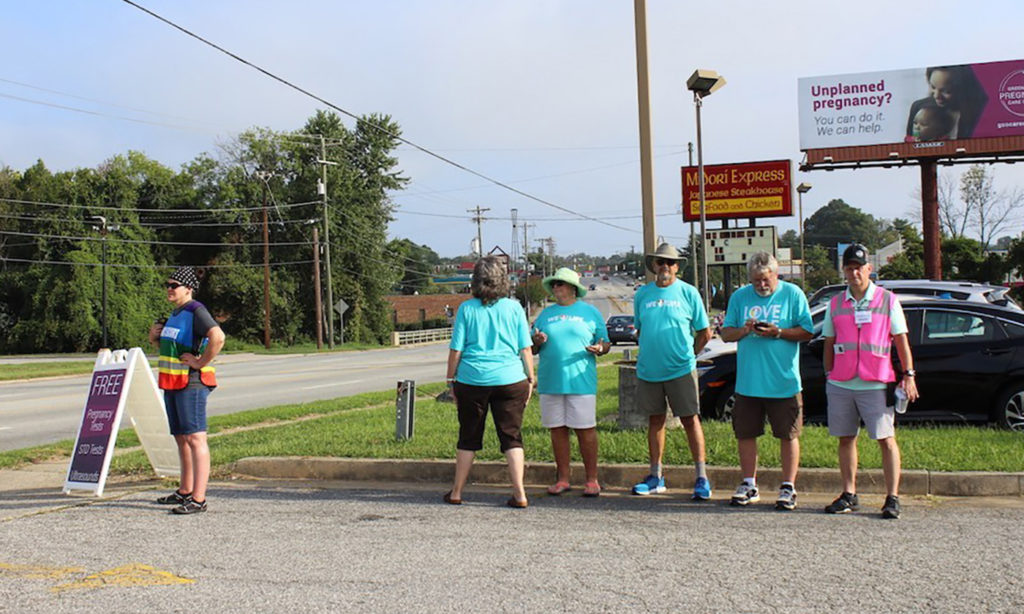
Some days, the emotional toll of escorting is intolerable, particularly for those targeted. But with protesters outnumbering escorts at least 10-to-1, the clinic is desperate to recruit more supportive volunteers.
Still, I held this image of warmly greeting clients and walking them to the clinic door. And this is indeed one part of escorting. But most of the rest of my first day is spent fending off the provocations of protesters—those affiliated with the care center as well as their assembled comrades.
One pink-vested woman asks if I know Jesus. And hearing the instructions of the head escort becomes hard when an older White guy turns up his megaphone and launches into a rant about child murder. While I’m directing a driver, a care center volunteer steps between us, and I stumble backwards while he shoves anti-abortion literature into her car. By the time the shift is over, I understand completely why some patients just turn around and drive home when they behold the scene they’ll be forced to navigate.
The first time I’m back at the clinic after losing the crutches, I witness a spirited altercation between an escort and a protester. He’s up in her face but smiling. “Why won’t you talk to me? I just want to have a civil conversation,” he says.
“James, we’ve been through this,” she tells him. “We’re not going to change each other’s minds.”
Later, she explains to me that they used to get into political arguments, but that it just made her less attentive to people who needed an escort. “I don’t know if that was intentional on his part or not,” she says. “But if so, it was clever. I have to remember that we’re here for patients.”
I’m keeping an eye on a car down the road that looks like it might be lost when a male protester whips out a phone and holds it close to my face. I realize he’s filming, which is legal according to the Freedom of Access to Clinic Entrances Act, the federal law intended to protect clinic patients from protesters. Unfortunately, the law deals in language so vague that it often evades enforcement. Filming and taking pictures of patients and escorts is legal, as are bullhorns; neither qualifies as “threat or force of threat.” Yet the law does prohibit behavior that “intimidates,” and in my subjective observations, patients are indisputably intimidated by protesters every day.
The outright hostility of this sidewalk climate isn’t unique to North Carolina, and it isn’t getting better. According to the National Abortion Federation, we’re witnessing record increases in violence against abortion clinics. Reproaction.org, a watchdog for fake pregnancy centers, reports incidences of staff showing up at the schools of pregnant minors who have sought their services.
Without question, my experience as a clinic escort has demonstrated the gravity of the anti-choice movement in the South and throughout the country. But I’ve had moments in which the unbridled power of resisting feels undeniable. I’ve been thanked for gestures as small as walking next to a patient past a jeering crowd or providing an umbrella to ensure anonymity from filming protesters.
An abortion clinic parking lot should not be a battlefield. But as long as it is, our willingness to walk in solidarity alongside pregnant people, trusting them to make that most profoundly personal choice for themselves and their families, remains our simplest and most crucial weapon.
Originally published by Yes! Magazine, 01.22.2020, under a Creative Commons Attribution-NonCommercial-NoDerivatives 4.0 International license.