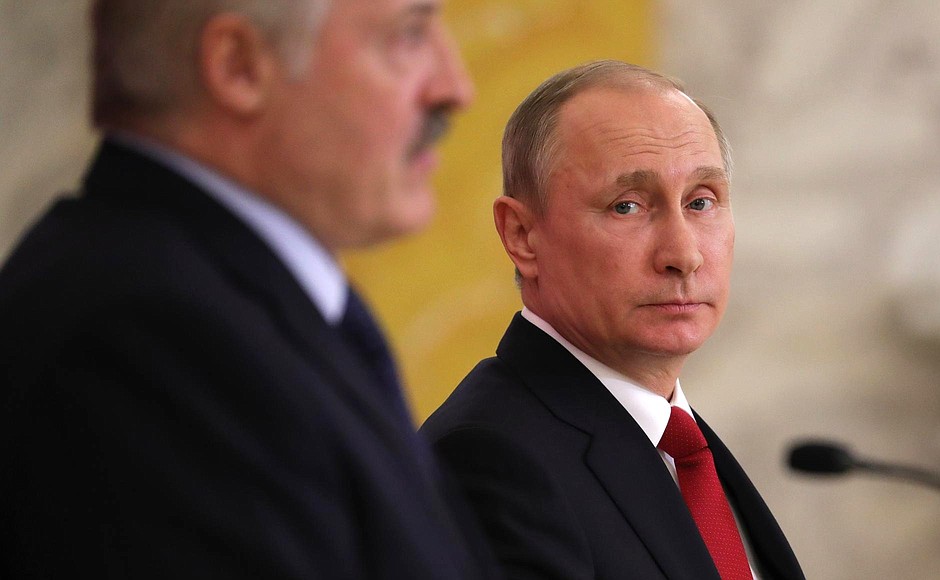
Russian President Vladimir Putin may be plotting to repeat the Crimean scenario in Belarus.
By Tatyana Ivanova
Russian President Vladimir Putin may be plotting to repeat the Crimean scenario in Belarus. At the beginning of the year, Putin started talking about a deeper integration of Russia and Belarus. This was a surprise even to Belarusian dictator Alexander Lukashenko.
It all began last summer when Russia was facing several economic challenges: a fall in oil prices on the world market, growing alternatives to Russian energy in Western Europe, and a general economic crisis. As a result, Putin proposed a phased elimination of the export duty on oil with an increase in the tax on oil production. This “tax maneuver” would have been fatal for the Lukashenko regime. On one hand the price of Russian oil would go up for Belarus. On the other, if the price of oil for a European user equals the Russian one, the Belarusian business of refining and selling oil products in the EU would collapse.
According to the estimates of the Ministry of Finance of Belarus, the loss of state revenues from the “tax maneuver” in 2019 alone would amount to $231.6 million. In subsequent years, this sum would increase.
That is why, in December, Lukashenko made several visits to the Kremlin to convince Putin to provide Belarus with monetary compensation for future losses. In return, the Kremlin set its own conditions. It would create a single state of Russia and Belarus with a single currency, judicial system, and parliament.
Even Lukashenko saw this ploy not as a union of equals but an invitation for Belarus to become part of Russia. After Russia’s annexation of Crimea, it has quite a sinister ring to it.
Belarusians: Seriously Scared
The idea of a Russian takeover of Belarus is not new. But even during the last “Zapad-2017” military exercises, when Russia moved an unprecedented amount of equipment and manpower into its neighbor’s territory, Belarusians did not have such a high level of anxiety over the sovereignty of their country as they do now.
At the moment, most political commentators assess the likelihood of Russia’s annexation of Belarus as 50-50. As Nikolai Khalezin, director of the Free Theater in London and a former well-known Belarusian journalist, commented:
The fact is, Putin himself does not know whether he will need Belarus as a mechanism for holding his power in Russia. For Putin today the game with Belarus is a game in reserve. At the same time, it is conducted with the methods recently tested in Ukraine—through the mythical “anti-Russian sentiments in Belarus.”
Vladimir Matskevich, a political analyst in Belarus, considers the annexation scenario quite plausible and therefore calls on Belarusians to demonstrate to their eastern neighbor their readiness to protect their sovereignty. “I do not like panic, it is worse than the threat itself,” he says. “But I don’t like carelessness in the face of a threat.” He also believes that the absorption of Belarus is only one of Putin’s options to hold onto power.
One reason why Russia might be interested in annexing Belarus is the economic crisis in Russia itself, notes Natalia Radina, editor-in-chief of Charter 97. Putin can no longer afford subsidizing Lukashenko’s family and his government e, and economically it would be cheaper to incorporate Belarus as a region of Russia.
Lukashenko: Dependent Independence Fighter?
The addiction of Lukashenko’s regime to Russian money is an inherent feature of this last dictatorship of Europe. Its mechanisms of repression and total control, a pocket parliament, propaganda institutes, and luxury presidential palaces—all require serious investments, to which Lukashenko owes Russia going back to the time of Yeltsin and Chernomyrdin.
Russia has supported the dictatorial and loyal regime of Lukashenko for decades: first with loans and low prices for supplied gas, then with cheap oil. In recent years, the Belarusian dictator has been enriched by Russia’s ban on food imports from the EU, introduced in response to Western sanctions. Prawns, cheese, apples, and other products never before produced in Belarus in such amounts flowed into the Russian market.
The Belarusian dictatorship needs more and more money because of the inefficiency of its economic system and the high costs of the security forces. According to official statistics, the country’s external debt increased by $3.4 billion from July 2016 to October 2018, while state budget revenues are about $10 billion. At the same time, the state budget for Lukashenko’s so-called “reserve fund” exceeds expenditures on defense. This is not surprising given that the danger to the regime comes not from outside but from Belarusian citizens.
Lukashenko’s struggle for the economic survival of his regime began to take shape as “protecting independence” not only in the eyes of the West, but also for its closest neighbors like Ukraine. The Belarusian dictator perfectly plays this card by releasing more and more new statements to the media that he is ready to defend independence in any way, including militarily.
A New Old Idea
Putin’s proposal for a treaty of union between the two countries, voiced at the beginning of this year, is nothing new. The two countries talked of creating a single state when they signed an action plan in 1997. By 1999, the union state had its own charter, an executive committee, a parliamentary assembly, and a television channel. However, the plans to create a Union State with a single currency and other attributes, announced in the treaty, were not realized. The Belarusian dictator was afraid to lose his power, and Russia didn’t need tighter union either. After all, by that time Belarus was practically completely subordinated to its eastern neighbor.
In the years following 2000, Russia began to form and strengthen the economic union of the six former republics of the USSR, and then, from 2015, the Eurasian Union, with only five of them. This economic union developed more successfully than the unviable state of Belarus and Russia.
So, why did Putin need to blow off the dust from this old treaty? In one scenario, if Belarus and Russia form a real state, then Putin could remain in power by leading it. Otherwise, he’d have to change the Russian constitution, which limits him to two consecutive presidential terms. However, there are great risks here. A recent poll on Echo Moscow radio showed that in the case of fair elections, the Russians would rather choose Lukashenko: he scored 67 percent versus against Putin’s 8 percent. In addition, if the annexation becomes violent, Russian discontent might rise so sharply as to trigger a revolution before the next presidential elections in 2024.
Recent events suggest that Putin and Lukashenko will stay the course for the in-depth integration of Russia and Belarus. Thus after recent face-to-face talks of two leaders on Valentine’s Day at the Sochy ski resort, Lukashenko said that he is ready to unite with Putin even tomorrow, but they have to ask the people of Russia and Belarus.
All this does not cancel the threat to the sovereignty of Belarus. Neither the current status quo nor the possible “deep integration” with Russia guarantees Belarus either political or economic independence. To secure the money he urgently needs, Lukashenko will continue to sell to Putin pieces of the country’s sovereignty. Only true democratization of the country, with authentic internal reforms, can change this sad reality.
The West should not be fooled by Lukashenko’s gestures of friendliness, such as receiving American ambassadors or setting 30-day visa-free travel for tourists from most Western countries. It should listen instead to the civil society of Belarus, which is actively opposing Lukashenko. These groups are urging the international community not to recognize the “union state” of Russia and Belarus.
Originally published by LobeLog, 02.19.2019, based at the Institute for Policy Studies, a program of Open Society Foundations, under the terms of a Creative Commons Attribution-NonCommercial-NoDerivs 3.0 Unported license.