The evolution of the latest smear on Omar demonstrates the extent to which Omar is facing bias, preconceived notions, and, in some cases, cynical manipulation of her words.

By Mitchell Plitnick
Attacks on Rep. Ilhan Omar (D-MN) are escalating. The big splash over the weekend came when a poster appeared in a display case at the West Virginia state capitol during Republican Party Day. It was an image of the Twin Towers of the World Trade Center ablaze after the 9/11 attacks. Superimposed in front of them was a picture of Omar, with the meme “’Never Forget’ – you said…I am the proof…you have forgotten.”
After the wave of outrage rolled through social media, the West Virginia GOP issued a statement disavowing the poster, saying someone had hung it up without their knowledge and calling it hate speech. But the GOP stopped short of condemning it, only saying that the party “do not support it.” Since the poster was in a display case in the capitol, it is difficult to believe that those arranging the event were unaware of the poster until after it became a national controversy.
Either way, this attack from the right followed on the heels of the latest criticism of Omar from largely liberal and centrist quarters. Almost on cue, the West Virginia controversy—with its blatant, indisputably hateful message—gave those centrist and liberal critics the perfect cover, as they could comfortably, if cynically, condemn the Republican attack on Omar while once again spuriously accusing her of anti-Semitism.
Her initial tweet that congressional attitudes toward Israel was “all about the Benjamins” may have been ill-advised, but anyone who was being honest, and not giving in to latent Islamophobia, knew that she was criticizing the role of a powerful lobby in setting policy, not trying to say that a secret cabal of sinister “Elders of Zion” were controlling the U.S. government.
Omar apologized for the tweet while insisting that she would not back away from criticizing the influence of lobbying groups in politics generally, and AIPAC on Middle East policy particularly. Last Wednesday, she did just that and stirred controversy anew.
The Latest Controversy
The evolution of the latest smear on Omar demonstrates the extent to which Omar is facing bias, preconceived notions, and, in some cases, cynical manipulation of her words. Here is what she said:
What I’m fearful of—because [Rep.] Rashida [Tlaib of Michigan] and I are Muslim—that a lot of our Jewish colleagues, a lot of our constituents, a lot of our allies, go to thinking that everything we say about Israel to be anti-Semitic because we are Muslim…To me, it’s something that becomes designed to end the debate because you get in this space of – yes, I know what intolerance looks like and I’m sensitive when someone says, ‘The words you used Ilhan, are resemblance of intolerance.’ And I am cautious of that and I feel pained by that. But it’s almost as if, every single time we say something regardless of what it is we say…we get to be labeled something. And that ends the discussion. Because we end up defending that and nobody ever gets to have the broader debate of what is happening with Palestine. So for me, I want to talk about the political influence in this country that says it is okay to push for allegiance to a foreign country.
Omar is clearly referring to the many forces that influence U.S. policy toward Israel and Palestine, which includes Jewish and Christian communities, weapons and tech manufacturers, and geopolitical strategic hawks. It’s obvious she was not referring to Jews or any other specific sector of the multi-faceted pro-Israel influence. But the reporter at Jewish Insider who authored the story couched her extensive quotes of Omar in the context of the “Benjamins” controversy. “’It is about the Benjamins,’ shouted one audience member to laughter and acclaim,” wrote reporter Laura Kelly.” To this, Reps. Omar and Tlaib both smiled along furtively.”
The implication that a nervous smile from Omar reflected guilt—as Kelly wrote and the Jewish Insider explicitly confirmed in an editor’s note—cast Omar’s subsequent words in a negative light, implying a nod and wink to anti-Semitism in every word she said. But Kelly’s implication was too subtle for New York Magazine’s Jonathan Chait.
After an audience member shouted out, “It’s all about the Benjamins,” at which, according to Kelly’s reporting, she smiled. Later she stated, “I want to talk about the political influence in this country that says it is okay to push for allegiance to a foreign country.” This is much worse (than the “Benjamins” tweet). Accusing Jews of “allegiance to a foreign country” is a historically classic way of delegitimizing their participation in the political system. Whether or not the foreign policy agenda endorsed by American supporters of Israel is wise or humane, it is a legitimate expression of their political rights as American citizens. To believe in a strong American alliance with Israel (or Canada, or the United Kingdom, or any other country) is not the same thing as giving one’s allegiance to that country. Omar is directly invoking the hoary myth of dual loyalty, in which the Americanness of Jews is inherently suspect, and their political participation must be contingent upon proving their patriotism.
Chait moved Omar’s quote even further from its original context, but that just got the ball rolling. A film clip that made the rounds over social media featured only Omar’s last sentence, now completely stripped of all its context. Then Omar’s colleagues jumped into the fray.
House Foreign Affairs Committee chairman Eliot Engel said, “It’s unacceptable and deeply offensive to call into question the loyalty of fellow American citizens because of their political views, including support for the U.S.-Israel relationship.” New York Democrat Nita Lowey tweeted, “I am saddened that Rep. Omar continues to mischaracterize support for Israel.” Another New York Democrat, Jerrold Nadler, said that the Democratic leadership would “have to say something and do something” in response to Omar. The Sheldon Adelson-funded Republican Jewish Committee sent out a campaign email asking people to call Speaker of the House Nancy Pelosi and demand that Omar be removed from the House Foreign Affairs Committee.
House Democratic leaders are reportedly drafting a resolution to reprimand Omar on the House floor, a highly unusual step. The report in Politico about the resolution mentioned that Omar faced rebuke earlier because she had “suggested pro-Israel groups were using their financial heft to shape U.S.-Middle East policy.” This illustrates the absurdity of the current flap, since there are many registered PACs promoting a pro-Israel policy, which, by definition, do just that. But Omar faced intense criticism for pointing out an obvious truth.
Omar’s Response
This time, Omar doesn’t seem ready to apologize, perhaps recognizing that the only way to avoid these controversies would be to stop talking about U.S. policy toward Israel. She responded to Lowey on Twitter, saying, “I should not be expected to have allegiance/pledge support to a foreign country in order to serve my country in Congress or serve on committee.” Omar thus made it clear that her “allegiance” comment was not about Jews having “dual loyalties” but about the need for U.S. politicians to constantly affirm their support of Israel.
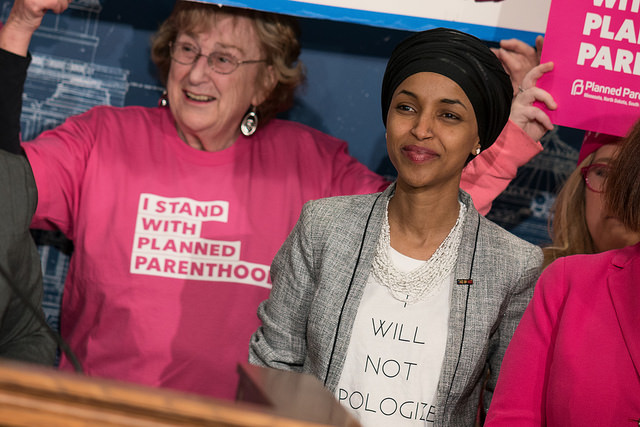
Omar is talking about a phenomenon that everyone across the full spectrum of pro-peace groups encounters every day. Many have noted over the decades that it is easier to debate the merits of Israeli policy and actions in Israel than in the United States. Ilhan Omar is becoming a victim of that dynamic. A non-native English speaker, she is having her every word parsed and analyzed. Sometimes it’s a disingenuous analysis carried out by people who wish to discredit Omar as an anti-Semite. Other times, it’s an analysis tainted by latent Islamophobia against the first hijab-wearing member of Congress. To see the double standard, take a look at the relatively subdued reaction to the far more blatant anti-Semitism from Republican Rep. Jim Jordan over Twitter last weekend.
Long-time DC insider Lara Friedman put it this way:
The ultra-sensitivity here is because of who Ilhan Omar is and what she represents—a Muslim woman who is critical of Israel. It is just bizarre to even have to say this, especially after 8 years of watching self-appointed defenders of Israeli try to tarnish Barack Obama as anti-Semitic… And it is just bizarre to have to say this, when we see over and over to the backdrop of the long-standing and stunning tolerance for anti-Semitism when it comes from sources viewed by the machers (Yiddish for “doer,” colloquially referring to movers and shakers) as friends of Israel… And it is downright bizarre to have to make this point when Congress and state legislatures are giving greater weight to the views of those who want to shield Israel from criticism/pressure than they are giving to the freaking ACLU.
Friedman’s last point refers to legislation in numerous states that requires people to sign an oath promising not to support the boycott, divestment, and sanctions (BDS) movement or engage in similar economic activism to oppose Israel’s policies, and to the recent law passed by the Senate (it has not yet come up in the House) that the ACLU has said violates the First Amendment by agreeing that individual states have the right to enact such anti-free speech laws. Omar was referring to the same thing.
On Monday, Rep. Juan Vargas (D-CA) added his voice to the critics of Ilhan Omar. But he inadvertently ended up proving her point. “It is disturbing that Rep. Omar continues to perpetuate hurtful anti-Semitic stereotypes that misrepresent our Jewish community,” he tweeted. “Additionally, questioning support for the U.S.-Israel relationship is unacceptable.”
There you have it. In the United States, it’s possible to debate any and every policy, domestic and foreign, except for unquestioning support for Israel. That, apparently, is Ilhan Omar’s chief sin.
Originally published by LobeLog, 03.05.2019, based at the Institute for Policy Studies, a program of Open Society Foundations, under the terms of a Creative Commons Attribution-NonCommercial-NoDerivs 3.0 Unported license.