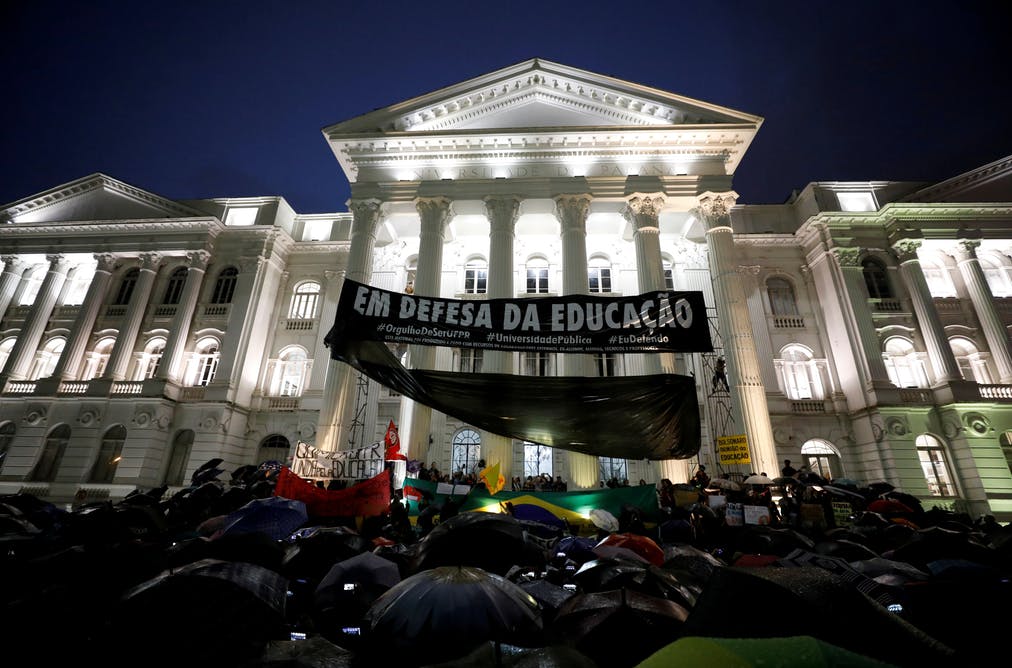

The proposed education spending cuts and curricular changes have students and teachers marching in the streets.

By Dr. Renato Francisco dos Santos Paula
Professor of Social Services
Universidade Federal de Goias
Tens of thousands of students and professors protested nationwide on May 30 against a Jair Bolsonaro administration proposal to slash Brazil’s public education budget and starve university humanities departments of resources.
It was the second mass demonstration in two weeks against the education policies of Brazil’s divisive new president.
Protesters in cities and towns across Brazil took to the streets to condemn an education ministry proposal to reduce funding for Brazilian public universities by 30% during the remainder of 2019. The ministry is also considering withdrawing financing entirely from the philosophy and sociology departments of public universities.
The objective would be to “focus on areas that generate immediate return to the taxpayer such as veterinary, engineering and medicine,” Bolsonaro wrote on Twitter on April 26.
Education in disarray
Bolsonaro, a provocative conservative who took office on Jan. 1, was elected in November with promises to radically restructure Brazil, including its schools.
Brazil’s chronically underfunded public education system has struggled to pay for maintenance and utilities since the country entered recession in 2015. In 2016, the conservative government of [President Michel Temer passed an austerity measure] that capped all federal public spending at 2016 levels for a period of 20 years.
Federal public universities in Brazil depend entirely on the central government for their budgets, though they may seek research grants and other funding on a project basis. State governments maintain their own universities in Brazil.
In order to “banish the ideologies of the left” from classrooms, the president opposes the study of any subjects related to sexual diversity, gender equality or racism.
Bolsonaro believes that women should be paid less than men because pregnancy is a financial liability for companies, and that enslaved Africans came to Brazil by choice. He wants Brazilian students to be taught those lessons, too.
Bolsonaro also plans to shift the federal government’s limited education resources to focus on elementary and secondary education, taking money away from higher education and scientific research.
But the president’s efforts to implement his education agenda have so far faltered. Initially, the problem was disarray in the education ministry.
Bolsonaro’s first education minister, the Colombia-born philosopher Ricardo Vélez Rodrígues, enjoyed the backing of powerful evangelicals in Brazil’s Congress. But his lack of management experience and ignorance of Brazilian administrative machinery created tension within the education ministry.
In February, Vélez directed all schools to recite Bolsonaro’s campaign slogan, “Brazil above all, God above all” after singing the national anthem. The order violated Brazil’s constitutional separation of church and state.
Velez also made public comments that embarrassed the Bolsonaro administration.
In a Feb. 19 interview with the magazine Veja, Vélez said that Brazilian schools should teach more civics courses because “Brazilians behave like cannibals when traveling, stealing things from hotels, stealing life preservers from under their airplane seat, stealing everything they can.”
Vélez was fired on April 8, four months into Bolsonaro’s term.
Controversial proposals
Vélez’s successor, Abraham Weintraub, is a university economist and former finance executive. He also believes that there is a “communist conspiracy to take power in Latin America.”
To expose teachers who push “leftist indoctrination” in the classroom, Weintraub has encouraged students to film these lessons and send the videos to the government.
Bolsonaro supports this idea. On April 28, he posted on Twitter a cellphone video in which a student confronts a teacher who expresses her concern over the number of military officials in Bolsonaro’s government.
“Teachers must teach and not indoctrinate,” Bolsonaro wrote on Twitter.
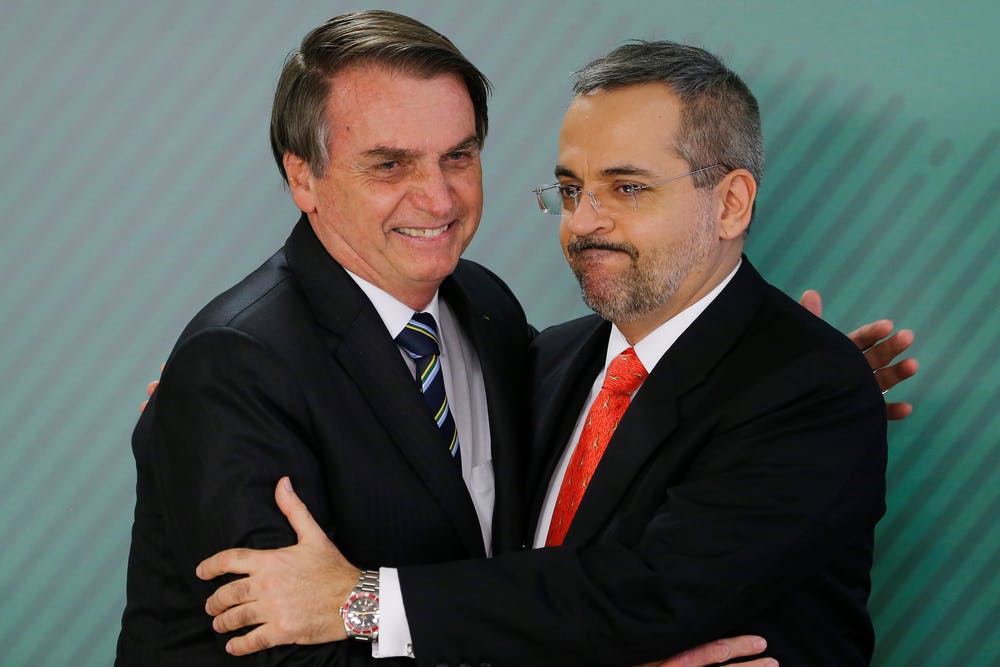
Weintraub is also trying to crack down on intellectual freedom at Brazilian universities.
In April, he suggested that the education ministry would cease to fund three schools – the University of Brasília, Rio’s Fluminense Federal University and the Federal University of Juiz de Fora, in Minas Gerais state – for “promoting disorder on their campuses.”
Their offenses included hosting former education minister Fernando Haddad – Bolsonaro’s opponent in the 2018 presidential election – as a campus speaker and holding seminars on the future of higher education under Bolsonaro.
After accusations that the budget cuts constituted political persecution, Weintraub seemed to backtrack. On May 15, he announced that the proposed 30% budget cut would apply to all Brazilian public universities.
That’s when mass protests first broke out.
Education is like a box of chocolates
Brazil’s controversial education budget cuts are not a done deal. They must be approved by Congress and implemented by the ministry of economy.
Meanwhile, the details of the proposal continue to change radically.
Weintraub was summoned to Congress on May 9 to present his education policy to dubious lawmakers. There, in contrast to prior public statements, he explained that he wanted to reduce the entire ministry of education budget by 30% – not just public university funding.
As such, universities themselves should only see their funding reduced by 3% to 4%.
Using chocolates to demonstrate his plan, Weintraub put 100 chocolates on the table and set aside three.
“We’re just asking for three chocolates from these 100 chocolates, three-and-a-half chocolates,” he said.
University administrators say that even a few lost chocolates would leave them unable to pay for water and electricity. Some are now considering seeking private funding to close the budget gap.
Originally published by The Conversation, 06.06.2019, under the terms of a Creative Commons Attribution/No derivatives license.