Trump appears to be oblivious to the threat of white nationalism.
By Hope Yen, Seth Borenstein, and Calvin Woodward
President Donald Trump appears to be oblivious to the threat of white nationalism.
Following a deadly mosque shooting in New Zealand, he said white supremacy isn’t a rising danger.
But data — including from his own Justice Department — point to rising hate group activity while he’s been in office.
Trump also asserts the U.S. is No. 1 in the world on the environment and suggests that Toyota’s announcement of U.S. job creation is due to his revised trade agreement with leaders from Mexico and Canada. Both claims are problematic. According to several studies, the U.S. lags several countries on air quality. And Trump’s proposed United States-Mexico-Canada Agreement has yet to take effect and faces uncertain prospects in Congress.
The misstatements came in a week of distorted truth on several fronts. On one, Beto O’Rourke opened his Democratic presidential campaign with a call to action on global warming that misrepresented the science.
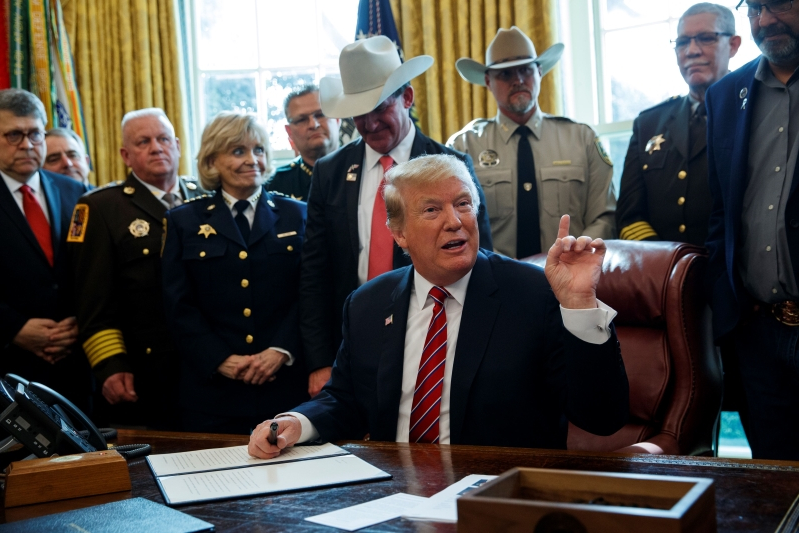
TRUMP, when asked if he views white nationalism as a rising threat worldwide: “I don’t really. I think it’s a small group of people that have very, very serious problems. I guess if you look at what happened in New Zealand, perhaps that’s the case. I don’t know enough about it yet. They’re just learning about the person and the people involved. But it’s certainly a terrible thing.” — remarks Friday in Oval Office.
THE FACTS: Both data and many experts who track violent extremists point to white nationalism as a rising threat in the U.S. and abroad.
According to data released this month by the New York-based Anti-Defamation League, for instance, white supremacist propaganda efforts nearly tripled last year from 2017. Reports of the propaganda — which can include fliers, stickers, banners and posters that promote hateful ideology — rose 182 percent to 1,187 cases. That’s up from the 421 reported in 2017.
The number of racist rallies and demonstrations also rose last year, according to the group. At least 91 white supremacist rallies or other public events attended by white supremacists were held in 2018, up from 76 the previous year.
The Anti-Defamation League in January said domestic extremists killed at least 50 people in the U.S. in 2018, up from 37 in 2017, and noted that “white supremacists were responsible for the great majority of the killings, which is typically the case.”
Separately, the Southern Poverty Law Center reported the U.S. had more hate groups last year than at any point in at least the past two decades. The organization, which tracks white supremacists and other far-right extremists, said the 1,020 groups it counted in 2018 amounted to the highest number since the center broadened its survey of such groups in the 1990s.
The center said it was the fourth straight year of hate group growth, representing a 30 percent increase roughly coinciding with Trump’s campaign and presidency. That came following three straight years of decline near the end of the Obama administration.
And the Justice Department reported in November that hate crimes across the U.S. spiked 17 percent in 2017 — marking a rise for the third straight year. There were 7,175 reported hate crimes that year, up from 6,121 in 2016, according to the FBI report. More than half of the crimes were motivated by bias against a person’s race or ethnicity. Anti-Semitic hate crimes increased 37 percent.
Among the episodes in the last few years: a white nationalist rally in Charlottesville, Virginia, in 2017 after which Trump blamed “both sides” for violence, and last October’s shooting at the Tree of Life Synagogue in Pittsburgh in which the gunman accused of killing 11 people allegedly drew inspiration from white nationalism. Authorities last month arrested a Coast Guard lieutenant, an alleged white supremacist who appeared interested in attacking top Democrats and network TV journalists.
Originally published by the Associate Press, 03.17.2019, republished for educational, non-commercial purposes.