

By Ryan Goodman
Co-Editor-in-Chief
Just Security
By Danielle Schulkin
Junior Fellow
Just Security
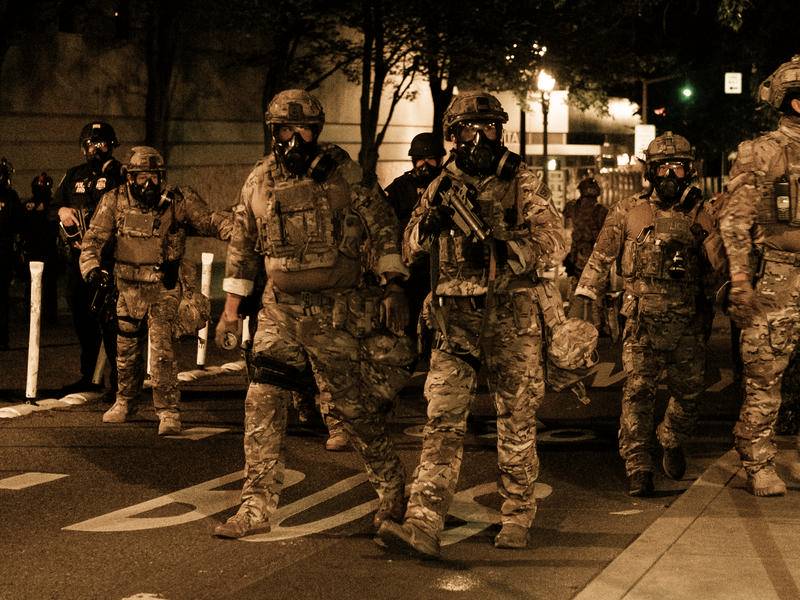
Recent images of US forces deployed against civilians in Portland, Oregon raise questions about how unprecedented these actions are and what other force the administration is willing to use against US citizens on US soil. An extraordinary feature of the Portland situation is the explicit and vocal opposition of the Governor of Oregon as well as other state and local officials to the Trump administration’s actions.
Yet, on Friday, July 17, Acting Deputy Secretary of Homeland Security Ken Cuccinelli confirmed that “this is a posture we intend to continue not just in Portland but in any of the facilities that we’re responsible for around the country.” He reconfirmed that stance on Monday, with President Trump later naming several cities on the potential list.
As we’ve recently discussed, Attorney General Barr has been developing a playbook for using federal forces without state consent for decades. But his authority for doing so not only relies on questionable legal doctrine (which we discussed before) but also relies on a distortion of the historical record. This distorted history centers on a key event in 1989: the deployment of federal troops to the Virgin Islands after Hurricane Hugo. In an interview on CBS’s Face the Nation last month, Barr rewrote what happened in 1989–falsely portraying the episode as though it provided a precedent for such aggressive military action. But the true record of the 1989 case stands, in much larger measure, for the opposite conclusion. And Barr should know better. He was there at the time.
In the 1989 case, President George H.W. Bush invoked the Insurrection Act to quell domestic unrest in the Virgin Islands. In interviews with the Miller Center years ago, Barr explained that he played a lead role inside the Bush administration on the legal basis for the president’s deployment of the military. That’s all the more reason for him to be aware that the administration at the time strenuously made the case that the governor of the Virgin Islands requested the deployment of the US military. It served the Bush administration well to stake out that position. Barr now tries to say the opposite happened. It would serve the Trump administration well for him to do so.
Based on interviews we conducted with U.S. officials who served with Barr at the time and the historical materials from those days’ events, Barr is plainly misleading the country now in his portrayal of the episode. And he appears to be doing so to legitimize President Trump’s threatening or exercising such powers without governors’ consent.
Unprecedented Action: The Historical Practice in Barr’s Way
To unleash the U.S. military to address a civil disturbance without a governor’s consent, the president would need to invoke the Insurrection Act. The law allows such a presidential action, but to do so would break from past practice.
It has been nearly thirty years since any president has seen the need to invoke the Act. The last time was in 1992, but that was with the consent of the Governor of California during the LA riots which erupted after four policemen were acquitted for the beating of Rodney King. The only instances in which the Insurrection Act was invoked to override the consent of a governor was decades earlier and for one limited basis: to combat a governor’s use of their state authorities, including national guard and police forces, to deprive Black Americans of their civil rights.
An article in the Michigan Law Review captures the received understanding of the historical record (emphasis added):
While invocation of the Act is rare, more rare is invocation without a request from the state government. The last time the Act was invoked was in 1992, when at the request of California Governor Pete Wilson, President George H.W. Bush dispatched 4000 soldiers and Marines to Los Angeles to quell the Rodney King riots. President Bush also used the Act in September 1989, when the governor of the Virgin Islands requested military help to put down looting that broke out following Hurricane Hugo (in a situation that closely paralleled post-Katrina New Orleans). But since the Civil War, the Insurrection Act has only been invoked without the request of a state’s government for one purpose–to effectuate school desegregation in the South in the 1950s and 1960s.
In short, the two most recent examples–in 1989 (Virgin Islands) and 1992 (Los Angeles)–were at the perceived request of the respective governors; and the only modern precedents in which governors’ consent were overridden was under a section of the Insurrection Act purposefully established to implement the Fourteenth Amendment guarantee to equal protection.
Barr’s Distortion of the Record
Barr has tried to create a different narrative about the 1989 events, asserting as fact that the relatively recent case of deploying military forces to the Virgin Islands to handle looting and other unrest following Hurricane Hugo was against the consent of the governor at the time.
Barr’s comments came during an interview with CBS’s Margaret Brennan. He stated:
“When I was AG last time, we did it twice. We did it in the Virgin Islands. The governor opposed us at that point, but there was a complete breakdown of law and order. Lives were in danger, and we sent in 82nd Airborne military police, along with U.S. marshals and FBI agents, and then subsequently we did it in California.”
In short, Barr purports to provide a clear example of a set of events that showcase: (1) a relatively recent example of use of the Insurrection Act; (2) overriding the consent of a governor; (3) for civil unrest that did not involve federal implementation of the Fourteenth Amendment guarantee to equal protection. Barr also claims special knowledge of the events and administration’s justification having served in the Justice Department’s leadership at the time.
If Americans were to believe Barr’s account, the historical episode would add legitimacy to President Trump’s use of federal military and security forces to address civil disturbances without governors’ consent.
But Barr should not be believed. His account of the Virgin Islands episode is deceptive.
The 1989 Case of the Virgin Islands: What Really Happened
From September 17-18, 1989, Hurricane Hugo ripped through the Virgin Islands, devastating city infrastructure and causing widespread damage. The morning after, Maj. Gen. Robert Moorehead, commander of the Virgin Islands National Guard, stated that the damage was so bad that “it appeared to me that we had been the victims of a nuclear blast.” More than 90% of the buildings in the Virgin Islands were reportedly damaged or destroyed with estimated costs surpassing $935 million.
“There was no communication whatsoever,” says Grant Peterson, who was Associate Director of FEMA’s State and Local Programs and Support Directorate during Hugo Hurricane at the time. “Those islands were beat to a pulp.”
Two days later, the White House sent a team from FEMA to assess the damage and to help reestablish communications to the islands. At the time, the Governor of the Virgin Islands, Alexander Farrelly, could not communicate with the White House and other federal officials due to the severely damaged communication systems on the islands. The White House Press Secretary Fitzwater stated at the time, “We anticipate receiving formal requests for assistance from Gov. Alexander Farrelly … and will review those requests immediately in an effort to expedite the appropriate Federal response.”
Using a makeshift Ham radio device from the back of a truck, FEMA eventually set up a special high-frequency radio communication channel to communicate with the State Adjutant General of the Virgin Islands National Guard. At the time, they still could not communicate with the governor but they were able to obtain Lt. Gov. Derek Hodge’s verbal request for aid, which he did as required under Title IV and Section 401 of The Stafford Act.
At the same time, the hurricane and its aftermath reportedly triggered pervasive looting and civil unrest on the islands. But the destruction of communication systems left the scale of the disorder unclear to officials in the White House.
FEMA finally established communications with the governor, according to FEMA personnel at the time. Peterson recalls the governor saying over the phone, “We are really in trouble here. We are trying to get supplies. I can no longer guarantee the health and safety of my citizens on my islands.” Peterson also remembers Farrelly requesting the D.C. National Guard.
Shortly thereafter, on September 20, 1989, President George H.W. Bush issued two proclamations, triggering the Insurrection Act. “I have been informed that conditions of domestic violence and disorder exist in and about the Virgin Islands endangering life and property and obstructing execution of the laws,” the President proclaimed. “Units and members of the Armed Forces of the United States will be used to suppress violence described in the proclamation and to restore law and order in and about the Virgin Islands.”
While President Bush did not mention the governor’s request for assistance, the White House press secretary, Marlin Fitzwater announced that the decision to deploy the military was based on “a thorough assessment of the situation by appropriate federal authorities and followed a request this afternoon from Governor Farrelly of the U.S. Virgin Islands requesting Federal assistance.”
In a 2001 interview, Barr appeared to provide a backstory to the governor’s issuing a request. A Justice Department official, according to Barr’s telling, told the governor, “‘You have to ask for federal assistance,’” else the federal government would come in anyway. “It all worked out very well,” Barr said.
The following morning at 7:15 AM, federal troops arrived on the Virgin Islands. With elements from the Army, Navy, Coast Guard, U.S Marshals and the FBI, Joint Task Force 140 (JTF-140), code-named Operation Hawkeye, was designed to assist local authorities to restore order to the islands. Troops were told to operate under the GARDEN PLOT Rules of Engagement, says Kevin Govern, a law professor who was deployed as one of two Army Judge Advocates in JTF-140 at the time.
Lt. Col. Longsworth, spokesman for an Airborne Corps deployed to the Islands, stated: “Martial law has not been declared. We are just here to assist local authorities. We are authorized to make arrests only in the total absence of local authorities.” A U.S. marshal stated that the military was instructed they were not allowed “to arrest anyone unless a member of the local force is present.”
The White House spokesman further clarified, “We stay in close contact with the police authorities on the islands and the governor and will be guided by their feelings about when they’re in control and when they can handle the situation.”
But later that same day, as troops were arriving, Gov. Farrelly denied asking for troops to restore order. He claimed that the White House offered military help and that he had confirmed that “if we asked for help we would get it.” But he claimed that he had not yet requested federal troops.
Later the same day, the White House appeared confused by the governor’s response. The White House spokesman stated, “That’s contrary to the information I have” and said that the White House stood by its earlier statement that Gov. Farrelly had requested federal troops.
A senior White House administration official acknowledged that Gov. Farrelly had not spoken to Bush but rather to the Federal Emergency Management Agency, stating: “I cannot explain why the governor would deny he did not request troops, because I can assure you that he did. Whether he did or not, the president has the power on his own to maintain civil order.”
Holland Redfield, a Virgin Islands territorial senator and legislative liaison to the White House, also said that Gov. Farrelly asked the White House for federal military support.
In any event, Farrelly was back on the same page as the White House within a day. In an interview with the Associated Press published on September 22, 1989, the governor said that “he welcomed federal help but contended reports of lawlessness were ‘distorted, and in some cases, exaggerated and, in a few cases, clearly malicious.’” The Associated Press reported:
Farrelly said accounts indicating that he had denied requesting federal help were accurate. But the governor said he subsequently did make the request of the Bush administration “to ensure that the situation did not escalate and accelerate beyond something we could control.”
The Justice Department reported that they obtained authority from the governor “to order FBI agents and deputy U.S. marshals to enforce all laws on the islands and to prosecute any looters.”
The sequence of events shows the Bush administration’s firm and consistent official position at the time was that they had authority from the governor to deploy federal troops. At best one might argue the episode was a somewhat ambiguous case of consent by the governor; but even this narrative stands in contrast with the Bush administration’s official position on the matter, which Barr has tried subsequently to spin.
Barr’s claim to special knowledge of the situation — due to his position in the Bush Justice Department — is even more reason for Barr to know his statements today are wrong. Curiously Barr even exaggerated his role in the Virgin Islands affair. In his recent CBS Interview, Barr said he was the Attorney General at the time. He was not. It was Dick Thornburgh. That’s a relatively minor error in Barr’s representation of the events of 1989. The major error is his attempt to smooth the path for extreme presidential powers that remain, for good reason, unprecedented.
Originally published by the Just Security, 07.21.2020, New York University School of Law, under the terms of a Creative Commons Attribution-No Derivs-NonCommercial license.