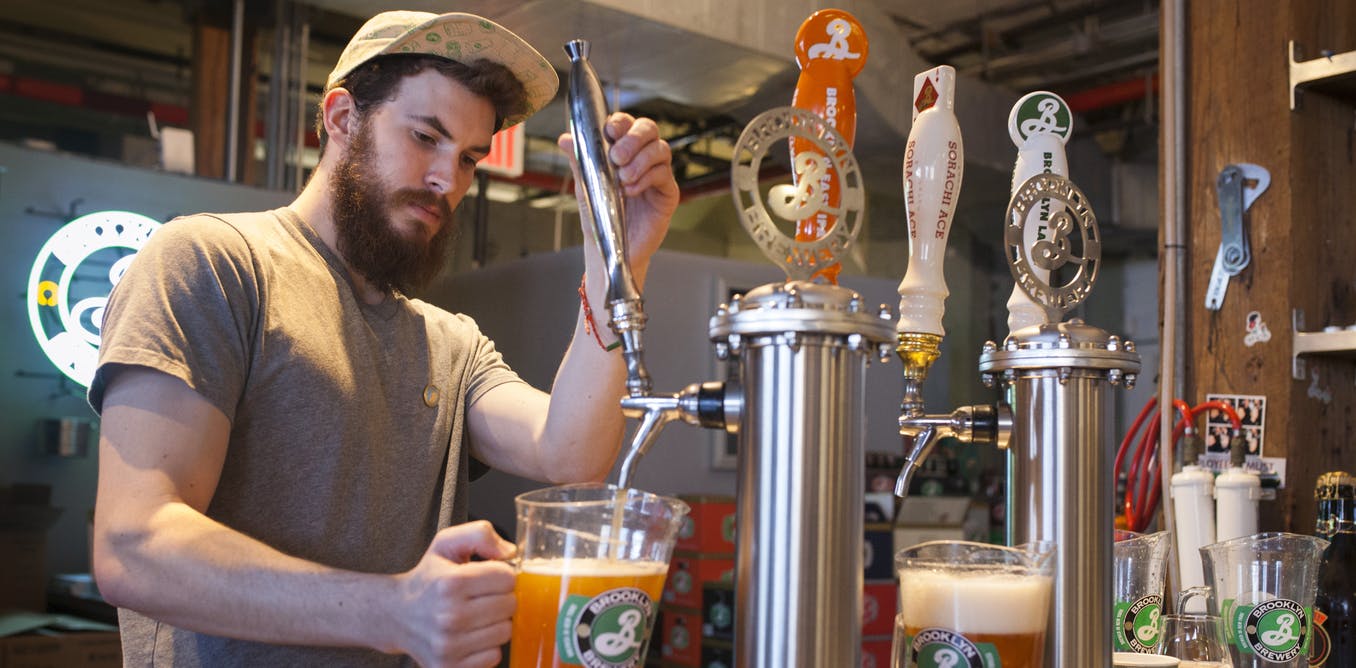
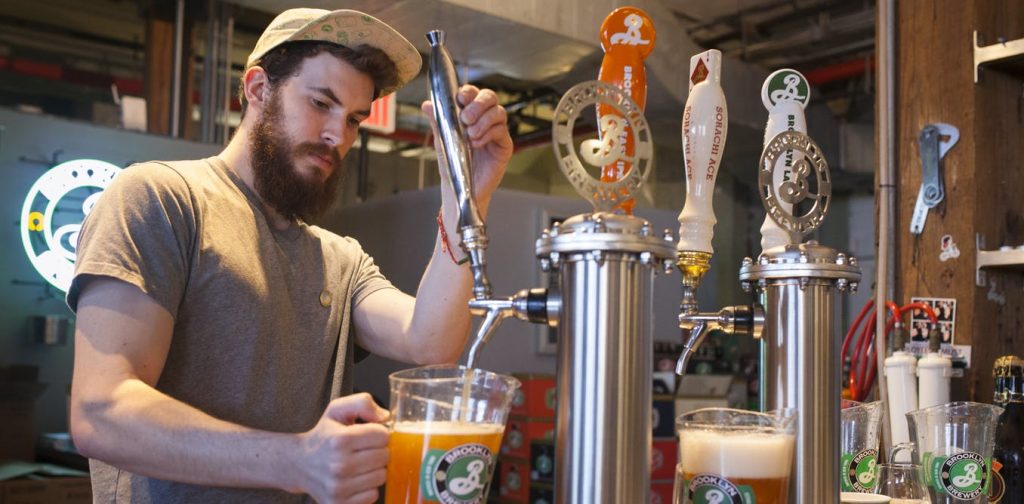
The likes of AB InBev and MillerCoors have been trying to jump on the craft beer bandwagon by snapping up artisanal breweries. Do consumers care?

By Jarrett Hart
PhD Student in Agriculture and Resource Economics
University of California, Davis
Craft beer’s popularity has exploded in the U.S. in recent decades, leading to soaring production and the creation of thousands of new breweries.
Much of that growth has come at the expense of traditional brewing giants like Anheuser-Busch InBev and MillerCoors.
So, naturally, these macro brewers have been trying to get a piece of the action by buying up their craft counterparts. Examples include AB InBev’s 2011 purchase of Goose Island Brewery and Tokyo-based Sapporo’s 2017 acquisition of Anchor Brewing – America’s oldest craft brewery.
But since a major appeal of craft beer – and a drinker’s willingness to pay a premium for a pint – is its localness and non-bigness, does being what I dub “crafty” beer owned by Big Beer spoil the brew?
That’s a question I ask in the Ph.D. dissertation I am writing for a degree in agricultural and resource economics. I wanted to know whether drinkers are willing to pay more for beer knowing that it isn’t actually independently and locally produced.
In my most recent research, I directly tapped consumers for answers by conducted a “choice experiment” at a bar specializing in craft beer.
Setting the scene

The scene of my experiment was a bar, University of Beer, in the college town of Davis, California, where I study. Over the course of more than a month, I recruited 301 patrons of the bar for my experiment.
Participants began the experiment by selecting the beer they would most like to order from the venue’s rotating list of 60 brews on tap. Then I presented them with a list of 10 randomly selected beers from the menu.
For each, I asked participants what they’d be willing to pay for the random beer so that they wouldn’t care whether they received it or their original selection – that is, whatever price would make them happy with either choice.
I also randomly gave some participants information about the beer’s brewery location and ownership status – such as “Brewers Association certified craft beer,” “import” or “MillerCoors.” Other participants did not receive this information for some or any of the randomly presented beers.
From here I was able to determine how much consumers were willing to pay for “local” or “craft” beer, but the findings were not as cut-and-dried as hypothesized.
Defining ‘local’
First I had to figure out what constitutes “local.”
I asked participants to identify each of the random beers they viewed as local or not local. Later in the experiment, I asked them to define “local.”
Participant responses revealed an array of “local” qualifiers – proximity was included in most definitions but some also cited production size or brewery ownership.
Frequently, a participant’s definition of “local” was inconsistent with the beers they actually deemed “local.”
To circumvent these inconsistencies, I did not adopt a universal definition of the term. Instead, a beer was considered “local” if an individual identified it as such.
Sorting for snobs
I also needed to separate “beer geeks” from average consumers.
Not everyone is equally enthusiastic about craft beer. Some care deeply about their beer, such as where it comes from and who produces it. Others simply want something tasty.
I hypothesized that these different types of consumers would likely have distinct preferences for craft versus macro and local versus non-local beer. To identify and sort participants, I administered a quiz at the end of the experiment to test their knowledge of craft brewery locations and ownership.
Putting a price on local beer
My findings unequivocally show that consumers prefer local beer – however they define it.
But how much do they prefer it – that is, how much are they willing to pay extra to have a local over a non-local brew?
Unfortunately I have to give a boring economist’s answer: That depends.
On average, the “local” premium is generally worth 25 cents to 54 cents per pint. However, this premium does not apply to every local beer. Consumers have beer styles they prefer – like IPAs, pilsners and stouts – and I find that the “local” premium diminishes for beers within their preferred style.
For example, an IPA lover doesn’t make a distinction between a local and non-local IPA.
However, when she orders a sour beer, she is willing to pay 45 cents – on average – more for a local sour than a non-local sour.
And how about for craft beer?
I found that only beer geeks, and not average consumers, are willing to pay a premium for certified craft beer versus a beer of unknown ownership. The 5 percent of consumers with the most beer knowledge were willing to pay 75 cents more per pint on average, while the top 25 percent offered an extra 47 cents.
And, like the “local” premium, this premium diminishes within the consumer’s preferred beer style.
Are ‘crafty’ beers devalued?
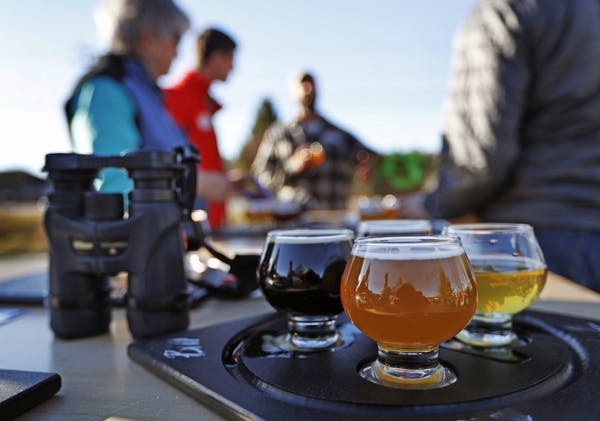
Finally, do “crafty” beers that are owned by Big Beer fetch the same premium as certified craft beer? Typically, no.
Of the Big Beer companies, I found that only Founders Brewing Company, now owned by Mahou San Miguel, was able to extract premiums from consumers similar to the ones independent craft brews obtained.
The other “crafty” beers in my study, however, couldn’t command the same premiums. In fact, I found that consumers wanted to pay $0.72 to $1.04 less per pint for a craft beers owned by other Big Beer companies relative to one owned by an independent brewery.
So unless you’re a beer geek like me, you probably don’t care if your artisanal ale is “Brewer’s Association certified craft.” But beer geek or not, when drinking your favorite type of ale or lager, you probably prefer that Big Beer doesn’t brew it.
Originally published by The Conversation, 02.12.2019, under the terms of a Creative Commons Attribution/No derivatives license.