

Colossal public monuments to Hinduism are going up across India, sending an ominous message to the country’s 260 million religious minorities.

By Dr. Indulata Prasad
Assistant Professor, Women and Gender Studies
School of Social Transformation, Tempe Campus
Arizona State University
Statues – big statues, the largest in the world – are being built all across India.
Like many public monuments, they attempt to convey history in a concrete form. But India’s new statues convey something else, too: the power and vision of one dominant group – and the vulnerability of others.
That’s because India’s biggest new public monuments all pay tribute to Hindu gods and leaders.
As a scholar of social change in India, I see statues as a projection of a nation’s values at a particular moment in time. For many Muslims and other religious minorities, then, these hulking public monuments of Hindu icons send an ominous message about their status in society.
Rising Hindu nationalism
The mammoth public shrines to Hindu nationalism are a pet project of Indian Prime Minister Narendra Modi and his right-wing Bharatiya Janata Party.
Since taking office in 2014, Modi has used his power to promote Hindu nationalism, a polarizing ideology that sees Hindus as India’s dominant group. Yet India is a constitutionally multicultural country with the world’s second largest population of Muslims – comprising over 170 million people.
Twenty percent of its 1.3 billion people are Muslim, Christian or another religion.
By 2021 India, which is already home to the tallest statue in the world – Gujarat state’s 597-foot-tall “Statue of Unity,” commemorating Indian independence hero Sardar Vallabhbhai Patel – plans to unveil two more record-breaking monuments, both portraying icons idolized by Hindu rightists.
A 725-foot bronze likeness of the god Ram planned for Uttar Pradesh state will soon surpass the Statue of Unity in size. And in Mumbai construction has been halted on a 695-foot-tall likeness of the medieval Hindu warrior Shivaji, pending the results of an environmental review.
Guinness World Records also recently judged Tamil Nadu state’s 112-foot depiction of the face of the Hindu god Shiva as the world’s largest bust statue.
All this is happening under Modi, who is up for re-election in monthlong general elections that start on April 11.
He was voted into office in 2014 on a platform of “development for all.” Promising to boost the economy in a country where nearly 22% of people live in poverty and millions go hungry, Modi and the BJP won an historic parliamentary majority over the center-left Indian National Congress, its main competitor.
Since then, India has improved in international “ease of doing business” rankings, passing regulations that improve commerce and the protection of property rights.
But some of Modi’s boldest moves to improve cash flow and boost public revenues, including a 2017 tax reform initiative and a ban on saving in certain high-value currencies, have failed. Unemployment has risen under BJP rule, particularly in rural areas, and the national economy suffered during the “demonetization” process.
Over the last five years, under Modi’s administration, India has also seen a startling rise of Hindu vigilante violence.
Indian vigilante ‘cow killings’
The attacks – often called “cow protection” – are sometimes deadly assaults that target Muslims and other Indians who, unlike many Hindus, do not consider cows to be sacred.
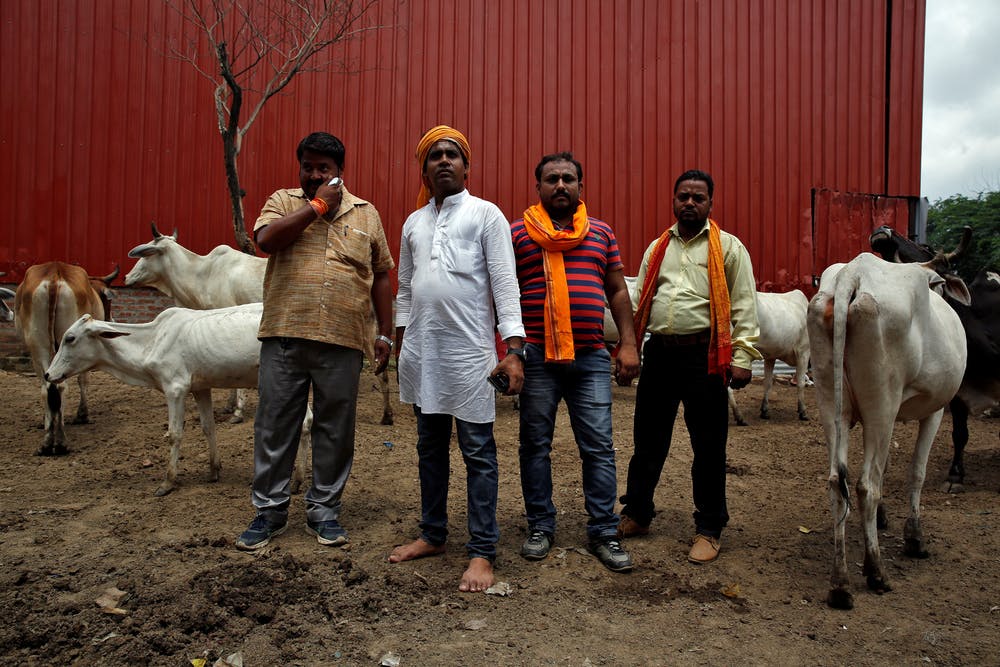
Hindu militants killed at least 44 Indians and injured 280 in about 100 attacks between May 2015 and December 2018, according to the international not-for-profit Human Rights Watch. Most of the dead were Muslims in states run by Modi’s political party.
The prime minister and his BJP have faced criticism for being slow to condemn anti-Muslim violence and for prioritizing legislation to safeguard cows, not the victims of vigilantism. Cow protection violence has also crippled India’s beef and leather industries, since they are primarily Muslim-run.
Muslim men who date Hindu women are another common target of vigilante violence, as are students, journalists, academics and artists perceived to be critical of Modi’s leadership.
The Hindu nationalists’ crusade against pluralism takes place even as the Modi administration cracks down on civil liberties. Between 2014 and 2016, 179 people were arrested on charges of sedition for protests, critical blogs or anti-government posts on Facebook, according to government crime statistics.
Fears of religious minority groups
This is the cultural context that has Muslims worried over India’s statue-building spree.
The BJP is not the first party to build public monuments celebrating only one segment of Indian society.
From 2007 to 2012, a top politician named Mayawati built numerous memorials and parks across Uttar Pradesh state commemorating leaders from India’s marginalized Dalit class, formerly known as the “untouchables.” Mayawati, a Dalit, commissioned statues of herself, her political mentor Kanshi Ram and other Dalit icons who fought against India’s caste system.
It was the first time such grand homage had been paid to the Dalit leaders who crusaded against India’s deep-rooted caste system.
But the US$800 million price invited scrutiny, and the courts have asked Mayawati to repay some of those funds.
India’s election commission also insisted that Mayawati’s statues be shrouded ahead of state elections in 2012, saying the visibility of the then-chief minister and her party symbol might sway voters.
In contrast, resistance to India’s giant new statues has been muted. And Hindu nationalists are pushing for more public commemoration of their faith.
In November 2018, tens of thousands of Hindus gathered to demand the construction of a Hindu temple in the Indian city of Ayodhya – at the same spot where, in 1992, Hindu zealots demolished an ancient Muslim-built mosque.

The proposal to build instead an enormous statue of Ram in Ayodhya is widely seen as an effort to placate Hindu nationalists in their decades-long quest for a Ram temple.
Fearing a repeat of the deadly violence that destroyed the ancient mosque, some local Muslims fled the city last November.
Indian elections
Indians will decide whether to give Modi another five years when they vote this spring in the world’s biggest election.
Recent polls show Modi and his BJP leading in a race in which several competitor parties have allied to defeat him.
The prime minister’s public approval got a 7% boost, to 52%, after India’s brief but sharp escalation of recent tension with neighboring Pakistan, a majority Muslim state.
Border disputes are a classic move for a strongman leader during election season. Paying homage to Hindu nationalist icons in the form of giant public monuments, however, is something different. Modi is transforming secular India, one statue at a time.
Originally published by The Conversation, 04.11.2019, under the terms of a Creative Commons Attribution/No derivatives license.