


Trump and other leaders use the word ‘crisis’ to claim there’s an emergency that demands urgent action. A leadership expert explains how to evaluate those claims.

By Dr. Bert Spector
Associate Professor of International Business and Strategy
D’Amore-McKim School of Business
Northeastern University
“This is a humanitarian crisis, a crisis of the heart and a crisis of the soul.”
That’s how President Donald Trump framed his demand for funds to build a “border wall” and end the partial government shutdown. That declaration was met with counter-claims that the crisis at the border was indeed real – but one of Trump’s own making.
I’m currently completing a book on the use and abuse of the word “crisis”by political and business leaders to create a sense of urgency.
While it is true that Trump and his administration are especially recklessin their deployment of the term crisis, they are far from alone in doing so.
‘Uh oh!’ – it’s a crisis
Political leaders frequently use these claims to advance a particular agenda.
For example, in 1964, President Lyndon B. Johnson used the supposed urgency of an attack on an American battleship to rally support for escalating the war in Vietnam. George W. Bush claimed a similar rationale for ousting Saddam Hussein from Iraq in 2001.
In every case, leaders reference real things in their claims: an attack on a battleship, possession of nuclear weapons, the number of immigrants entering a country, the observable effects of climate change or the arrest of a CEO. These are the cold, hard facts that can and should be subjected to objective fact-checking – even if doing so isn’t always easy.
But what transforms objective description of an event into a crisis is that the leader adds an “uh-oh” element. That’s where the urgency of crisis comes into play.
This element of a claim is not objective at all. It is a subjective reading of the world around us, a reading filtered – sometimes unconsciously and other times quite deliberately – through our own biases and previously established opinions.
It’s that subjective uh-oh element that is intended by the leader to convince followers that the social unit – the community, the business or even the nation – faces an urgent situation.
Objective and subjective

All claims of crisis contain both objective descriptions of events and subjective explanations of why they should be understood as a crisis.
Observers can and should evaluate the objective element of a claim according to their accuracy.
On the border “crisis,” for example, the president declared: “In the last two years, ICE officers made 266,000 arrests of aliens with criminal records.”
The statement is, as it stands, accurate. But it relies on the suppression of key facts. For example, figures show that most of the crimes committed by “illegal aliens” are immigration-related offenses rather than violent attacks. The number of illegal immigrants entering the United States is declining. And the immigrant community is mostly law-abiding.
Trump’s claim also had an uh-oh element when he labeled it a “humanitarian crisis, a crisis of the heart and a crisis of the soul.”
Of course, this is a subjective interpretation of the world. It can no more be thought of as accurate than inaccurate. But that doesn’t mean observers can’t evaluate the subjective element of a claim. To do so, I suggest using the criterion of plausibility.
How to evaluate a crisis claim
Plausibility is the “quality of being believed.”
It is an argument that is potentially believable, demanding a conclusion drawn on the basis of well-defined reasoning. Plausibility insists that reliable principles and methods of reasoning are utilized in a transparent and logical process. You may or may not agree with the interpretation, but the path from description to use of the term should be clear.
I would suggest that there is no logical progression from the number of illegal immigrants to the assertion of a “humanitarian crisis, a crisis of the heart and a crisis of the soul.” The reasoning relies almost entirely on biased stereotyping.
Responding to a ‘crisis’
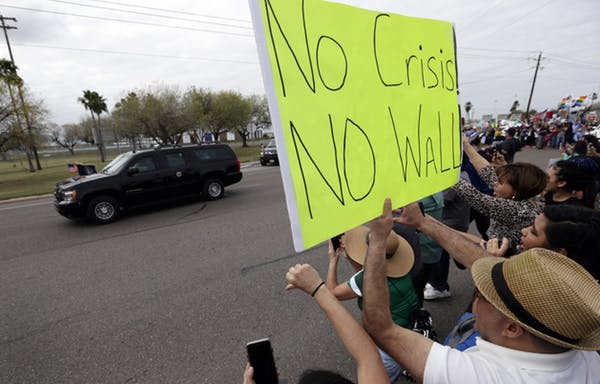
Based on my research, I propose a classification system for all claims of crisis that considers both the accuracy of the objective, descriptive element of a claim and the plausibility of the subjective uh-oh element. Claims of crisis that combine an accurate description with a plausible explanation can be said to be legitimate. Claims that are either inaccurate, implausible or both are not.
It is fruitless to engage in a debate as to whether a claim of a “humanitarian crisis,” a “crisis of the soul” or even a business crisis is true or false, right or wrong.
By appreciating that a crisis is not a real thing but rather a label applied by a leader to an ambiguous, dynamic world, Americans and others can appreciate the elements that constitute a claim and evaluate it as legitimate or otherwise. After doing that, we can all then begin to determine how to respond.
Originally published by The Conversation, 01.16.2019, under the terms of a Creative Commons Attribution/No derivatives license.