Officials at USAID warned that favoring Christian groups in Iraq could be unconstitutional and inflame religious tensions.
By Yeganeh Torbati
Reporter
ProPublica
Last November, a top Trump appointee at the U.S. Agency for International Development wrote a candid email to colleagues about pressure from the White House to reroute Middle East aid to religious minorities, particularly Christian groups.
“Sometimes this decision will be made for us by the White House (see… Iraq! And, increasingly, Syria),” said Hallam Ferguson, a senior official in USAID’s Middle East bureau, in an email seen by ProPublica. “We need to stay ahead of this curve everywhere lest our interventions be dictated to us.”
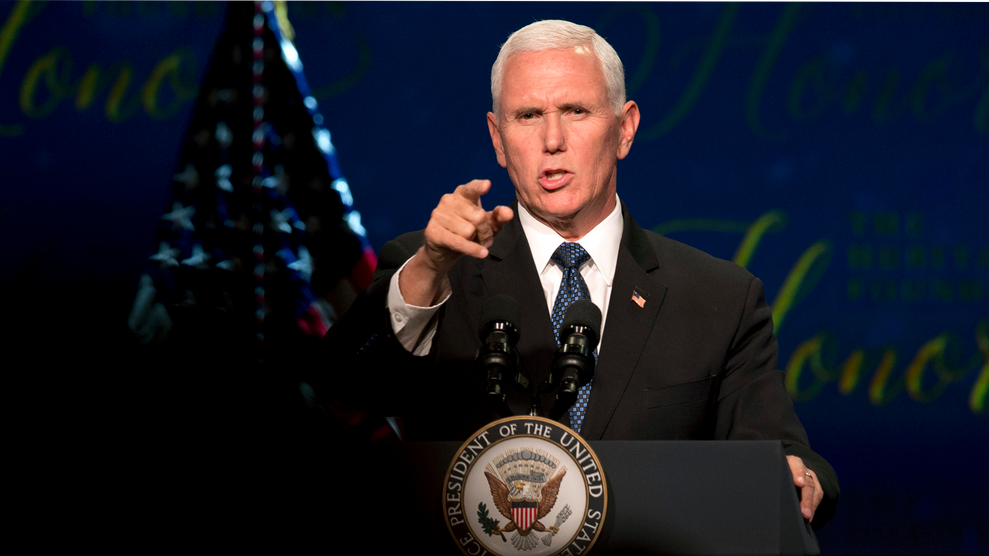
The email underscored what had become a stark reality under the Trump White House. Decisions about U.S. aid are often no longer being governed by career professionals applying a rigorous review of applicants and their capabilities. Over the last two years, political pressure, particularly from the office of Vice President Mike Pence, had seeped into aid deliberations and convinced key decision-makers that unless they fell in line, their jobs could be at stake.
Five months before Ferguson sent the email, his former boss had been ousted following a mandate from Pence’s chief of staff. Pence had grown displeased with USAID’s work in Iraq after Christian groups were turned down for aid.
ProPublica viewed internal emails and conducted interviews with nearly 40 current and former U.S. officials and aid professionals that shed new light on the success of Pence and his allies in influencing the government’s long-standing process for awarding foreign aid. Most people spoke on the condition of anonymity.
The Trump administration’s efforts to influence USAID funding sparked concern from career officials, who worried the agency risked violating constitutional prohibitions on favoring one religion over another. They also were concerned that being perceived as favoring Christians could worsen Iraq’s sectarian divides.
“There are very deliberate procurement guidelines that have developed over a number of years to guard precisely against this kind of behavior,” said Steven Feldstein, a former State Department and USAID official during the Obama administration. When politics intrude on the grant-making process, “you’re diluting the very nature of what development programs ought to accomplish.”
USAID regulations state that awards “must be free from political interference or even the appearance of such interference and must be made on the basis of merit, not on the basis of the religious affiliation of a recipient organization, or lack thereof.”
Last month, USAID announced two grants to Iraqi organizations that career officials had previously rejected. Political appointees significantly impacted the latest awards, according to interviews with officials and other people aware of the process. Typically, such appointees have little to no involvement in USAID grants, to avoid perceptions of undue political influence on procurement.
One of the groups selected for the newest awards has no full-time paid staff, no experience with government grants and a financial tie that would typically raise questions in an intense competition for limited funds. The second organization received its first USAID direct grant after extensive public comments by its leader and allies highlighting what they described as a lack of U.S. assistance to Christians. The two groups — a charity that primarily serves Christian Iraqis and a Catholic university — were not originally listed as front-runners, according to a document seen by ProPublica.
The Wall Street Journal and BuzzFeed have previously reported Pence’s interest in increasing foreign aid to Christians and his displeasure with USAID’s activities in Iraq.
Pence’s spokeswoman, Katie Waldman, did not respond to questions. A USAID spokeswoman did not respond to specific questions, including about Ferguson’s email, but said the latest grants were appropriate.
“The Trump Administration has made responding to the genocide committed by the so-called Islamic State of Iraq and Syria (ISIS) against religious and ethnic minorities a top priority,” said the spokeswoman, Pooja Jhunjhunwala. “Assistance to religious and ethnic communities targeted by ISIS is not a departure from the norm, but rather a continuation of USAID’s rich history of promoting inclusive development and defending human dignity and religious freedom in our partner countries.”
Approximately 97% of Iraq’s population is Muslim, according to the most recent U.S. figures available. Religious minorities — including Christians, Yazidis and others — make up around 2% to 3% of Iraq’s total population.
The Trump administration’s efforts to steer funding to these minorities in Iraq stand in stark contrast to its overall approach to foreign aid. It has repeatedly proposed cutting U.S. diplomatic and foreign assistance budgets by billions of dollars. In August, as the White House was considering cuts to an array of foreign aid programs, it shielded funding for religious minorities abroad, according to news accounts.
As Trump mounts a 2020 reelection effort, he is taking steps to solidify his conservative Christian base, including his decision last week to install his spiritual adviser, Florida televangelist Paula White, in a White House position. Increasing aid to Christians abroad is a core value for his supporters.
In a speech last month at the Values Voter Summit in Washington, a major gathering of the religious right, Trump touted his administration’s work on behalf of religious minorities in Iraq and Syria.
“Other presidents would not be doing that,” he said. “They’d be spending a lot more money, but they’d be spending it on things that would not make you very happy.”
Late in the Obama administration, USAID’s activities in Iraq focused on an effort by the United Nations to restore basic services as soon as cities had been liberated from Islamic State rule.
By the end of 2016, the United States had contributed over $115 million to the effort through USAID, and other countries had contributed hundreds of millions of dollars more. U.S. officials credit the U.N.’s work with enabling millions of Iraqis to return to their homes soon after the fighting was done instead of languishing in refugee camps.
“Here’s another example of when the U.N. and the United States work together, really good things can happen,” said John Allen, the former special presidential envoy to the global coalition formed to defeat ISIS, at an event at the Brookings Institution in September.
Robust U.S. support for the U.N.’s work initially carried over into the Trump administration. In July 2017, the administration announced that USAID would provide an additional $150 million to the U.N. Development Program’s Iraq stabilization fund, bringing the total U.S. contribution to more than $265 million since 2015.
But by then, U.S. officials in Iraq were sensing dissatisfaction among some Iraqi Christians and American religious groups with the U.S. strategy and the U.N.’s work. Trying to head off problems, U.S. officials urged the U.N. in the summer of 2017 to pay special attention to the Nineveh Plains, an ethnically and religiously diverse region of northern Iraq where many of the country’s Christians live.
U.N. officials were reluctant, arguing their assistance could go further in dense urban areas like Mosul, as opposed to the Nineveh Plains, a stretch of farmland dotted by small towns and villages.
“They were going for the biggest bang for the buck,” one former U.S. foreign service officer said.
Dylan Lowthian, a UNDP spokesman, said the agency worked closely with local Christian leaders in 2017 to encourage more people to return to the Nineveh Plains.
“UNDP is one of the largest supporters of minority communities in Iraq in terms of volume of projects, impact, and funding,” Lowthian said.
But the pressure from Washington built. Influential religious groups like the Knights of Columbus and current and former Republican members of Congress advocated throughout 2017 for direct U.S. aid to religious minorities, including Christians and Yazidis. They said that the groups merited special attention because they had been targeted for genocide by Islamic State and that local churches had proven track records of delivering aid quickly and reliably. Furthermore, Christians — who fled the country in droves after the 2003 U.S. invasion of Iraq — were at risk of disappearing from Iraq altogether if they didn’t receive help, they argued.
Bashar Warda, a powerful archbishop based in Erbil, Iraq, was a key figure in this effort. “The Christians of Iraq desperately need American government humanitarian aid now, and we need it to be delivered in a manner to ensure it actually reaches us and does not get absorbed and redirected in the existing aid structures,” he said in a 2017 interview with Crux, a Catholic- focused publication. “While the U.S. has donated generously to the overall humanitarian aid effort in Iraq, almost none of this aid reached the Christians.”
Warda met with Pence in late 2017 and stood beside Trump in the Oval Office in 2018 as he signed a bill authorizing the State Department and USAID to provide relief to victims of Islamic State, particularly religious minorities. Warda had advocated for the bill’s passage.
Originally published by ProPublica, 11.06.2019, under a Creative Commons Attribution-NonCommercial-NoDerivs 3.0 United States license.