
More tourists is more business and more climate change awareness, but visiting thawing destinations can be a double-edged sword.

By Marcello Rossi
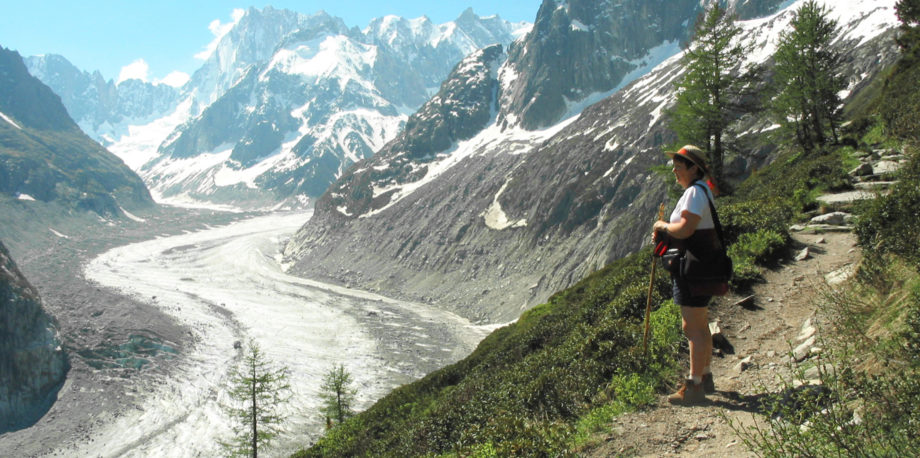
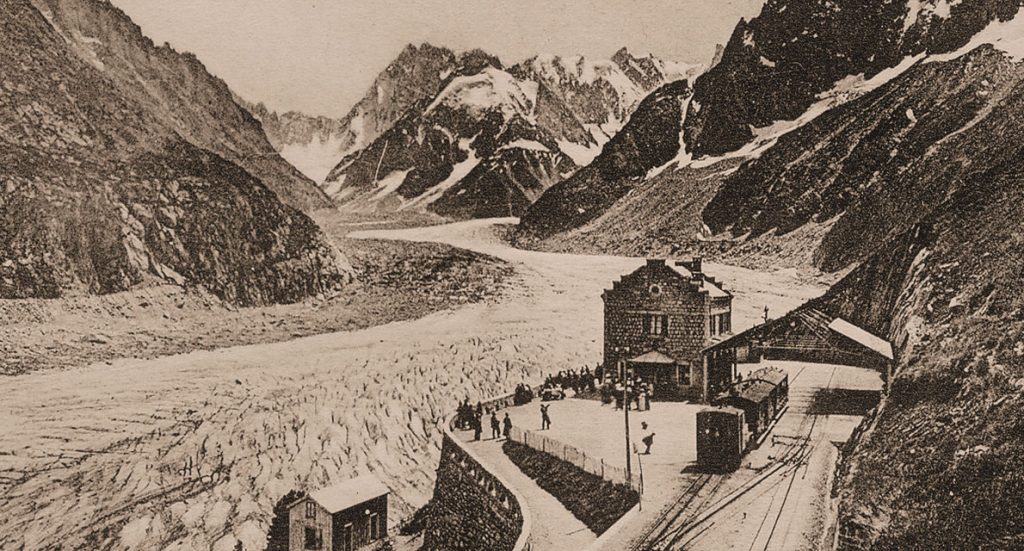
A generation ago, descending three steps was all visitors had to do to take a close-up look at the Mer de Glace, a massive, crevasse-riddled glacier winding down the Mont Blanc massif in the heart of the French Alps. Today it takes 480 steps to reach the ice. And from there, the gaping, debris-covered mouth of the glacier is still hundreds of steps farther.
The Mer de Glace is but one example of the retreat of Alpine glaciers, casualties of a warming climate that has quickened their melting in the past several decades. The glacier, the second largest in the Alps, has receded some 700 meters (2,300 feet) since 1990. Portions also have thinned by some 100 meters (300 feet) around the same time.
Scientists predict that it may not be much longer before this frozen marvel can hardly be seen. As a result, this receding natural wonder increasingly lands on the bucket lists of tourists from all over the world.
“I felt that I had to go before the glacier may kick the bucket before I do,” Abigail Redal, a visitor from Colorado, told me on a recent trip to the glacier. “I’m grateful that my 19-year-old daughter and I had the chance to see what’s left of the Mer de Glace. The next generations will likely not.”
Traveling to destinations at risk of disappearing is a relatively new phenomenon known as last chance tourism. The underlying principle is pretty straightforward: to see species, cultures and natural habitats before they are irrevocably altered or vanish. This may be good for the tourism business, for connecting people with nature and for driving home the need to do something about climate change. But concerns are growing about adverse outcomes as well.
A Growing Trend
As the Mer de Glace shrinks year by year, an increasing number of tourists are rushing to see it before it’s too late. Jacques Mourey, a geographer and a mountain guide, says one of the reasons many visitors give him for wanting to see the glacier is the impression that it’s their last opportunity to do so.
The uptick is noticeable for Jean-Marie Claret, the manager of an ice caveinside the glacier that is resculpted every year. “In the past people used to come here only to the enter the belly of the glacier and see the sculptures and lights hosted inside the cave,” Claret says. “Now more and more are coming to see these things before they will be hard to find.”
Rising temperatures are also spurring more climbers and mountaineers to visit the Alps. “Chamonix is a mountaineering mecca. But melting permafrost is causing the vanish of iconic routes, such as the Bonatti pillar,” Mourey says. “People want to climb those itineraries before they disappear or become too dangerous.”
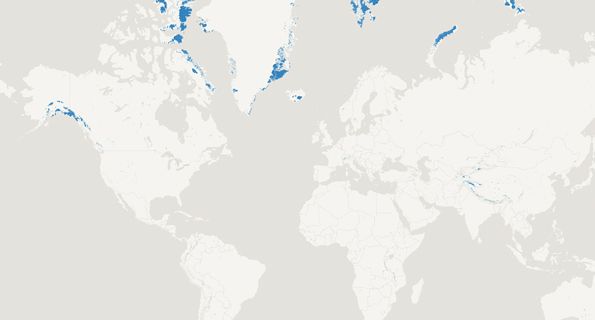
This trend is not unique to the European Alps. At Glacier National Park in Montana, where the 26 active glaciers that remain of the original 150 or so are poised to vanish in a decade, the volume of visitors grew noticeably over the past five years. Half a world away, so many tourists packed China’s Baishui Glacier No. 1, one of the world’s fastest-melting glaciers, that local authorities had to limit their access in 2018.
“There’s a growing awareness that most glaciers won’t be around in a few decades’ time, so people want to see them before they become a shadow of their former selves,” said Harvey Lemelin, a professor at the School of Outdoor Recreation Parks and Tourism at Lakehead University in Canada, who co-edited a book on tourism and vanishing destinations. “Places like the Mer de Glace definitely offer that kind of experience.”
Nurturing Awareness
While the idea of visiting parts the world that may soon be destroyed by climate change sounds grim to some, others see actual socio-economic and cultural benefits. Tourists bring money that can be earmarked for conservation efforts or job creation. Visiting glaciers gets more people connecting with nature. And it adds a dose of reality to the sometimes abstract concept of climate change.
Kateryna Shornikova, an officer at United Nations Environment’s Europe office, is among those who see benefit in having more people visiting melting glaciers.
“As they have come to symbolize the effects of global warming worldwide, they provide a unique opportunity to nurture environmental awareness on what climate change means in real life,” she says. Destinations, she adds, could raise entry costs or charge additional taxes to bankroll activities that raise awareness.
The heightened attention that online bucket lists draw to imperiled destinations can, however, be a double-edged sword, Lemelin warns.
“While a greater number of tourists can certainly bring a number of economic benefits, especially in areas where jobs and lives are heavily dependent on tourism, they can also put a further strain on the ecological integrity of already threatened environments,” he says.
Another issue is risk. “Warmer temperatures are making glaciers more accessible — and also more unstable,” explains Lemelin. More than 550 rockfalls occurred in the Mont Blanc massif between 2007 and 2015. On one occasion, an avalanche blocked the railway connecting the ski town of Chamonix with the Mer de Glace. Although no lives were lost, this highlighted a major problem concerning visitor safety, says Mourey, who cited accidents in Alaska and New Zealand, where people were killed by collapsing ice shelves.
Then there’s the environmental paradox: traveling long distances to see melting glaciers before they disappear makes for more greenhouse gas emissions, which hasten the decline of the site visitors are there to see.
“Most people tend to underestimate how they themselves contribute to climate-changing emissions, as one person’s air travel or full tank is nothing compared to oil and gas emissions,” says Eke Eijgelaar, a sustainable tourism researcher and lecturer at Breda University in the Netherlands. “But you have to tally the overall impact, which is way too big.”
According to Climate Central, every round-trip transatlantic flight causes the loss of 30 square feet (3 square meters) of Arctic sea ice.
Making the Most
Some think offering visitors carbon offsets can help to alleviate the downsides. But it’s a challenging path. A survey of Antarctic cruise ship passengers revealed that fewer than 7% were willing to engage in activities to offset their emissions. Another studypublished this year in Annals of Tourism Research found that most last-chance tourists visiting Canada’s Jasper National Park and Churchill, Manitoba, were not willing to offset carbon produced from their trip.
“It’s unpleasant to accept that while you’re traveling to a destination before it disappears, you’re in fact destroying it,” says lead author Mark Groulx, an environmental planner and assistant professor at the University of Northern British Columbia. “Most people fail to realize this. Or simply pretend otherwise.”
Others have turned to climate education to make the most of the situation. Guides at Alaska’s Mendenhall Glacier intentionally mention climate change, teaching the audience about the link between carbon emissions and shrinking glaciers.
Another example is the Glaciorium, a multimedia museum established in 2012 near the Mer de Glace, which offers visitors an in-depth interactive and educational perspective on the planet’s warming climate, as well as presentations about glacier history. (Ironically, though, local authorities are consideringmoving it to a safer spot also because of climate change, which is weakening the reliability of the railways to access the site and threatening the stability of the current aging infrastructure.)
Whether glacier tourism offers a net benefit or not, it’s pretty clear that as long as the glaciers are around, the tourists will be, too.
“Glaciers are unlike other endangered species,” says Eijgelaar. “You can’t replace them. You can’t really protect them. When they’re gone, they’re gone forever.”
Originally published by Ensia, 04.26.2019, under the terms of a Creative Commons Attribution-NoDerivs 3.0 Unported license.