

By Paul Rosenberg
Senior Editor
Random Lengths News
For 40 years now, the religious right has been a fixture in American politics and for all that time it has befuddled observers who continually misunderstand it, beginning with its support for Ronald Reagan, a divorced Hollywood actor, against Jimmy Carter. Reagan was the first US president to describe himself as a “born-again Christian”.
But Reagan – whose wife consulted an astrologer for guidance as first lady – was a virtual saint compared to Donald Trump, the most recent presidential beneficiary of their enthusiastic support, and someone that 81 percent of self-described white evangelical protestants rewarded with their votes.
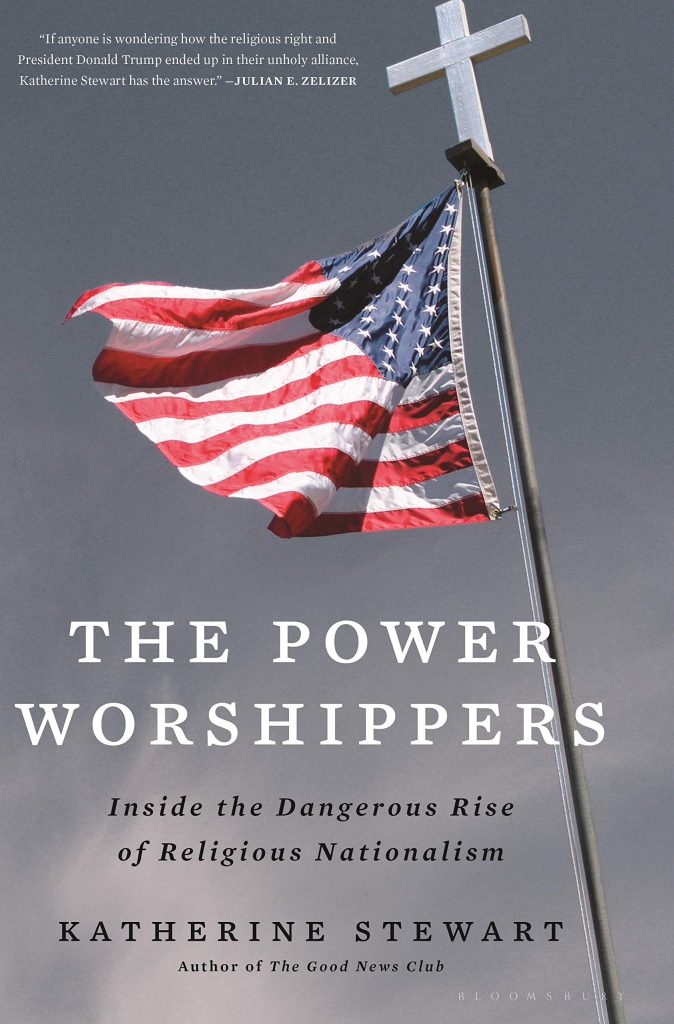
The secret to making sense of them is simply stated in the title of Katherine Stewart’s new book: The Power Worshippers: Inside the Dangerous Rise of Religious Nationalism. It draws on more than a decade of first-hand experience and front-line reporting that began when her daughter’s public elementary school was targeted to house a fundamentalist Bible club.
“The purpose of the club was to convince children as young as five that they would burn for an eternity if they failed to conform to a strict interpretation of the Christian faith,” she recalls.
The struggle to stop them, and what she learned in the process about the broader plan to undermine public education and make way for sectarian religious education, led to her 2012 book, The Good News Club.
But that was only one facet of the larger Christian nationalist movement The Power Worshippers explores, complimenting her own up-to-the-minute reporting with vital historical backstories that contradict and correct much of what most Americans think they know.
She argues – echoing Karen Armstrong’s argument about the nature of fundamentalism in Christianity, Judaism and Islam – that it is not premodern, as both adherents and critics commonly assume.
It is, in fact, modern in its methods and doctrines, which “notwithstanding their purported origins in ancient texts have been carefully shaped to serve the emotional needs of its adherents, the organisational needs of its clerical leaders, and the political needs and ambitions of its funders”.
Stewart is hardly alone in writing about Christian nationalism, but this formulation of how it fits together as a powerful power-seeking movement is uniquely clarifying, and provided the starting point for this interview with her.