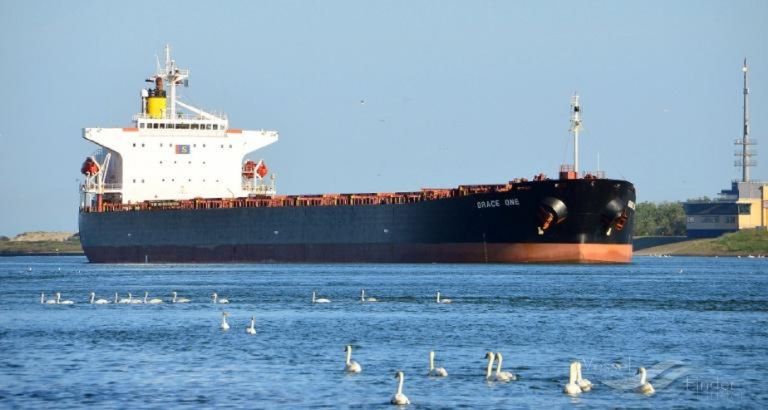

On what grounds could a European government detain a non-European vessel transporting to Syria crude oil extracted by a non-European country, Iran?

By Francois Nicoullaud
On July 4, the government of Gibraltar detained in its waters a Panamanian ship, the Grace I, allegedly on its way to deliver Iranian oil to a Syrian harbor. Immediately after the move, Gibraltar outlined in an official statement that the “action arose from information giving […] reasonable grounds to believe that the vessel, the Grace I, was acting in breach of European Union sanctions against Syria.” And it added: “We have reason to believe that the Grace I was carrying its shipment of crude oil to the Banyas Refinery in Syria.” One day later, the Gibraltar Supreme Court issued an order confirming that the detention of the Grace I for another 14 days was required “for the purposes of compliance with the EU Regulation 36/2012 on sanctions on Syria.”
On what grounds could a European government detain a non-European vessel transporting to Syria crude oil extracted by a non-European country, Iran?
The European Union firmly condemns the principle of secondary, or extra-territorial sanctions, widely practiced by the United States. Therefore, European prohibitions address primarily European nationals as well as persons and entities active on European territory. European law cannot prohibit a Panamanian ship from carrying what it wishes in open seas (except, of course, products targeted by international law, like drugs or undeclared nuclear materials). However, it can forbid European insurance companies from insuring a ship or its freight, it can forbid European banks from financing the venture, it can detain the ship if it stops in a European harbor, it can forbid the freight from being brought ashore. But for this, the ship itself, its freight, or its destination must be subject to European sanctions.
Obviously, the Grace I, as a ship, was not liable to European sanctions as long as it did not enter European territorial waters: Spain’s or Gibraltar’s. Looking at the delimitation of territorial waters in the Strait of Gibraltar, it is difficult to believe that the Grace I penetrated Gibraltar’s very modest territorial waters, save for a technical stop. But, according to a further official statement from the Gibraltar Government, this is precisely what happened. Obviously, this was an ill-advised move.
What about the oil it was carrying? Following the implementation of the Vienna nuclear agreement, all European sanctions concerning Iranian oil have been lifted.
Now about the destination? Syria is clearly under European sanctions, but that does not mean that all activities and persons in Syria are subject to a European blockade. A blockade, in international law, is an act of war.
EU Regulation 36/2012, quoted by the Gibraltar Supreme Court as the legal ground for the detention, prohibits the delivery to Syria of equipment and technology that might be used for internal repression, dual-use items (nuclear material and equipment), and equipment, technology, and software of interest for military use. Four articles refer one way or another to oil. Article 6 prohibits the import, purchase, or transport of oil originating in Syria. Article 7 prohibits the sale and export of jet fuel to Syria. Articles 8 and 9 prohibit the shipment of equipment, technology, and assistance to the Syrian oil industry. There is nothing is this regulation that specifically prohibits the delivery of oil to Syria. But Chapter V—“Freezing of Funds and Economic Resources”—and its article 14 state that “no funds and economic resources” shall be made available to persons and entities listed in an Annex II. Annex II lists several oil companies and refineries, including the Baniyas Refinery Company, which the government of Gibraltar has presented as the alleged destination of the Grace I’s cargo. This could be the legal ground for the detention of the ship, if indeed the sale of oil to a refinery is a way “to make available an economic resource” to it.
Iran, for its part, has denied that the Grace I was in Gibraltar’s territorial waters when the UK Marines boarded it and also denied that the ship was heading to Syria. It has formally protested this “act of piracy.” Interestingly, the Spanish Minister of Foreign Affairs hinted that the ship’s detention was provoked by a tip and a request coming from the United States.
Aside from some Iranian threats of reprisals, the case up to now has been dealt with at the legal and diplomatic levels. As long as these ways are not exhausted—and even after—Iran has no real interest in carrying out its threats to reciprocate by seizing a British tanker in the Persian Gulf. With such a move, Tehran would antagonize the European countries that, for the time being, have stayed aloof from the quarrel and certainly other countries as well.
What could be an acceptable way out for the two parties? First, let’s keep in mind that the Gibraltar jurisdictions, in order to confirm the seizure the Grace I’s cargo, need documented, unquestionable evidence of its Syrian destination. Lacking such evidence, they would have no other choice than to release the ship. The crew—which apparently includes no Iranians—is presently being questioned. Given that the oil cargo in question has not reached its alleged destination, the judges could also consider that the offense has not yet been established.
All in all, there are serious grounds for releasing the Grace I, perhaps with a court injunction not to come close to Syrian shores. In that case, the ship would better avoid further risks and return to its homeport. To put an end to this strange episode, that would be a lesser evil.
Originally published by LobeLog, 07.11.2019, based at the Institute for Policy Studies, a program of Open Society Foundations, under the terms of a Creative Commons Attribution-NonCommercial-NoDerivs 3.0 Unported license.