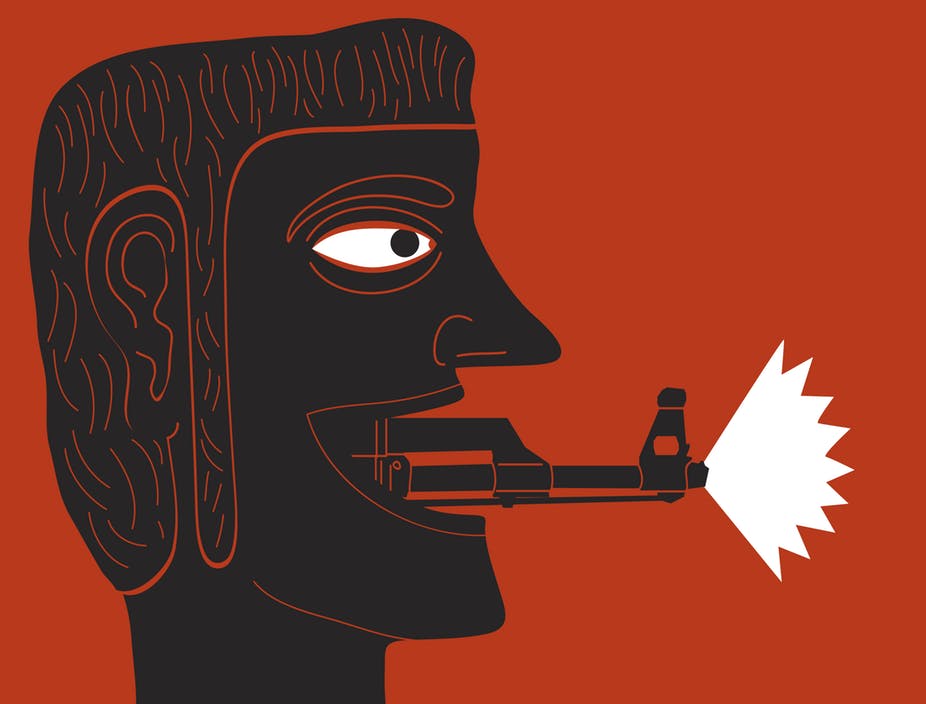
Each spin of the news cycle hits us with another ‘bombshell,’ while everything from free speech to race has been ‘weaponized.’ What’s the effect of being relentlessly exposed to metaphors of war?

By Dr. Robert A. Myers
Professor of Anthropology and Public Health
Alfred University
In a manifesto posted online shortly before he went on to massacre 22 people at an El Paso Walmart, Patrick Crusius cited the “invasion” of Texas by Hispanics. In doing so, he echoed President Trump’s rhetoric of an illegal immigrant “invasion.”
Think about what this word choice communicates: It signals an enemy that must be beaten back, repelled and vanquished.
Yet this sort of language – what I call “warspeak” – has relentlessly crept into most aspects of American life and public discourse.
After the Columbine shooting, I started writing about how “gunspeak” – the way everyday turns of phrase, from “bite the bullet” and “sweating bullets,” to “trigger warnings” and “pulling the trigger” – reflected a society obsessed with guns.
But warspeak’s tentacles extend much further. Words and phrases derived from war imagery crop up in advertisements, headlines and sports coverage. They’ve inspired an entire lexicon deployed on social media and in politics.
The intent might be as benign as the creative use of language. But I wonder if it communicates larger truths about American violence and polarization.
The political battlefield
For decades, America has been fighting metaphorical wars – wars on heart disease, drugs, smoking, cancer, poverty, advertising and illiteracy.
Then there are the culture wars, which have intensified recently to include wars on Christmas, abortion, bathrooms, cops and women. These are different: They involve people on two sides of a polarizing issue.
War targets an enemy – someone or something to be defeated, using whatever means necessary. It’s one thing when you’re at war with a disease. It’s quite another when you’re at war with a group of people on the other side of a political issue.
The political arena seems to have become especially fertile ground for warspeak.
Otherwise boring legislative machinations have been energized with the drama of a life or death struggle. The Republican-controlled Senate uses a “nuclear option” to confirm judges by a simple majority of 51 votes rather than the older standard of 60 votes. Senate Majority Leader Mitch McConnell’s ability to speed along the appointment of conservative judges constitutes the latest volley in a “judicial arms race.”
Elections deploy the language of military campaigns. Republican donors and lawmakers warned Trump of a potential bloodbath before the 2018 midterm elections. Meanwhile, Democrats running for president strategize in their campaign “war rooms” for ways to build up “war chests” that will leave them with enough funds to compete in the “battleground states.”
The political media reinforces it all. In its coverage of the July primary debates, The New York Times wrote that the moderates were “throwing firebombs” at the progressives. Cory Booker, the “happy warrior,” sparred with former Vice President Joe Biden who “took incoming fire” all night, but “shot back” and survived, even as moderator Don Lemon “threw a generational warfare bomb.”
Our semantic arsenals
Then there are the less obvious ways warspeak has become part of everyday speech.
Baseball players mash bombs while basketball players drain three-point bombs. Social media is replete with photobombs and tweet bombs, and there are so many bombshells on cable news, it’s a miracle your TV hasn’t exploded.
Everything has been “weaponized.” According to Google’s Ngram Viewer, the use of the word in print has increased by more than a factor of 10 between 1980 and 2008.
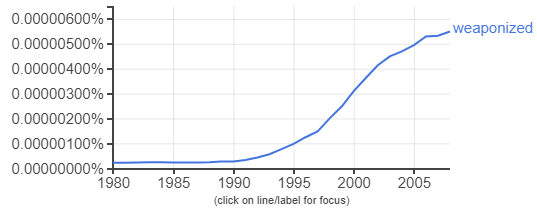
You might have seen it applied to race, feminism, children, immigrants, Immigration and Customs Enforcement, higher education, free speech and songs.
But did you know that tennis serves, laughter, paperwork and Midwestern niceness can also, apparently, be weaponized?
Then there are the warriors in our midst – the weekend warriors, gridiron warriors, keyboard warriors and spiritual warriors – while the country’s future software engineers sign up for coding boot camps to learn their trade.
We’re all in the trenches, and most of us don’t even know it.
Why warspeak matters
Semantic wars, like all wars, are costly. But the role of warspeak in today’s society isn’t as easily quantified as a military budget or body count.
Nonetheless, I believe warspeak matters for three reasons.
First, it degrades our ability to engage with one another about important issues. Law professors Oren Gross and Fionnuala Aolain have written about how the framing of issues as a “war” can “significantly shape choices.” There is an urgency that’s communicated. Instantaneous action is required. Thought and reflection fall by the wayside.
Second, in the context of politics, warspeak seems to be connected to violent political attitudes. In 2011, researchers at the University of Michigan found that young adults exposed to political rhetoric charged with warspeak were more likely to endorse political violence.
Finally, if everything from weather to sports is charged with violent imagery, perceptions and emotions become needlessly distorted. Political carnage and carnage in the classroom, weaponized songs and weapons of war, snipers on the hockey rink and mass shooters – all blur together across our cognitive maps.
There’s a reason why writers, talking heads and politicians deploy warspeak: It commands people’s attention in an increasingly frenzied and fractured media environment.
I wonder, however, if it contributes to political polarization – what Pew Research describes as the “defining feature of American politics today.” And I wonder if it’s one reason why, according to Gallup, Americans’ stress, worry and anger increased in 2018, to the highest point in a dozen years.
One thing is clear: Americans no longer need to be enlisted in the Army to suffer from battle fatigue or be shell-shocked by the latest mass shooting.
Originally published by The Conversation, 08.06.2019, under the terms of a Creative Commons Attribution/No derivatives license.