
If a president can invite a foreign power to influence the outcome of an election, there’s no limit to how far foreign powers might go to curry favor with a president by helping to take down his rivals.

By Robert Reich, J.D.
Carmel B. Friesen Professor of Public Policy
University of California, Berkeley
Trump has asked a foreign power to dig up dirt on a major political rival. This is an impeachable offense.
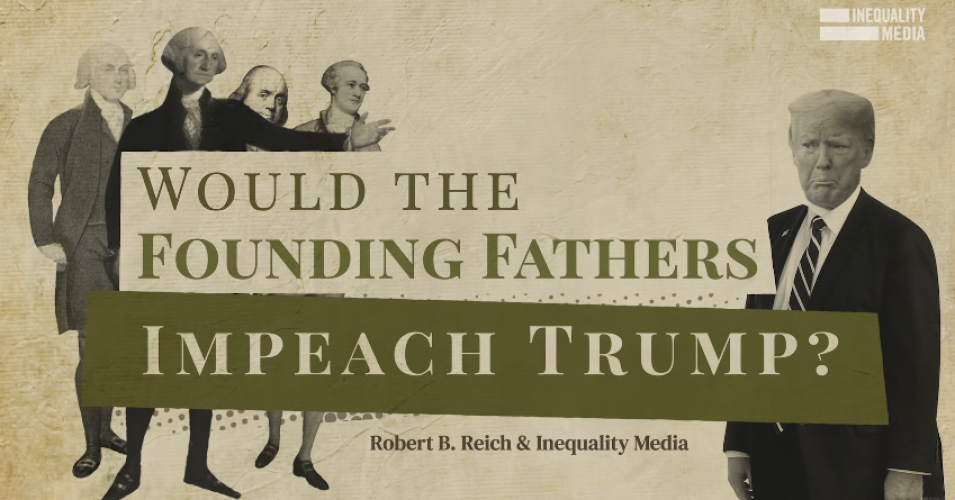
Come back in time with me. In late May 1787, when 55 delegates gathered in Philadelphia to begin debate over a new Constitution, everyone knew the first person to be president would be the man who presided over that gathering: George Washington. As Benjamin Franklin put it, “The first man put at the helm will be a good one,” but “Nobody knows what sort may come afterwards.”
Watch:
Initially, some of the delegates didn’t want to include impeachment in the Constitution, arguing that if a president was bad he’d be voted out at the next election. But what if the president was so bad that the country couldn’t wait until the next election? Which is why Franklin half-joked that anyone who wished to be president should support an impeachment clause because the alternative was assassination.
So they agreed that Congress should have the power to impeach a president—but on what grounds? The initial impeachment clause borrowed from established concepts in English law and state constitutions, allowing impeachment for “maladministration”—basically incompetence, akin to a vote of no confidence.
James Madison and others argued this was too vague a standard. They changed it to “treason, bribery, or other high crimes and misdemeanors.”
But what did this mean?
One of the biggest fears of the founding fathers was that the new nation might fall under the sway of foreign powers. That’s what had happened in Europe over the years, where one nation or another had fallen prey to bribes, treaties and ill-advised royal marriages from other nations.
So those who gathered in Philadelphia to write the Constitution included a number of provisions to guard against foreign intrusion in American democracy. One was the emoluments clause, barring international payments or gifts to a president or other federal elected official. The framers of the Constitution worried that without this provision, a president might be bribed by a foreign power to betray America.
The delegates to the Convention were also concerned that a foreign power might influence the outcome of an election.
They wanted to protect the new United States from what Alexander Hamilton called the “desire in foreign powers to gain an improper ascendant in our councils.“ Or as James Madison put it, protect the new country from a president who’d “betray his trust to foreign powers.” Gouverneur Morris of Pennsylvania, who initially had opposed including an impeachment clause, agreed to include it in order to avoid “the danger of seeing the first Magistrate in foreign pay.”
During the Virginia ratifying convention, Edmund Randolph explicitly connected impeachment to foreign money, saying that a president “may be impeached” if discovered “receiving emoluments [help] from foreign powers.” George Washington, in his farewell address, warned of “the insidious wiles of foreign influence.”
You don’t have to be a so-called “originalist,” interpreting the Constitution according to what the founders were trying to do at the time, in order to see how dangerous it is to allow a president to seek help in an election from a foreign power.
If a president can invite a foreign power to influence the outcome of an election, there’s no limit to how far foreign powers might go to curry favor with a president by helping to take down his rivals. That would be the end of democracy as we know it.
Now, fast forward 232 years from that Constitutional Convention in Philadelphia to Donald Trump.
It’s not just the official summary of Trump’s phone call with Ukrainian president Zelensky in which after telling Zelensky how good America has been to Ukraine, Trump asks for “a favor, though” and then explicitly asks Zelensky to dig up dirt on Joe Biden, one of Trump’s most likely opponents in the 2020 election.
Trump’s entire presidency has been shadowed by questions of foreign interference favoring him. Special counsel Robert Mueller’s investigation documented extensive contacts between Trump’s associates and Russian figures—concluding that the Kremlin sought specifically to help Trump get elected, and that Trump’s campaign welcomed Russia’s help.
Trump at one point in the 2016 election campaign even publicly called on Russia to find Hillary Clinton’s missing emails, and within hours Russian agents sought to do just that by trying to break into her computer servers.
More recently, he openly called on China’s help, saying before cameras “China should start an investigation into the Bidens.”
This is an impeachable offense, according to the framers of the Constitution. Trump did it.
Case closed.
Published by Common Dreams, 11.05.2019, under the terms of a Creative Commons Attribution-Share Alike 3.0 license.