
It is more than a failure. It is a tragedy.

By Joseph Cirincioni
President
Ploughshares Fund
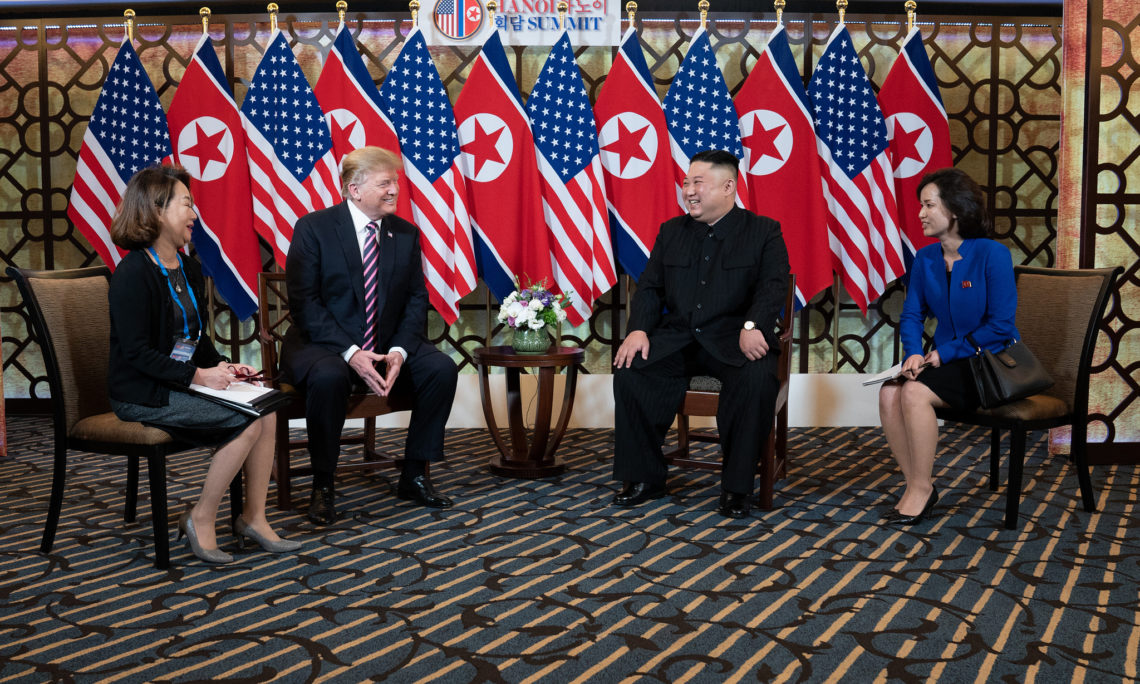
The summit between Kim Jong Un and Donald Trump was not just a failure to secure a nuclear deal that was close to achievement. The diplomatic effort in Hanoi was the latest, tragic missed opportunity to restore peace to the Korean Peninsula.
There is plenty of blame to go around. It starts with a narcissist president who bragged that “I am the only one that matters” and, thus, never staffed his State Department with experts to help him resolve one of the world’s most intractable nuclear problems. He believed his imaginary deal-making abilities could cut the Korean Knot.
He was matched by a brutal dictator who thought that he could flatter and cajole a pompous fool into paying more for concessions than they were worth. They both short-circuited the negotiations, leaving an impossibly short few weeks to hammer out a deal that would normally take months.
The U.S. administration was further hampered by deep divisions over whether it wanted a deal or not. For instance, a “senior official” leaked comments that undercut chief negotiator Steve Biegun for getting “too far over his skis” even as he flew across the ocean to try to conclude an agreement he had optimistically sketched out in a talk at Stanford just a week before.
Behind the scenes—and then suddenly, ominously at the table in Hanoi—was the stealth hand of John Bolton, who has proven a master at killing arms control agreements but completely incapable of negotiating any security accords to replace them. He was, intentionally or not, aided by politicians in Washington who, divided by party and ideology, nonetheless joined first in mockery of the negotiations and then in quick, smug embrace of the collapse of the talks.
All were backed up by the herd of Washington journalists and pundits who, as E. Tammy Kim writes for The New York Times, “concluded that the summit was a failure and that Mr. Trump never should have met with Mr. Kim in the first place. The Blob was content.” But South Korean hopes for peace, she notes, including the high expectations of President Moon Jae-in, “were crushed.”
It is more than a failure. It is a tragedy. There was a deal to be had. There was no “trap.” There was no real risk that “Trump was going to give away the store.” Instead, there was an honest difference in negotiating positions.
Pyongyang wanted to trade some of its nuclear capabilities for most of the sanctions. Washington wanted most of the nuclear capabilities for relaxation of some of the sanctions. In between, was a compromise waiting to be made. But neither could make it. Trump did not “walk away from a bad deal.” He was simply too incompetent to forge a good deal.
The negotiation process itself is now further discredited. Leading Democrats may not fully grasp the hole they are digging for themselves when they applaud Trump for “walking away” and denounce Kim as never being seriously interested in denuclearization.
They, not Trump, are left holding the nuclear bag. They may support diplomacy in principle, but having so thoroughly denounced negotiations with Kim as futile, how exactly do they propose to solve this problem? They are making it harder for a future Democratic president to resurrect the process. The Republicans will be no help, for they will likely shift to oppose a process they supported only because of Trump.
Notably lacking in all the back-patting in Washington are any serious alternative proposals. Fortunately, there are independent experts with some good ideas.
It’s not clear if Kim will ever give up completely his nuclear arsenal. But that proposition can be tested in a series of steps that, in themselves, reduce the risks of war. “Diplomats should prioritize the negotiation of a threshold agreement, a deal that establishes a minimal acceptable condition of stability and prevents the unlimited expansion of North Korea’s nuclear and missile arsenals or its proliferation to other countries,” recommendsa new report by The International Study Group on North Korea Policy.
With complete nuclear disarmament clearly impossible at this point, interim steps could achieve some of this stability and prevention. Shutting down the nuclear plants at Yongbyon, for example, would be a “big deal,” as nuclear scientist Sig Hecker points out. “Because without plutonium, they will really not be able to have major improvements in their nuclear weapons program,” he says. And without the tritium produced at the Yongbyon facilities, the size and efficiency of their weapons would also be limited. Such a move is worth relaxation of some of the sanctions. Adding a peace declaration would not only bring joy to Koreans, north and south, without any compromise of U.S. or Korean security, it would establish a solid basis for ending the decades of hostility on the peninsula.
The best hope is that this administration can somehow pick up the pieces. Both sides left the door open with diplomatically kind words in Hanoi at the sad end of the summit. It may be that there will be some sober recalculation in both capitols that would benefit from these suggestions.
It is difficult, however, to see who would pick these pieces up. Likely not Mike Pompeo, who seems to have one foot out the door. Certainly not Bolton, who is busily burning the pieces. As for Trump, having just squandered the only realistic chance he had for a foreign policy victory, his incredibly shrinking presidency may not allow him much more time or room for another attempt. The walls are closing in.
“Policymakers across the political spectrum have squandered strategic opportunities to deal with North Korea well before it acquired the nuclear capabilities that challenge the Trump administration today,” my colleague, Catherine Killough, argues in her new report on Korean diplomacy, “We must learn from these experiences to ensure we do not make the same mistakes again.”
The United States did not learn these lessons in Hanoi. How many chances will there be?
“It could be worse,” says former Korea negotiator Bob Gallucci. “Indeed, they were worse not very long ago.” He’s right. Both sides are further from war than in the “fire and fury” days of Trump’s first year.
It may be up to the Democrats. They must figure out a way to support new diplomatic efforts while Trump is still able to carry them out. They should want the next president to inherit an ongoing diplomatic process with open channels of communication and—if possible—an interim deal already established.
As the experts at National Security Action after the summit failure said, “Diplomacy is the only viable path with North Korea; there is no palatable alternative.”
President Moon is already hard at work trying to make sure that the process does not break down completely, that recriminations do not lead to increased tensions. He supports Trump’s decision to cancel the U.S.-Korea military exercises, believing that move will keep the risk of miscalculation low and encourage Kim to maintain his freeze on nuclear and missile tests. So, too, are some of the experts noted above and others, many supported by Ploughshares Fund and other foundations. They are working behind the scenes to see if a compromise might be stitched together, if Democrats and Republicans might yet pull together.
There is still a slim hope that this tragedy may have a final, hopeful act.
Originally published by LobeLog, 03.06.2019, based at the Institute for Policy Studies, a program of Open Society Foundations, under the terms of a Creative Commons Attribution-NonCommercial-NoDerivs 3.0 Unported license.