By Astra Taylor
Introduction
At the center of the idea of democracy lies an intellectual abstraction, an abstraction that renders democracy, almost by definition, a distinctly challenging form of government. Stripped to its basics, democracy means rule of the people(demos, people, and kratia, rule). This means figuring out just who the people who allegedly rule actually are always requires some baseline level of theoretical engagement. It’s not as obvious as pointing to a picture of a monarch and saying, “That’s the ruler.” Over the centuries, all sorts of details—from the ornate headgear to the strange habit of marrying family members—symbolized a single individual’s sovereignty over a population. In royal social orders, the king or the queen makes the decisions, and “the people” are irrelevant; no one administering the government cares what the peasants think. But who, or what, do you point to in a democracy to symbolize the status of the people as their own rulers? The very notion of a democratic people is an idea, and an elusive one at that, not a real tangible thing. “The people” isn’t self-evident or whole; it is constructed, contingent, and constantly shifting. “The people,” in this sense, don’t actually exist.
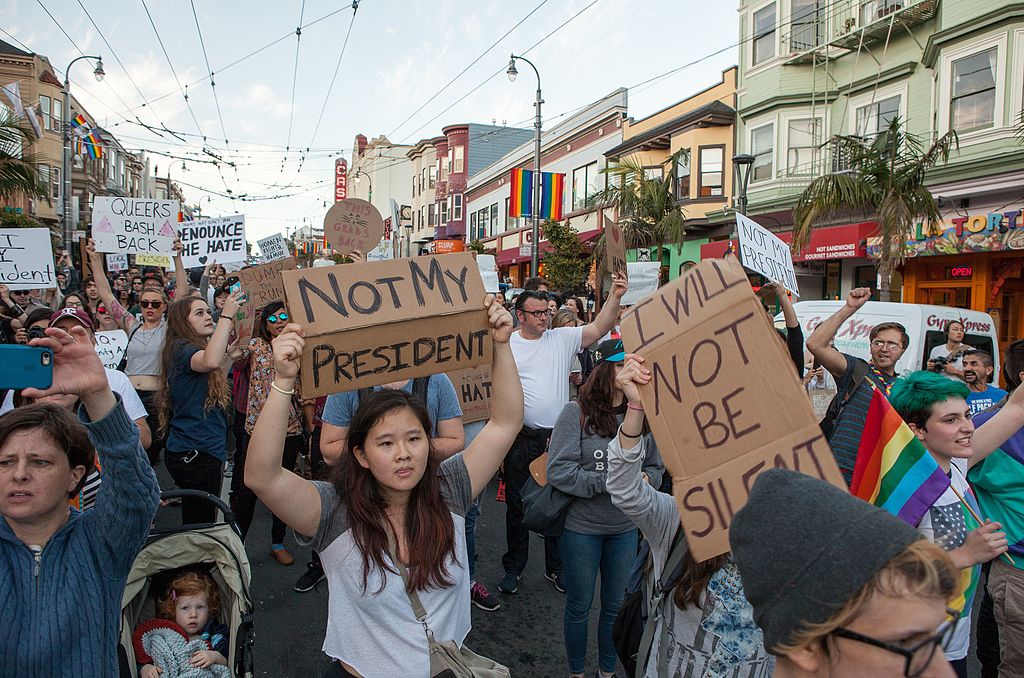
We could, I suppose, just be lazy and point to elected officials as the avatars of our will—they are literally our “representatives,” after all. But doing so would not only be yielding to a formal technicality—it would also be a rather morale- deflating exercise, given all the disappointing specimens who find their way into office. What’s more, it would also be inaccurate. During the wave of pro-democracy Occupy protests that kicked off in Spain and Greece before spreading to the United States in 2011, there was a chant that could often be heard shouted by masses of people outside government buildings: “You don’t represent us!” Wherever this slogan rang out, people meant the same thing: the individuals in power don’t stand for the people, or stand up for them—and given the money-driven and compromised condition of western democracies long hailed as the vanguard of expansive popular representation, it’s hard to argue the point.
Marching and Staggering
How, then, might we instead go about envisioning the people? How can we represent them in a way that rises to the challenge and honors the complexity of the task at hand? The most suggestive, and instructive, way to tackle the riddle of popular sovereignty as a visual proposition might be to review some of the best-known efforts to render “the people” as self-conscious political subjects in Western art. To begin understanding how to see the people as they might one day be, we’d do well to get a better grasp of how they have been formerly, and formally, portrayed.
Consider, for example, the iconic Liberty Leading the People, composed in 1830 by Eugène Delacroix and held in the Louvre’s permanent collection. Standing amid carnage, against a background of gray smoke, Lady Liberty holds a musket in one hand and the tricolor flag of the republic in another while wearing a red Phrygian cap, that unmistakable Jacobin symbol. A brave child waves a pistol at her side, while a young man stands holding a hunting shotgun to her left; a top hat is perched on his head, symbolizing the poor and the petty-bourgeois in revolt together. The rebellious crowd also includes a figure of a craftsman or worker and a student. Here is an image of the people in the throes of their own revolutionary assurance—beleaguered and injured, yes, but fully aware that they’re being summoned forward, and into power, by the ineluctable logic of history. They are justified in their armed insurrection.
For a more recent gloss on the people’s destiny, we could turn to Diego Rivera’s Depression-era “Detroit Industry” series, an homage to Ford Motor Company’s industrial might and innovation. Rivera spent months observing Ford’s River Rouge plant and sketching drafts. His finished work portrays burly men building mechanical wonders, together with a powerful suggestion of the hazards and horrors entailed in such work—automobile assembly lines juxtaposed with the manufacture of poison gas. In the 1950s, after Rivera’s Marxism triggered McCarthyite opposition, officials posted a disclaimer: “Rivera’s politics and his publicity seeking are detestable. But let’s get the record straight on what he did here. He came from Mexico to Detroit, thought our mass production industries and our technology wonderful and very exciting, painted them as one of the great achievements of the twentieth century. . . . If we are proud of this city’s achievements, we should be proud of these paintings and not lose our heads over what Rivera is doing in Mexico today.”
In 2013, in the wake of another economic crisis, the once proud city declared bankruptcy and almost had to sell Rivera’s mural to assuage its creditors; the Ford Foundation, with other philanthropic groups, swooped in to save the day. In contrast to Delacroix’s effort to conjure the people as the confident augurs of a new democratic age, this is an image of the people both empowered and stymied on the path to realizing a fuller, substantively democratic livelihood; they are both the creators and casualties of the Industrial Age.
Divided and Conquering
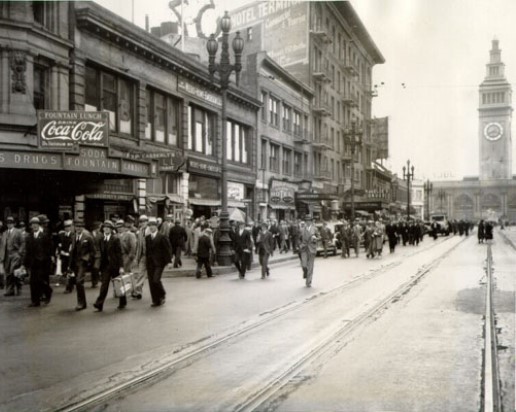
In a similar vein, one of the best known, and most candid, New Deal murals is made up of twenty-seven panels, gracing what was then San Francisco’s main post office. Instead of creating a triumphalist image of a benevolent, heroic working people typical of the period, artist Anton Refregier painted California’s history riven by prejudice and oppression. One panel shows the violent divisions of the Civil War playing out in San Francisco’s Union Square; another honors a 1934 dock workers strike during which two longshoremen were killed and many others injured; another unflinchingly portrays Irish workers viciously beating Chinese immigrants accused of stealing jobs. (Beneath this panel is an 1875 quote from Irish labor leader Frank Roney: “Attacks upon the Chinese I consider unreasonable and antagonistic to the principles of American Liberty.”)
When they were unveiled at the height of the New Deal’s campaign to present a “popular front” of support among homegrown Americans for the burgeoning welfare state, the murals were hugely controversial: What kind of propaganda was this? critics demanded. (Criticism came from all corners. According to one account, “The Catholic Church protested that a friar preaching to Indians at Mission Dolores was too fat; Refregier slimmed him.”) The complaints stemmed, in part, from the public’s own material stake in Refregier’s project: it’s no coincidence that his installation marked one of the final public paintings of their kind supported by the federal government. In a fit of Cold War paranoia, Vice President Richard Nixon tried to have them destroyed. Refregier insisted on presenting the past not as a romantic backdrop for a pat celebration of the status quo but as a prelude to contemporary strife that must be reckoned with. This tense and unresolved depiction of America’s mythic mass democracy is perhaps most familiar to those of us who, with mounting alarm, have tried to chronicle the battered democratic polis of the Trump era—a vision of the people beset by ethnic, racial, and class conflict.
And of course there’s Norman Rockwell and his famous renderings of Franklin Roosevelt’s Four Freedoms: Freedom of Speech, Freedom of Worship, Freedom from Want, and Freedom from Fear. Rockwell’s sequence of portraits, commissioned to help sell war bonds, are still some of the most widely circulated images in American history. They show a middle-aged white man letting his opinion be known at a New England town meeting; white heads bowed in worship at church; white parents tucking in their white children to sleep; a happy white family sitting down to a holiday feast. This might be termed the people’s mass apotheosis—an image of contented, consuming people who are still called upon to protect their way of life (only not, significantly, at the squalid and blood-soaked barricades of Paris but through strategic purchases and investments in self-defense and future stability).
Or, finally, we could gaze at The Verdict of the People. This canvas was painted by Missourian George Caleb Bingham in 1855—and was granted pride of place by Donald Trump’s handlers for a photo-op of the newly sworn-in president at his post-inaugural luncheon. The press release from Senator Roy Blunt, who requested the painting, highlighted the seeming diversity of the crowd: “Bingham’s electorate is one of inclusiveness,” he insisted. But historians quickly clarified that the image actually depicts the electoral victory of a pro-slavery candidate in a small-town antebellum race. The artist thus offers a less-than-flattering verdict of his own: witness “the people” as an elective body who have chosen something awful and are pleased as punch about it.
Looking back on these variegated renderings of the people with the chastened benefit of hindsight, it’s immediately apparent that many are left out. The paradoxical effect of this whitewashed and patriarchal iconography is that it also forcefully highlights the presence of people who aren’t white and/or male whenever they happen to appear. Delacroix’s painting, of course, dates from a time when women weren’t fully enfranchised citizens, but Lady Liberty’s exposed and heaving bosom occupies the front and center of the canvas. And in The Verdict of the People, a single black man is featured prominently, selling moonshine at the bottom left of the frame—perhaps Bingham’s suggestion that despite all the controversy over slavery, African Americans were not to be regarded as suitably virtuous and self-disciplined democratic subjects. Being unseen or over-exposed produce the same cruel effect—marking populations as insignificant and excluded.
This stable of imagery again brings us back to the central quandary of democratic theory: Who counts as the people, and how can that definition be substantively revised and updated in view of shifting historical circumstances? Or to rephrase things in the language of iconography: Who is visible? Who is forced into the shadows? Self-government is a perpetual battle over who is in and who is left out, and we are living at a moment when this abiding struggle appears to be reaching a crescendo. At the same time, though, these questions, and the challenges they pose to representation, always lurk below the surface, even in periods of relative political calm.
Pox Populi
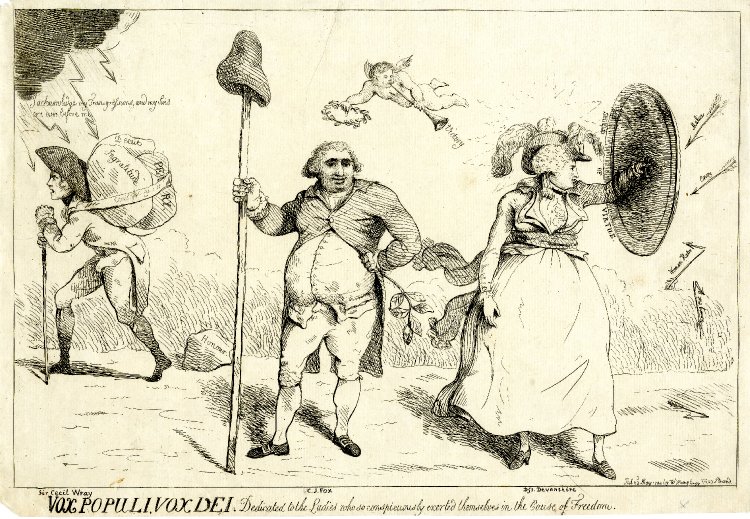
Today this struggle is increasingly understood as a symptom of a populist resurgence, not as a challenge intrinsic to democracy. According to the conventional wisdom, populism defines “the people” against a corrupt elite, and today elites are being spurned the world over. A growing class of liberal pundits tarnish every political stance they don’t approve of as “populist,” as though any mention of “the people” is an aberration from the liberal democratic status quo. (It’s only by this deeply ahistorical and analytically bankrupt insistence that we see “populist” Donald Trump equated to “populist” Bernie Sanders, despite the former leader’s xenophobia and racist pronouncements and policies, and the latter’s overt, inclusive pluralism.) By the distorted logic of our new cohort of antipopulist liberal thinkers, those who denounce Wall Street kleptocrats and self-serving-CEOs as enemies of working people are but the mirror image of right-wingers fulminating against immigrants, feminists, queers, and an all-powerful “politically correct” establishment. All one has to do, it seems, to claim an influential pundit sinecure or political science professorship, is to simply incant the bogey-word “populism” and poof—like magic—the left and democratic socialism disappear, together with the specter of longer-term economic displacement and discontent that lay at the actual core of the revolt against neoliberalism in our time.
The reactionaries who cynically exploit this global mood of revolt from below are genuinely influential and more than a little terrifying. But there’s nothing to be gained, analytically, by casually caricaturing their rise, their rhetoric, and their ideological worldview as “populist.” Worse, for committed democrats who have long struggled to make the promise of self-rule a substantive aspect of our productive lives, there is much to lose. A whole spectrum of political possibility is being wantonly sacrificed—specifically the unique democratic American heritage of the People’s Party, dating from the turn of the twentieth century.
Seeing Ourselves
In place of the firm insistence by Gilded Age capital-P Populists and neo-Gilded Age democratic socialists that democracy should redress the market predations of industrial-age plutocrats, the Trumpist movement has abetted the continued upward consolidation of wealth and the steepening social chasms of inequality. Trump and his far-flung enablers have focused exclusively on putative cultural affronts to the white forgotten man, who is incongruously figured as both unjustly marginalized and reassuringly universal. The political theology of Trumpism promotes the farce that “the people” is a stable entity, a pale-skinned self-evident ruling caste bound by blood, soil, MAGA hats, and tiki-torches. In order for them to be restored to their rightful place at the head of cultural and political life, the faithless institutions and political forces that have orchestrated their betrayal needs to be cleansed—immigrants expunged and fenced out, college campuses clamped down on, patriarchs reaffirmed, and so forth. And the same logic holds for the allied reactionary movements lately seizing power in Europe. The over-the-top rhetoric of ethno-nationalist Nigel Farage reveals just how absurd such a framework is. When celebrating the outcome of the Brexit referendum, he crowed that the vote was a “victory for real people,” thereby making the 48 percent of the British electorate who cast their ballots for the UK to stay in the European Union somehow unreal.
Such pronouncements are both transparently vile and inane—and bound to sow greater disaffection among the very working-class constituencies whose material grievances they crudely distort and exploit. But they do represent another backward-tending redoubt in the longer-term battle over who counts as “the people” and who doesn’t—not, as some want to believe, a shocking anomaly or foreign intrusion that can be disavowed as “not who we are” (whoever that “we” may be). As we’ve seen, this tension is central to democracy itself, but it is especially central to American democracy, which was born of a constitutional compromise that counted black human beings as fractions of a person.
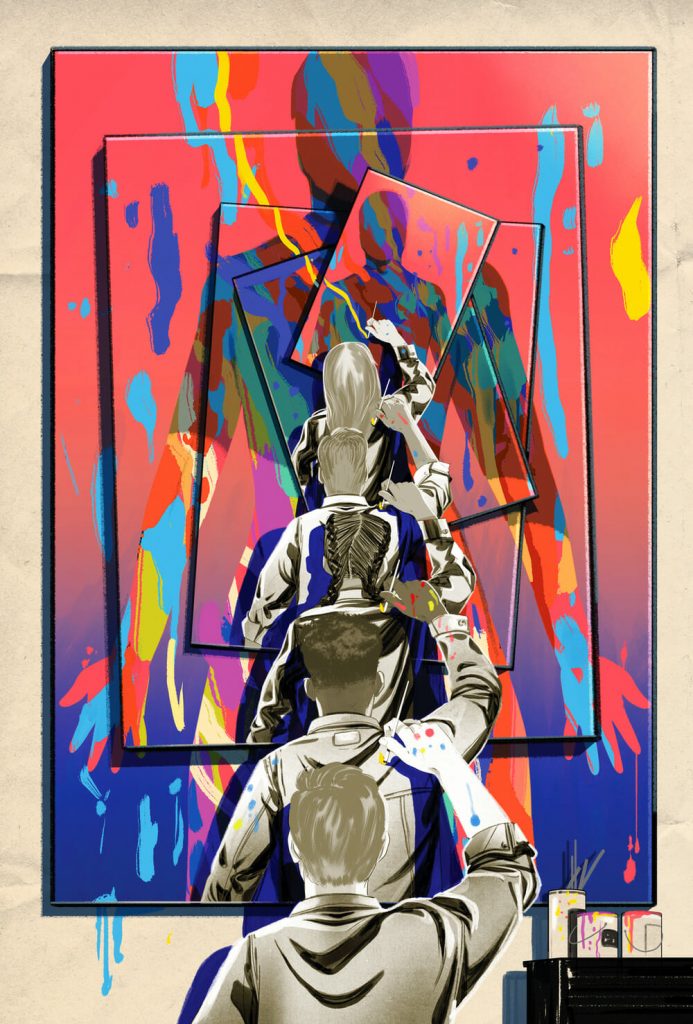
Against this backdrop, we must experiment with ways of symbolizing the demos that do not mark some people as categorically “unreal” or otherwise less than others. Even more urgently, we need to marshal into the center of public life the self-representation of groups who have been erased, stereotyped, and otherwise diminished in conventional portrayals of the people. As Lawrence Goodwyn, the author of the definitive 1976 history of the American Populist movement, said about the actual legacy of Populism for would-be reformers of modern corporate capitalism: “The people need to ‘see themselves’ experimenting in democratic forms.”
The challenge, then, is how to do all of this in a way that’s not hackneyed, propagandistic, or sentimental. Contemporary advertisements pay saccharine tribute to the notion of diversity because corporations are seeking consumers not citizens, and they’ll take anyone’s money in their quest to amass profits. How do we portray the people as a unity without papering over the shocking inequalities that define the status quo?
This question is far from an abstraction for me. I spent the last three years making a documentary called What Is Democracy?, and as I wrestled with that question I was also forced to grapple with the people who are definitionally bound to redefine democracy in its next phase of development. I’m sure there are plenty of ways in which I fell short, but I didn’t take the challenge lightly. I tried to make it clear that the film was by no means a definitive portrait; I attempted to include a polyphony of voices while not subsuming the uniqueness of individuals. I tried to emphasize not just diversity but solidarity, not just inclusion but transformation. I tried to show a democratic people not limited by a single nation or strict conception of citizenship. I also tried to show the demos in action, not in the quiescent repose of Norman Rockwell’s reveries, but in the daily struggle to have one’s needs and desires included on the agenda of a political order that for the past four decades has grown militantly hostile to anything resembling social democracy. Most of all, I tried to show how the stubborn question of who counts as the people continues to be contested and challenged on multiple levels, and that some people are quite literally fighting for their lives in its shadow. This meant, in other words, that I was charged with showing both the promise of democracy and its all-too-plain disappointments. The people aren’t always pretty. I also tried to show, as Rivera and Refregier had, that this ugliness can translate directly into hateful bigotry and material exploitation.
Moving Pictures
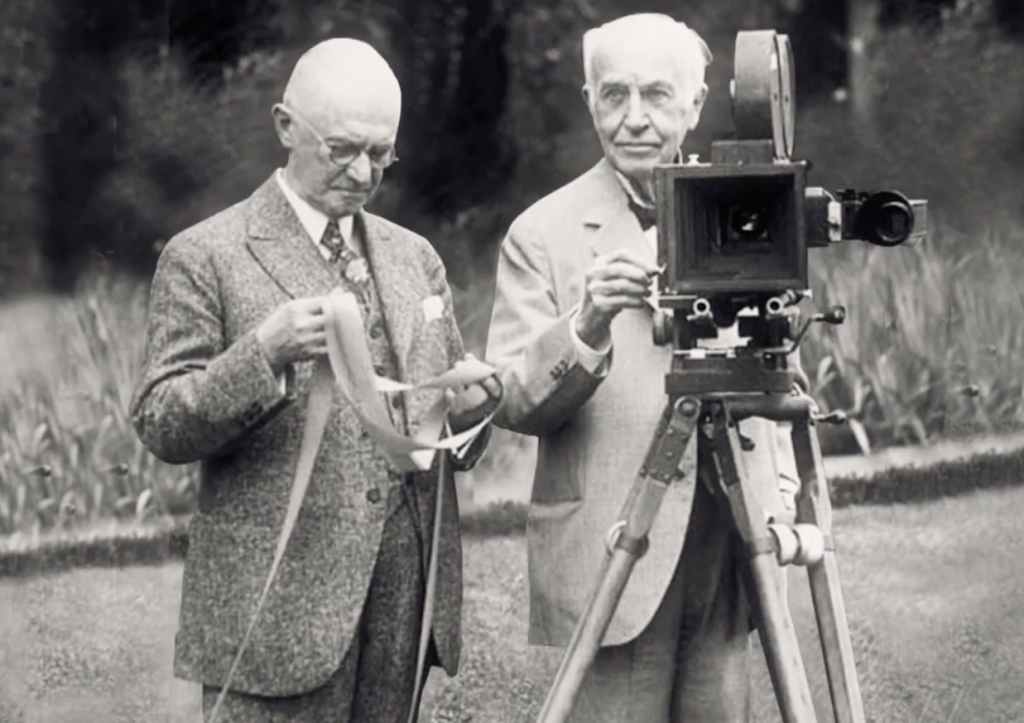
Making my documentary often felt like a quixotic undertaking. It was, for starters, an effort to translate a central problem of political philosophy to the screen—which is not, to put things mildly, a recipe for runaway success at the box office. Beyond such formal constraints, I also found myself struggling with the same visual quandary that the fistful of art works I’ve mentioned here sought to resolve: I had to at least attempt to represent the demos in a way I felt was fair and generous. But can’t a more accurate, if exhausting and demoralizing, portrait simply be gleaned by visiting the bowels of an internet message board or reading user-generated comments? Does scrolling through an algorithmically generated social media feed offer a window straight into the soul of the people, in all our fragmentation, distraction, and impotent rage?
Though a feature film might seem a bit antiquated in an age of snapchats and dark posts, at least I wasn’t working with oil and pigment. As Alexander Provan notes in an excellent recent essay in Art in America, the traditional painters who set out to represent the people to the best of their creative ability have long been replaced by “a panoply of professionals” who claim to uncover the preferences of the people through new methods of data harvesting. “The imagination of the artist,” Provan writes, “has been surpassed by the techniques of the behavioral economist, filmmaker, advertiser, pollster, lobbyist, data scientist, and social media analyst. And politicians have become mediums through which messages are tested and refined, demographics are established and tweaked.” Today’s politicians run data-driven campaigns, creating proposals based on data sets from focus groups, reaching and mobilizing their constituents using precision targeting. In this age of rampant digital personalization, who needs “the people” anymore?
Our fast-fragmenting and notoriously insular mediasphere appears to make the project of coherently depicting “the people” all the more hopeless. But perhaps in every crisis of representation lies opportunity—if you are employed in the field of data collection and analytics, at least. The visual challenges of imagining and conjuring the people has been superseded by the pseudo-science of measuring and marketing their demographic self-images to them—to us. But “the people”—whatever the people is—is not just the aggregated preferences of millions of atomized individuals, a lowest-common-denominator pabulum of averages, as pollsters would have us believe.
Paintings may have been replaced by polling, but the results are not necessarily more accurate, and arguably even less so. Isn’t that the distressing moral of how the presidential balloting played out in 2016? Liberal-leaning media experts and political professionals mistook the high-tech vision of the demos that they themselves had assiduously polled and marketed to as the actually existing electorate right up until election night, with the disastrous results we are now living through. They forgot their models and predictions were representations, believing them instead to be the real thing. The gap between image and actuality was profound. The New York Times forecast gave Clinton “an 85 percent chance to win” while the experts at the Princeton Election Consortium put the probability (at one point just days before the election) as “greater than 99 percent” and Clinton’s campaign, using its own polling, came to similar self-affirming conclusions. Pew Research later claimed the discrepancy was due to something called nonresponse bias: “It is possible that the frustration and anti-institutional feelings that drove the Trump campaign may also have aligned with an unwillingness to respond to polls.” Liberals eagerly took what was, in fact, angry silence to be a sign of nonexistence; the best methods money could buy couldn’t detect millions of people who weren’t onboard the Democratic train.
Rule by the Unreal
Republicans, meanwhile, aren’t so easily deceived, but only because they are more cynical. Conservatives don’t care about the people and have always been content to rule as a minority. They want to rule as a fragment of the people—a very rich and powerful fragment. But occasionally even they need a fig leaf. Remember “Joe the Plumber” Wurzelbacher from the 2008 campaign trail? Here was the voice of the people challenging Obama’s nefarious plan to “spread the wealth” at the steep expense of heroically aspiring business owners like himself—even though his name was not Joe, but Samuel, and he wasn’t the entrepreneurial licensed plumber he claimed to be, but an uncertified plumber’s assistant. (He also had an outstanding lien for more than $1100 in unpaid back taxes, which rendered his agitprop question to Obama an impressive triple-gainer of falsehood. The penalty for this mendacious stunt was that Wurzelbacher was promptly hailed as a hero of the misunderstood working-class and was elevated as a worthy, if ultimately unsuccessful, candidate for Congress himself. He still pops up in conservative media to rail about the perfidy of the libs and the glories of Donald Trump.)
Trump himself has likewise made enthusiastic use of such prop figures of demotic authenticity, such as Diamond and Silk—the two black sisters and erstwhile Democrats whose videos, where they animatedly affirm the president’s every word, attract hundreds of thousands of views. Watching their shenanigans online, it can be tempting to dismiss them as unreal, given their over-the-top adulation for Trump, unhinged rants, and opportunistic arguments (upset at declining Facebook traffic, Diamond recently invoked the specter of segregation, decrying a “new Jim Crow . . . to suppress the voices of conservatives”). But I can report they are, in fact, all too real: in 2016, as I was filming footage for What Is Democracy? I ran into the duo on the highway as they were en route to a Trump campaign stop in Raleigh, North Carolina. And sure enough, a couple of hours later I saw them on stage, cheered on by an enthusiastic throng. “This election will decide whether we are ruled by a corrupt political class . . . or whether we are ruled by the people,” Trump announced to the crowd later in the hour. “We’re going to be ruled by the people, folks.” With the aid of a pair of black figureheads made prominent by virtue of the conspicuous absence of people like them within the broader Trump insurgency, the sorry spectacle updated the American quandary of popular representation for an age of recursively fragmenting participation in civic life. It’s now up to us to envision and project a different stable of images—based on a new set of viable political coalitions—to revive the old Populist quest to lend experimental and material dimensions to the democratic forms currently banished to the margins of the picture. We, the unreal people, must find ways to make ourselves seen and heard.
Originally published by The Baffler (43, January 2019) under the terms of an MIT Open Source license.