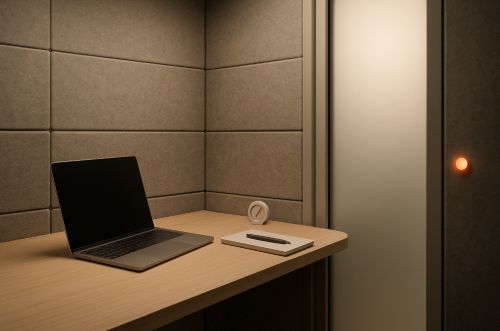
To finish work faster, professionals must implement proven quiet tricks, including carving out a personal focus zone, taking controlled acoustic breaks, and utilizing flexible privacy infrastructure to eliminate distractions.
The ambient noise of open-plan offices constantly drains attentional resources, leading to prolonged recovery times after every interruption. By intentionally managing your acoustic environment, you can protect your concentration and complete complex tasks with greater efficiency.
1. Carve Out a Personal Focus Zone
The first step toward accelerating task completion starts with claiming a physically defined zone that signals to your brain it is time for deep work. Open-plan offices operate on the premise that proximity breeds collaboration, but this design guarantees a constant stream of interruptions. In fact, background noise can lead to as much as a 66 percent drop in productivity. Your brain is constantly monitoring social environments for relevant signals, making focused work exhausting in an open setting.
A focus zone solves this by establishing clear environmental boundaries. The most effective approach involves acoustically controlled spaces with measurable noise reduction. Utilizing spaces like PrivacyPod’s STC-certified office phone booths provides this type of single-occupancy focus architecture without requiring construction or permanent modifications.
Stepping into a dedicated quiet space immediately strips away the ambient hum of the floor and stops overlapping reverberations.
Teams that introduce dedicated quiet zones report fewer task-switching moments and faster completion times on high-concentration work. When environmental interruptions cease, workers can avoid lengthy cognitive resets and quickly return to deep focus. Identify the two or three high-focus tasks on your weekly calendar that demand uninterrupted attention, and commit to completing them inside a dedicated quiet zone.
2. Use Controlled Quiet Breaks to Reset and Recover
The fastest path to finishing more work is recovering better. Sustained mental effort without adequate recovery depletes the brain’s ability to filter distractions and maintain working memory. In loud environments, this depletion accelerates because the brain is simultaneously executing focused tasks and monitoring ambient noise. In fact, an increase of 10 dB reduces productivity by approximately 5%.
Research indicates that time spent in low-stimulation acoustic environments restores attentional capacity far more effectively than passive rest in noisy surroundings. Authentic silence mitigates stress markers and allows the prefrontal cortex to recover from sustained activation. A 10 dB decrease in environmental noise exposure decreases the risk of cardiovascular disease by 7 to 17%. Even 10 to 15 minutes of uninterrupted silence can measurably restore focus for the next work block.
Dedicated acoustic environments function as on-demand recovery spaces. A structured, quiet break serves as a vital recovery mechanism with a measurable return on investment for high-performing organizations. Between deep-work blocks, schedule a short, intentional retreat into a quiet space. Workers who manage their attentional resources through environmental resets consistently finish the day with higher output and fewer errors.
3. Make Privacy Flexible Enough to Follow Your Workflow
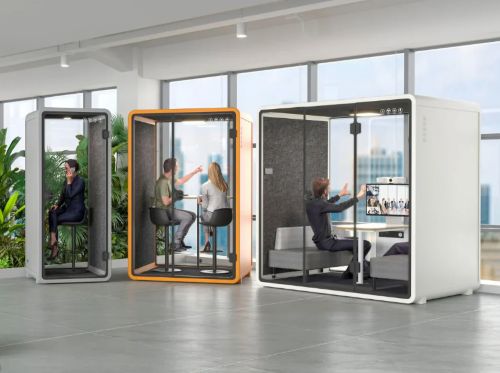
The need for quiet shifts constantly changes with the workday, project evolution, and team size. A fixed privacy solution anchored to one corner of the floor or limited to a single booked room inevitably leaves operational gaps.
Traditional privacy infrastructure relies on permanent walls and expensive glass partitions. When organizational needs shift, permanent architectural elements can create severe operational bottlenecks.
Modular acoustic architecture solves this spatial friction. Privacy solutions built on movable casters allow facilities managers to reposition quiet zones across a floor plan without tools, permits, or operational downtime. A single-occupancy focus zone on Monday can easily anchor a different workspace cluster by Thursday.
This flexibility must also extend to capacity. A functional acoustic ecosystem scales with immediate demand, offering single-occupancy spaces for focused work, two-person configurations for sensitive conversations, and larger modular rooms for team huddles.
When teams stop losing time searching for a quiet room, that recovered time goes directly back into productive output. Portable acoustic architecture also ensures that sensitive human resources conversations and executive briefings remain confidential.
The Bottom Line
Quiet is a strategic input that directly determines the quality and speed of professional output. Carving out focus zones, protecting recovery time, and building flexibility into acoustic access are performance decisions that reduce the structural drag of open-floor noise. The most competitive environments give people genuine control over their acoustic experience, supporting both dynamic collaboration and deep concentration. Ultimately, the most sustainable way to accelerate work is to aggressively protect the quiet hours.
| Author Profile: PrivacyPod is the leading manufacturer of soundproof office pods and meeting booths for businesses seeking flexible, sustainable workspace solutions. |
About the Author