

By Dr. John E. Taylor, J.D.
Professor of Law
West Virginia University
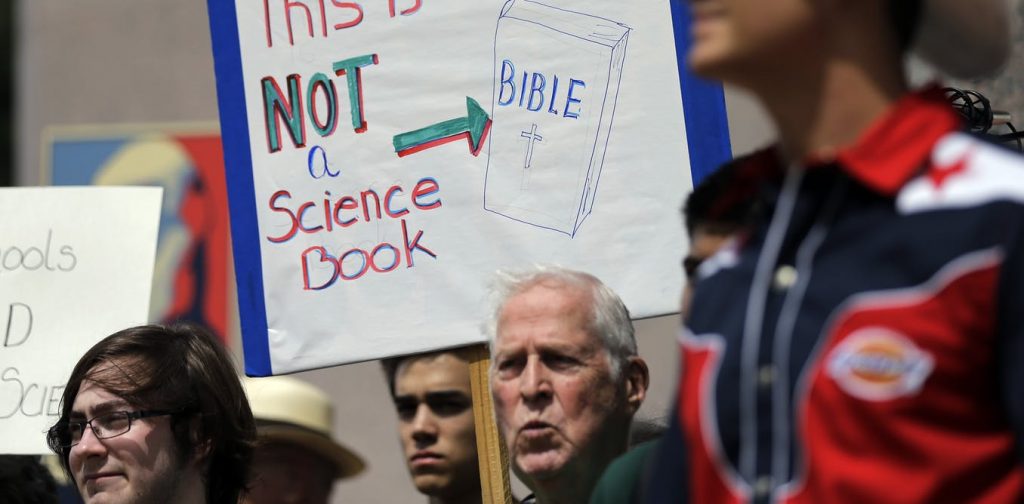
Over thirty years ago, the U.S. Supreme Court’s decided Edwards v. Aguillard, a groundbreaking case that ruled it unconstitutional to require creationism to be taught in public schools.
Though much has changed in 30 years, the broad questions raised by this case remain timely. Who gets to decide what knowledge will be transmitted to the next generation – parents? Elected officials? Academic experts? What role (if any) should the courts play in policing such decisions?
As a scholar of education law and First Amendment law, I’ve seen these very questions animate curricular controversies over climate change, American history, and more.
While recent debates seem to share a common structure with controversies about the teaching of evolution, there’s a key difference: Edwards v. Aguillard stands not for the broad idea that it’s unconstitutional for public schools to teach “bad science,” but for the narrower idea that it’s unconstitutional for them to teach religion as truth.
A century of science and religion
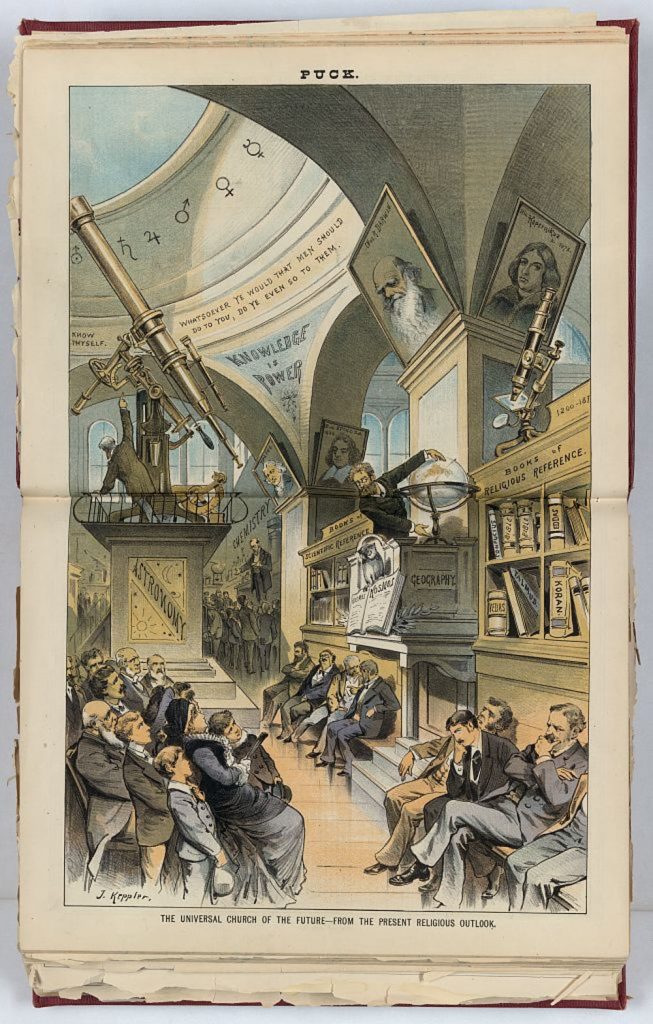
Some conservative religious believers – mainly fundamentalist or evangelical Protestants – have long viewed Darwin’s ideas as incompatible with their faith. Consequently, they’ve resisted the undiluted teaching of evolutionary theory in public schools.
Early resistance took the form of statutes criminalizing the teaching of evolution, most famously the Tennessee ban at the heart of the famous “Scopes Monkey Trial” of 1925.
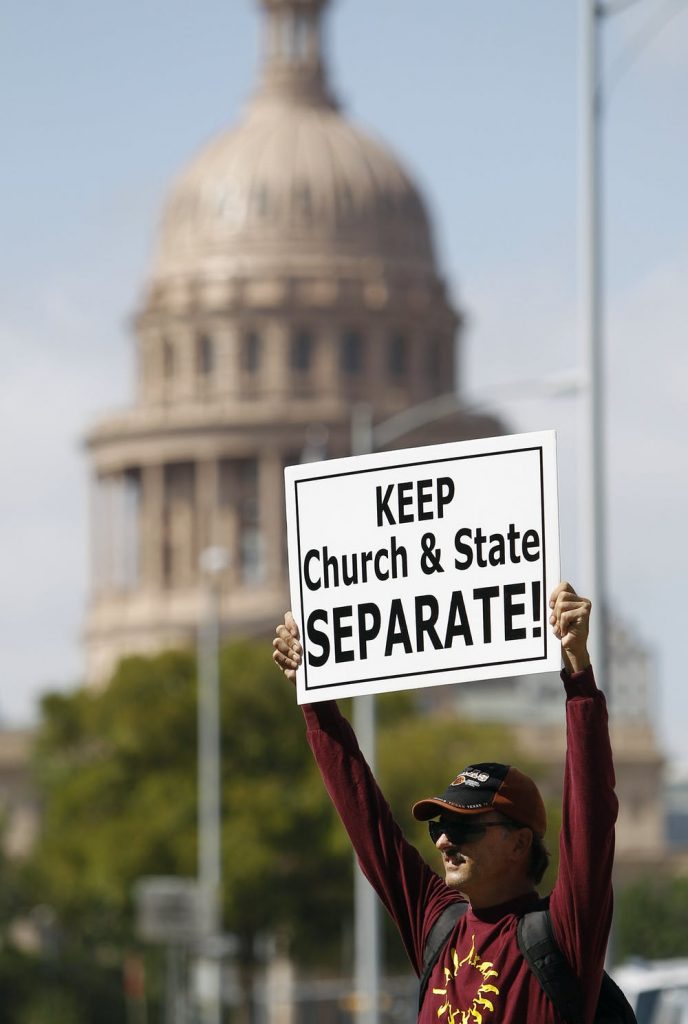
In the next four decades, the legal playing field changed dramatically. The Supreme Court applied the Constitution’s Establishment Clause to the states in 1947, initially reading the clause to require the “separation of church and state.” In the early 1960s, cases banning school-sponsored classroom prayer and devotional Bible reading interpreted the separation of church and state to mean that schools could teach about religion, but they couldn’t constitutionally teach religion as true.
It followed that teaching the biblical creation story as a true account of human origins was out of the question. The Supreme Court put a categorical end to Tennessee-style “monkey laws” in its 1968 decision in Epperson v. Arkansas.

In 1971’s Lemon v. Kurtzman, the Supreme Court solidified its views on church-state separation by adopting a three-prong “test” to determine whether laws violated the Establishment Clause. To be constitutional:
- A law must have a secular legislative purpose.
- Its primary effect must neither advance nor inhibit religion.
- It must not foster excessive government entanglement with religion.
Lemon’s support on today’s Supreme Court is much weaker than it was 40 years ago, but it has been the dominant test employed in the case law on creationism and evolution.
Can we teach a bit of each?
Why, then, didn’t the Supreme Court’s adoption of the Lemon test close the book on creationist teaching once and for all? The answer, in a nutshell, is that creationism went underground.
Once the state could neither teach biblical creationism nor categorically forbid the teaching of evolution, creationists turned to new strategies.
The first post-Epperson wave of resistance involved a number of state legislatures that required the “balanced treatment” of both evolution and “scientific creationism” in the science classroom. Students would be presented with two “scientific” accounts side by side and could make up their own minds.
Yet, for this strategy to succeed, proponents needed to convince courts that “scientific creationism” was more than just Sunday school in disguise. In McLean v. Arkansas (1982), a federal district court struck down Arkansas’s balanced treatment law, ruling that it merely omitted biblical references without actually changing the religious purpose of the law. The court also developed a definition of “science” and concluded that “creation science” did not satisfy it.
Edwards v. Aguillard

In 1981, Louisiana passed the “Balanced Treatment for Creation-Science and Evolution-Science in Public School Instruction Act.” Though similar to the law struck down in McLean v. Arkansas, Louisiana lawmakers took extra steps to attempt to cleanse religion from their law after Arkansas’s balanced treatment act had been challenged in court.
Under the law’s terms, no school was required to teach either evolution or creation science, but if one were taught, the other had to be taught as well. The declared purpose of the law was protecting “academic freedom.”
On June 19, 1987, the Supreme Court ruled 7-2 in the case of Edwards v. Aguillard that the Louisiana law was unconstitutional. Writing for the court, Justice Brennan explained that the act had no secular purpose – and thus violated the first prong of the “Lemon test.” Further, Brennan rejected the act’s purported purpose of protecting academic freedom:
“The Act actually serves to diminish academic freedom by removing the flexibility to teach evolution without also teaching creation science, even if teachers determine that such curriculum results in less effective and comprehensive science instruction.”
‘Teaching the controversy’
Like Epperson v. Arkansas, the Edwards case was a decisive Supreme Court defeat for anti-evolution forces.
As creationists came to understand that the Supreme Court would not approve laws with religious agendas so close to the surface, many shifted their focus to more subtle tactics, which involved some version of “teaching the controversy” regarding evolution. One strategy was to adopt disclaimers explaining to students that evolution was a “theory, not a fact” or that teaching evolution was “not intended to influence or dissuade the Biblical version of Creation.” Courts uniformly ruled against these disclaimers.
Kitzmiller v. Dover School District (2005), the best-known post-Edwards case, addressed the strategy of substituting “intelligent design theory” for “scientific creationism.” A Pennsylvania school district’s evolution disclaimer included the suggestion that students consider the theory of “intelligent design” as developed in the textbook, “Of Pandas and People.”

Intelligent design proponents argue that mutation and natural selection cannot adequately explain the emergence of “irreducibly complex” biological structures; such structures must have been designed. Officially, the “designer” could have been anyone – a space alien, perhaps – thus “intelligent design” is claimed not to be religious in character.
The district court, however, soundly rejected these arguments. As had the court in McLean v. Arkansas, the Kitzmiller court discussed the nature of science and concluded that intelligent design was not science.
The legacy of Edwards today
Courts have been remarkably consistent in rejecting creationist efforts to undermine the teaching of evolution. It’s tempting to see these cases as a sign that courts will protect the integrity of science and of academic judgments generally. (One might think, for example, that courts would just as readily step in when political actors reject the teaching of mainstream climate science in public schools.) But the cases don’t sweep so broadly.
Even in cases where courts explicitly state that creationism/intelligent design is not science, they make this point only as a step toward the critical point that creationism is religion. In other words, courts do not weigh in on whether science lessons must be supported by mainstream scientific experts, only that religious views can’t be taught as science.
Respect for academic expertise is incredibly important. One might argue, as Robert Post has done, that the expertise fostered by academic disciplines deserves First Amendment protection. But the courts aren’t there yet.
Recent efforts to undermine the teaching of evolution have mainly taken the form of so-called “academic freedom” or “science education” bills, which have been proposed in a number of states and have passed in Louisiana (2008) and Tennessee (2012).
These bills exploit an opening left by Edwards v. Aguillard: Teachers are not required to teach creation alongside evolution; rather, they’re given the “academic freedom” to emphasize critiques while teaching evolution in their science classes. The bills downplay religion by not mentioning the topic of evolution or by mentioning it alongside other controversial topics like climate change.
Legal precedent would not allow public school teachers to explicitly use this “academic freedom” to undermine science education in favor of religion. However, it’s difficult to know how many teachers are choosing to do so – and whether those choices have anything to do with the legislation.
Edwards v. Aguillard struck an important blow for science education, and it fundamentally reshaped the tactics available to creationists. Its influence on these fronts has been significant and laudable, but its reasoning is heavily reliant on historical links to old-school creationism and on a conception of the separation of church and state that’s stricter than the likely views of current Supreme Court justices. These points limit the case’s ability to speak to the full range of curricular problems we confront today.
Originally published by The Conversation, 06.23.2017, under the terms of a Creative Commons Attribution/No derivatives license.
About the Author