

By Elizabeth (Liza) Goitein, J.D.
Co-Director, Liberty & National Security Program
Brennan Center for Justice
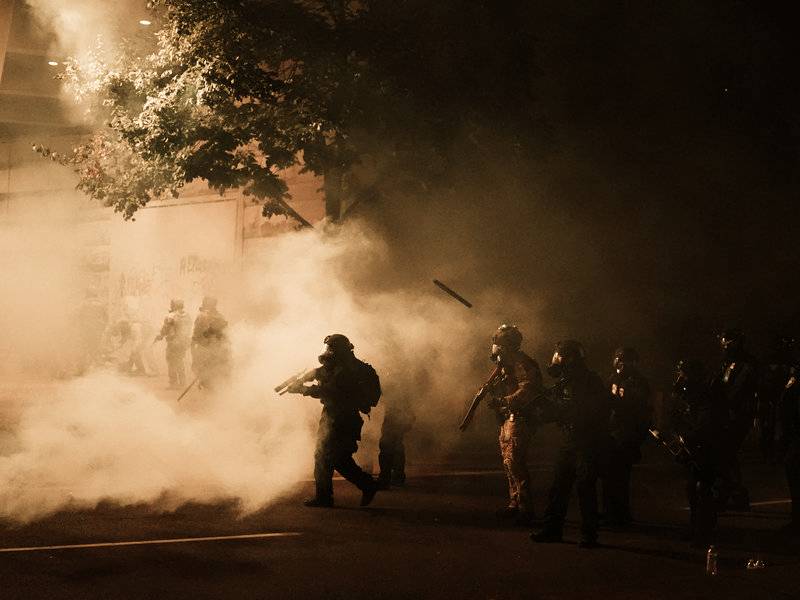
It doesn’t take a legal expert to know that what’s happening in Portland, Oregon is an abuse of power. When unidentified federal forces dressed as soldiers pull people off the streets into unmarked vans, something is gravely wrong. What’s less apparent is that this abuse is part of an ongoing effort by the administration to get around “posse comitatus”: the principle that the president cannot use the military as a domestic police force. The implications for the rule of law — and potentially for the 2020 election — are staggering.
The Department of Homeland Security personnel deployed in Portland are federal law enforcement agents, not members of the armed forces. But the evidence is mounting that they are not there to enforce the law. Instead, they are acting as a paramilitary wing to assist the president in his longstanding goal to (in his words) “take over” U.S. cities run by Democrats.
This goal dates back to the beginning of Trump’s presidency. Five days after his inauguration, he tweeted: “If Chicago doesn’t fix the horrible ‘carnage’ going on, 228 shootings in 2017 with 42 killings (up 24% from 216), I will send in the Feds!” (Three and a half years later, he’s about to get closer to carrying out his threat: He announced on Wednesday that he will send 200 federal agents to the city, plus 35 additional agents to Albuquerque.) He has issued similar threats periodically throughout his time in office.
But it was the protests that erupted across the country in response to the brutal police killing of George Floyd that finally gave the president his chance. At the president’s direction, the governors of 11 states (10 of them Republicans) sent their National Guard units into Washington, DC, where largely peaceful protests had been marred by isolated incidents of violence and looting. The deployment was over the objections of the city’s mayor, Muriel Bowser.
Congress passed the Posse Comitatus Act to prevent exactly this type of action. The 1878 law bars federal troops from participating in domestic law enforcement activities absent an express authorization by Congress. But the Act applies to the National Guard only when its units are federalized. Even though Guard troops were clearly acting at the direction of the president and secretary of defense, the president did not officially federalize them, leaving them free to conduct law enforcement activities.
That gambit served the president’s purposes in DC. But pulling the same trick in a state might be more difficult. Although the administration’s legal theory would permit it, the optics of sending one state’s National Guard forces into another state would likely be more disturbing than sending them to the nation’s capital. Moreover, governors might be more reluctant to cooperate if another state’s sovereignty were at stake.
So the administration is trying out a new end run around the Posse Comitatus Act. The Department of Homeland Security has sent dozens of agents to Portland to “restore order,” against the will of Portland’s mayor and the governor of Oregon. The official justification for the deployment is to protect federal property, which federal law enforcement agencies may do with or without local authorities’ consent. But in less scripted moments, the president has blown this cover, repeatedly declaring that he’s sending the feds to do the job of local Democratic officials because those officials are doing it so badly. “You’re supposed to wait for them to call, but they don’t call,” he complained.
In any case, it’s fairly obvious that DHS agents aren’t in Portland simply to protect federal property or personnel. They’ve been recorded driving in areas far from any federal building and apprehending people who are not visibly engaged in any crime, let alone a federal one. In these cases, no charges are brought, no laws “enforced.” After holding the person for a short but terrifying period of time, the agents release them, leaving no record of the event. What they leave instead is a message of intimidation.
This isn’t the behavior of a law enforcement agency, state or federal. It’s the behavior of a lawless paramilitary force — and it’s no accident that President Trump chose DHS for the job. The department was conceived and structured as a quasi-military agency in the wake of 9/11. This origin story is reflected in its mission (which includes anti-terrorism, border security, and cybersecurity), the military-style weapons and gear it acquires directly from the defense industry, and even its inclusion of one branch of the armed forces (the Coast Guard).
The military mindset is particularly strong in Customs and Border Protection. In 2014, the former head of internal affairs at CBP warned that the agency considered itself a “paramilitary border security force” that operates outside “constitutional restraints regarding use of force.” CBP has repeatedly demonstrated that its loyalty to President Trump outweighs fidelity to the rule of law. Not coincidentally, the federal agents in Portland were drawn primarily from CBP.
As a legal matter, Trump’s misuse of federal law enforcement in Portland doesn’t violate the Posse Comitatus Act, because the agents are not members of the armed forces. But with DHS acting as a paramilitary force, the deployment nonetheless violates the fundamental principle behind the law. And it highlights the reason that principle exists in the first place: so that the president will not have a personal army at his disposal to “take over” local governments or to suppress domestic dissent.
Congress and the courts must step in. Otherwise, having found his army, Trump is sure to use it again in coming months. Bullying Democratic mayors and governors plays well with his base, whose support was beginning to waver due to Trump’s disastrous mishandling of Covid-19. More chilling, he could deploy his paramilitary forces in Democratic strongholds on Election Day as a means of suppressing voter turnout.
President Trump has already used federal forces to undermine local sovereignty and the rights of protesters. This practice must be stopped, lest he use these same tactics to undermine our democracy come November.
Originally published by the Just Security, 07.24.2020, New York University School of Law, under the terms of a Creative Commons Attribution-No Derivs-NonCommercial license.
About the Author