By Joshua Holland
Former Senior Digital Producer
BillMoyers.com
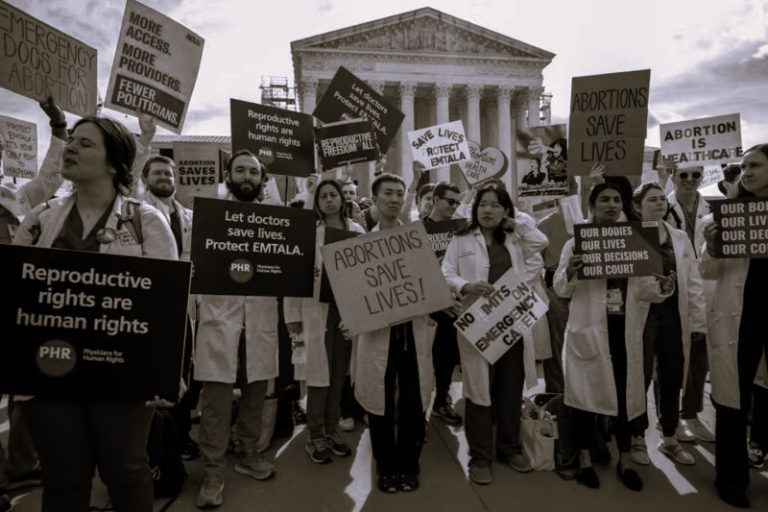
Conventional wisdom holds that the rise of the religious right as a political force to be reckoned with during the 1970s and 1980s was driven by conservative Christians’ intense opposition to the Supreme Court’s decision in Roe v. Wade. But Dartmouth College’s Randall Balmer writes that “the abortion myth quickly collapses under historical scrutiny.” He notes that “it wasn’t until 1979 — a full six years after Roe — that evangelical leaders, at the behest of conservative activist Paul Weyrich, seized on abortion not for moral reasons, but …. because the anti-abortion crusade was more palatable than the religious right’s real motive: protecting segregated schools.”
When Roe was first decided, most of the Southern evangelicals who today make up the backbone of the anti-abortion movement believed that abortion was a deeply personal issue in which government shouldn’t play a role. Some were hesitant to take a position on abortion because they saw it as a “Catholic issue,” and worried about the influence of Catholic teachings on American religious observance.
Shortly after the decision was handed down, The Baptist Press, a wire service run by the Southern Baptist Convention — the biggest Evangelical organization in the US — ran an op-ed praising the ruling. “Religious liberty, human equality and justice are advanced by the Supreme Court abortion decision,” read the January 31, 1973, piece by W. Barry Garrett, The Baptist Press’s Washington bureau chief.
Religious bodies and religious persons can continue to teach their own particular views to their constituents with all the vigor they desire. People whose conscience forbids abortion are not compelled by law to have abortions. They are free to practice their religion according to the tenets of their personal or corporate faith.
The reverse is also now true since the Supreme Court decision. Those whose conscience or religious convictions are not violated by abortion may not now be forbidden by a religious law to obtain an abortion if they so choose.
Garrett reassured his readers that the decision had been made not by “a Warren type or ‘liberal’ Supreme Court,” but “a ‘strict constructionist’ court, most of whose members have been appointed by President Nixon.”
Two days earlier, The Baptist Press profiled Linda Coffee, a Southern Baptist who was one of the two Texas attorneys who argued Roe before the Supreme Court. She told the paper that “the ruling does not relieve each individual of standing firmly behind his or her moral or religious viewpoint about what a person is or when life begins,” and worried that an “emotional reaction to the ruling will result in failure to distinguish between the legal principle of the decision and the moral implications now left to the doctor patient relationship.”
Originally published by BillMoyers.com, 07.17.2014, under the terms of a Creative Commons Attribution-NoDerivatives 4.0 International license.
About the Author