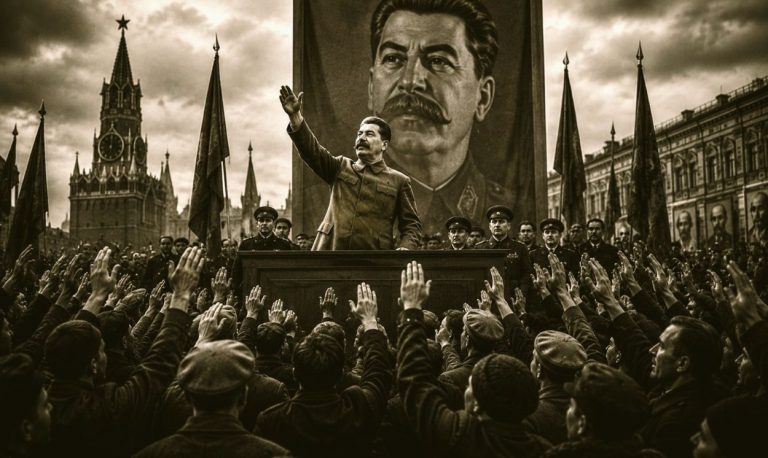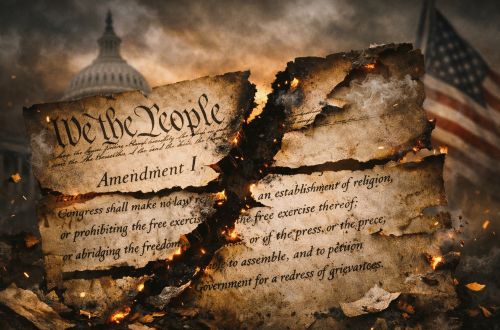
Dissent labeled disruptive, reframed as dangerous, institutionalized as a threat, enforced through executive power, and finally normalized as something deserving punishment.

By Matthew A. McIntosh
Public Historian
Brewminate
Introduction
The First Amendment is rarely dismantled head-on. In modern democracies, its erosion more often unfolds through repetition, reframing, and normalization. Speech is not outlawed outright; it is reclassified. Protest is not banned; it is delegitimized. Journalists are not silenced en masse; they are pressured, surveilled, and discredited. What disappears is not the text of constitutional protection, but its practical force.
In recent months, a pattern has emerged across political rhetoric, media coverage, and policy discussion surrounding President Donald Trump’s renewed presidency. Claims that protesters are “paid agitators,” the relabeling of dissent as criminal or extremist, threats to invoke extraordinary executive powers, and escalating hostility toward journalists together form more than isolated controversies. They represent a coherent trajectory in which the exercise of First Amendment rights is increasingly treated as suspicious, conditional, or dangerous.
This brings together reporting, analysis, and commentary from across the media landscape to trace that trajectory. Each piece stands on its own. They reveal how language hardens into institutional posture, how posture gives way to enforcement, and how enforcement becomes culturally acceptable. The danger is not hypothetical. It lies in the gradual transformation of dissent from a protected civic act into a perceived threat to order.
What follows is not an argument built on speculation, but a documented pattern drawn from the public record. The question is not whether the First Amendment still exists in law. It is whether it is being permitted to function in practice.
Framing Protestors as Frauds or Agents
“Trump Repeats Baseless Claim That Renee Good Was Part of ‘Leftwing Network’ of Paid Agitators
Trump endorsed a claim that Renee Nicole Good — a woman killed by an ICE agent — was part of a “leftwing network” of paid agitators, insisting that only a paid troublemaker would scream at federal agents, despite video contradicting that assertion. – The Guardian
In this article, Trump’s repetition of an unfounded allegation, that those expressing anguish at a federal officer’s killing of a civilian must be paid agitators, exemplifies a broader effort to delegitimize protest and dissent. By framing outcry against government actions as orchestrated and financially motivated, the rhetoric undercuts the sincerity and constitutional protections of protest, implicitly suggesting that genuine dissent is suspect unless state-sanctioned or approved.
“Online Posts Make Baseless Claim Linking Protesters to Craigslist Ad”
Some social media posts cited a Craigslist ad to falsely claim it showed people protesting immigration raids in Los Angeles were being paid to participate, but the advertisement was actually a prank unrelated to the protests. – FactCheck.org
This fact-check shows how the paid protesters narrative circulates regardless of evidence, reinforcing a political environment in which grassroots engagement is portrayed as artificial or manipulated. Such framing not only spreads misinformation but also weakens the perceived legitimacy of public demonstration, a core aspect of First Amendment expression, by recasting organic civic participation as a paid spectacle.
Language and Labeling: How Dissent Gets Reframed
Overview
If the allegation of “paid protesters” supplies the myth, language supplies the mechanism. Once dissent is rhetorically reframed as agitation, disruption, or criminality, the First Amendment does not need to be repealed. It only needs to be reinterpreted. This section shows how political language works quietly but decisively to strip protest of its legitimacy.
“Word of the Week: Who Gets Called an ‘Agitator’”?
The term “agitator” has long been used in American political discourse to describe people who challenge authority, but its meaning has shifted over time, often deployed selectively to delegitimize protest movements rather than describe actual incitement or violence. News8Now
This piece highlights how seemingly neutral language carries ideological weight. By branding protesters as “agitators,” political actors subtly imply illegitimacy, danger, and outside manipulation. The label transforms dissent from a protected civic act into a social nuisance or threat, laying rhetorical groundwork for restrictions on speech and assembly without openly attacking constitutional rights.
“Trump, DC Crime, and the Revival of the “Paid Protest” Narrative”
President Donald Trump has revived claims that demonstrators opposing his policies are paid participants, tying protest activity to crime and disorder in Washington, D.C., despite a lack of evidence supporting those assertions. – The Hill
By linking protest to criminality, this rhetoric collapses the distinction between lawful dissent and public disorder. The framing invites audiences to see protest not as democratic participation but as a public safety problem. In doing so, it reframes the exercise of First Amendment rights as something inherently suspect, justifying surveillance, restriction, or suppression in the name of order.
Institutional Framing: When Dissent Becomes a “Threat”
Overview
Once dissent has been rhetorically reframed as illegitimate, the next step is institutional adoption. What begins as partisan language becomes embedded in policy discussions, security frameworks, and official narratives. At this stage, protest is no longer merely disapproved of. It is treated as a potential danger to the state itself.
Labeling Dissent as Terrorism: New U.S. Domestic Terrorism Priorities Raise Constitutional Alarms
New domestic terrorism frameworks in the United States risk sweeping constitutionally protected political activity into security classifications, raising serious concerns among legal scholars about the erosion of First Amendment protections. – The Conversation
This analysis demonstrates how the boundary between protest and extremism becomes dangerously blurred when dissent is filtered through counterterrorism logic. By expanding the conceptual scope of “domestic terrorism,” the state gains latitude to monitor, deter, or penalize ideological opposition. The First Amendment remains intact in theory, but in practice, political expression becomes vulnerable to national security justifications.
“GOP Rhetoric and the ‘No Kings’ Protests”
Republican leaders have increasingly portrayed large-scale protest movements as destabilizing and dangerous, framing opposition demonstrations as threats to order rather than expressions of democratic engagement. – CNN
This article illustrates how protest movements challenging executive authority are recast as destabilizing forces rather than civic actors. The institutional embrace of this framing shifts protest from a protected democratic function into a perceived governance problem. In doing so, it normalizes state suspicion toward dissent and prepares the public to accept limits on speech and assembly in the name of stability.
Constitutional Danger Zone: State Power, Enforcement, and the Insurrection Act
Overview
At this point, the threat to the First Amendment is no longer rhetorical or symbolic. When executive power openly signals a willingness to deploy force against protest, constitutional rights are not merely chilled. They are placed on conditional status. This section shows how speech and assembly become contingent on executive tolerance rather than protected by law.
“Trump Threats Raise Alarm Over Possible Use of the Insurrection Act”
Trump has renewed threats to invoke the Insurrection Act in response to protests, prompting concern among legal scholars and civil liberties advocates who warn that such a move could override state authority and suppress constitutionally protected demonstrations. – NPR
This reporting underscores the most direct mechanism through which First Amendment rights can be overridden in practice. The Insurrection Act grants the executive sweeping authority to deploy federal force domestically. When protest itself is framed as insurrectionary, the legal distinction between lawful assembly and rebellion collapses. The result is a constitutional environment in which speech and protest exist only so long as they are deemed non-threatening by the executive branch.
“Trump’s Domestic Terrorism Memo Chillingly Targets People Based on Ideology”
A domestic terrorism memorandum issued under the Trump administration raises serious First Amendment concerns by targeting individuals and groups based on ideological beliefs rather than criminal conduct, according to civil liberties advocates. – FIRE
This analysis reveals how enforcement mechanisms increasingly focus not on actions but on beliefs. When ideology itself becomes a marker of suspicion, the First Amendment’s protection of viewpoint diversity is effectively inverted. Rather than shielding dissent from state retaliation, constitutional law becomes secondary to executive determinations of acceptable ideology.
Press Freedom, Surveillance, and the Architecture of Autocracy
Overview
Historically, the suppression of dissent rarely stops with protesters. Once speech in the streets is framed as dangerous, scrutiny turns to those who document, amplify, or legitimize it. A free press becomes not a constitutional safeguard but an obstacle. This is the point at which democratic erosion shifts from episodic to systemic.
“Searching Reporters’ Homes, Suing Journalists, and Repressing Citizen Dissent Are Well-Known Steps Toward Autocracy”
Governments that search journalists’ homes, pursue legal action against reporters, and repress citizen dissent follow a familiar authoritarian pattern that has appeared repeatedly across history, according to scholars of democratic backsliding. – The Conversation
This article situates contemporary threats to press freedom within a well-documented historical sequence. When governments begin treating journalists as adversaries rather than constitutional partners, transparency collapses. Surveillance, intimidation, and legal harassment serve not only to silence reporters but to isolate dissent itself. Without a free press to legitimize protest and expose state overreach, First Amendment rights erode in tandem, leaving citizens visible to the state while the state becomes increasingly opaque to its citizens.
Cultural Normalization and the Final Warning
Overview
Authoritarian pressure does not rely solely on law or enforcement. It succeeds when repression becomes culturally legible, socially acceptable, and morally inverted. At this stage, censorship is reframed as accountability, punishment is recast as order, and dissent is portrayed not as democratic participation but as deviance. This final section addresses that normalization directly.
“The Trump Administration’s Dangerous Embrace of Cancel Culture”
Despite public denunciations of “cancel culture,” the Trump administration has repeatedly used governmental power to punish critics, pressure institutions, and discourage speech it finds objectionable. – Center for American Progress
This analysis exposes the rhetorical inversion at the heart of the current moment. While framing itself as a defender of free speech, the administration deploys state power to penalize dissenting voices. The result is not a neutral marketplace of ideas, but a politicized environment in which speech aligned with power is protected and speech challenging power is sanctioned. The First Amendment becomes selective in practice, even as it is celebrated rhetorically.
“Musk Suggests Imprisoning Teachers as Cultural Enforcement Escalates”
Public remarks suggesting the imprisonment of teachers reflect a growing cultural appetite for punitive responses to ideological disagreement, particularly within education and civic institutions. – Common Dreams
Though not an act of state policy, this episode illustrates how authoritarian instincts migrate into cultural discourse. When influential figures normalize punishment for ideological divergence, they help prepare the public to accept similar measures from the state. Cultural permission precedes political enforcement. What begins as rhetoric hardens into expectation.
Conclusion
These articles trace a coherent and troubling trajectory. Dissent is first dismissed as fake. It is then labeled disruptive, reframed as dangerous, institutionalized as a threat, enforced through executive power, and finally normalized as something deserving punishment. At no point is the First Amendment formally repealed. Instead, it is slowly hollowed, narrowed, and made conditional.
The danger lies not in any single statement or policy, but in the pattern itself. Democracies do not collapse when speech is banned outright. They erode when speech survives only by permission.
Originally published by Brewminate, 01.16.2026, under the terms of a Creative Commons Attribution-NonCommercial-NoDerivatives 4.0 International license.
About the Author