Kean’s acting style reframed the relation between the British theatrical tradition, the actor’s stage performance, and audience reception.

By Dr. Jonathan D. Mulrooney
Professor of English
College of the Holy Cross
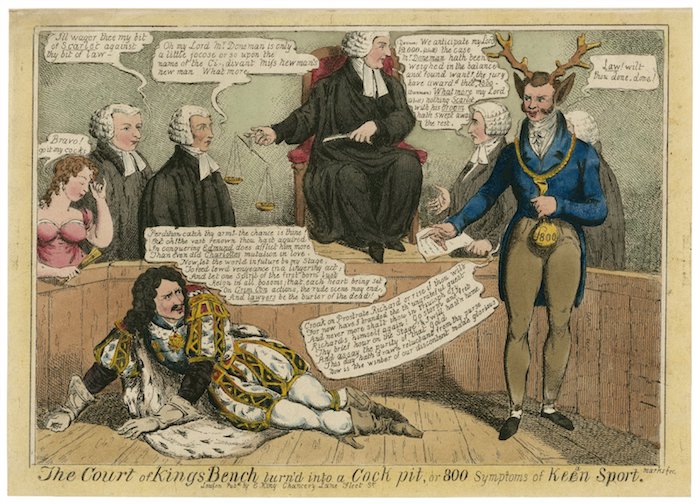
In a conventional sense, Edmund Kean’s London debut at Drury Lane theater on 26 January 1814 matters because it marked the arrival to the metropole of the man who would become the early nineteenth century’s most important actor. In another, more fundamental sense, Kean’s arrival heralds a change in the notion of the British theatrical event as both historical occurrence and locus of public narrative. From the first reviews of his performance of Shylock that January, through his controversial divorce and trial for Criminal Conversation with the wife of City Alderman John Cox in 1825 (see fig. 1), to his death in 1833, Kean was a celebrity whose coverage in the British press surpassed that of any actor before him. While David Garrick had presided over London theater during the middle and late years of the previous century, and Kean’s older contemporaries John Philip Kemble and Sarah Siddons were figures of no small renown, Kean was rivaled in his era only by Lord Byron for the ceaseless attention and commentary his public and private personae generated. Often making little distinction between his presence on the stage and his “private” actions off it, press accounts of Kean took his performances as occasions to consider the actor’s relation to the nation’s theatrical tradition, to its literary history, and to its shifting class relations.
In part, Kean’s prominence was the result of a burgeoning periodical culture in Regency London. Venues for the publication of reviews and other kinds of theatrical writing had increased in number rapidly in the two decades leading up to Kean’s arrival, with a proliferation of newspapers, magazines, and journals appearing both in the city and around the country. The late eighteenth century had seen the founding and rapid growth of such daily newspapers as the Times and the Morning Chronicle, in which theatrical reviews were frequently published. By 1809, when the newly built Covent Garden’s “Old Price” riots demonstrated a widespread distaste for theatrical management’s mercenary ticketing and seating policies, events inside the theater had become almost secondary to the print accounts of them that circulated throughout the city (On the Old Price Riots, see Terry F. Robinson, “National Theatre in Transition: The London Patent Theatre Fires of 1808-1809 and the Old Price Riots.”) Broadsides, pamphlets, and correspondent accounts in newspapers and daily theatrical periodicals provided for weeks an ongoing commentary about the actions of the rioters and of the management to whom they were opposed.[1] The circulation of such accounts in turn fostered broader conversations about the political and social functions of theater in London and throughout the provinces. Government regulation had, by the early nineteenth century, marked Drury Lane and Covent Garden as the theaters in London most identified with the British dramatic tradition because they were (with the seasonal exception of the Haymarket Theatre) the only holders of Royal patents granting the right to perform sanctioned, spoken drama. Other venues found myriad ways around these restrictions, generating a popular, even plebian, theatrical culture that included pantomimes, aquatic and equine dramas, circus-like performances, and musicals. Eventually, the patent theaters needed to respond to the growth of these alternative entertainments, and Kean was key to that response. Debuting fewer than five years after the “Old Price” controversy, Kean’s acting manifested many of the concerns the riots had brought to the fore: to whom did British theater belong? What was the moral and patriotic responsibility of actors and theater managers? What was the proper conduct of London theater audiences? Reviews repeatedly commented on Kean’s class, his importation of a pantomimic representational style onto London’s officially sanctioned stage, and his abrupt and rapid transitions from one emotion to another. William Hazlitt’s review of Kean as Coriolanus is exemplary in its attention to all of these qualities:
Mr. Kean’s acting is not of the patrician order; he is one of the people, and what might be termed a radical performer. …That is, he cannot play Coriolanus so well as he plays some other characters, or as we have seen it played often. Wherever there was a struggle of feelings, a momentary ebullition of pity, or remorse, or anguish, wherever nature resumed her wonted rights, Mr. Kean was equal to himself, and superior to every one else; but the prevailing characteristics of the part are inordinate self-opinion, and haughty elevation of soul. (Collected Works 13.402)
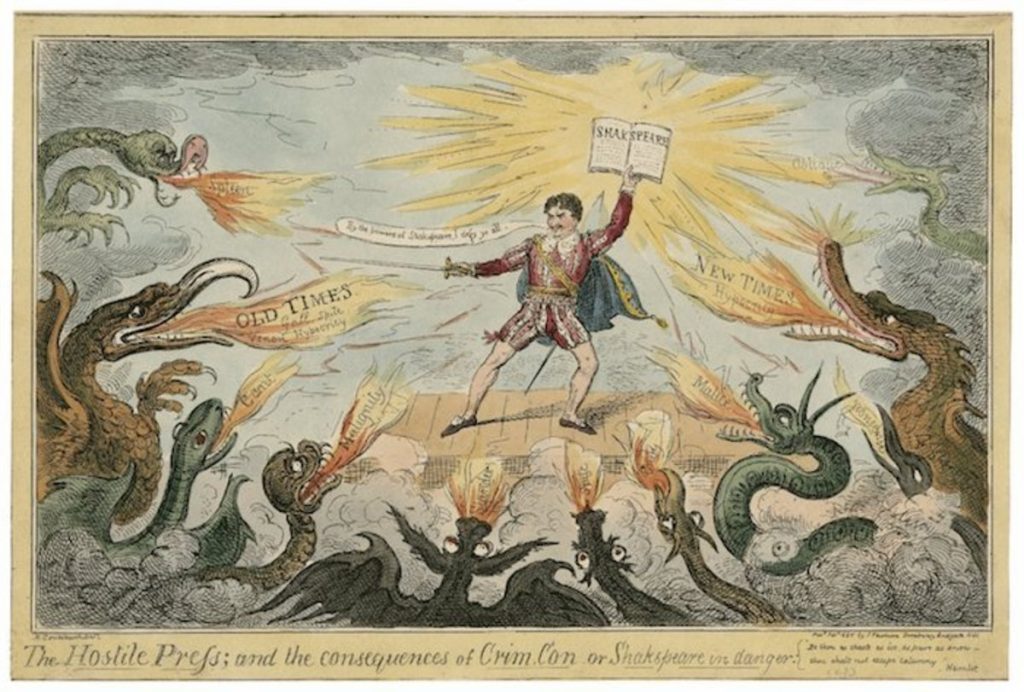
Hazlitt’s choice of Coriolanus as the figure that prompts his analysis is itself telling. In a Regency defined by war, class tensions, and the impositions of arbitrary power, Shakespeare’s play would have resonated with London theater audiences. The force of Kean’s acting, in Coriolanus as in Kean’s signature role Richard III, resided not only in an impersonation of a particular character but also in a conspicuously politicized alignment of well-known dramatic figures with the contemporary political scene (see fig. 2).

In Hazlitt’s rendering, Kean so clearly and passionately identifies with the lower orders of his audience—an urban, levelling, Cockney segment of London society—that he is incapable of representing to them “one who fancies himself a God.”[2] This inability shows itself most vividly in Kean’s physical pacing:
Mr. Kean, instead of ‘keeping his state,’ instead of remaining fixed and immovable (for the most part) on his pedestal of pride, seemed impatient of this mock-dignity, this still-life assumption of superiority; burst too often from the trammels of precedent, and the routine of etiquette, which should have confined him; and descended into the common area of man. …The intolerable airs and aristocratical pretensions of which [Coriolanus] is the slave, and to which he falls victim, did not seem legitimate in him, but upstart, turbulent, and vulgar. (Collected Works 13.402)
Hazlitt argues that movement itself—Kean’s inability to abide in a single state-of-being for any length of time—defines (and, in the case of Coriolanus, limits) his communication of the character’s patrician nature. Rather than a “still-life assumption of superiority,” Kean’s representation occurs in time, “burst[ing] too often from the trammels of precedent” into the “common area of man,” thereby making conspicuous the actions by which the actor crafts his impersonation.
Aligning Kean with the spectacular illegitimate productions of the day—those that took place in unsanctioned theaters and emphasized spectacle over the spoken word—this conspicuous madeness evokes an historical dimension to the actor’s presence rather than positing it as timeless, as Kemble’s senatorial orations had done. Like the pantomimic figures after whom he modeled his physical gestures, Kean sought to convey feeling through difference—a change in pace, arm movement, or intense facial expression—rather than through the presentation of a unified, even singular, emotional state.[3] If Kemble embodied on the legitimate stage a naturalized British tradition, Kean modeled a way of engaging the world that remained always conspicuously subject to historical contingency. Samuel Taylor Coleridge, with different political allegiances than Hazlitt, remarked a similar temporal intensity to Kean’s style: “Kean is original; but he copies from himself. His rapid descents from the hyper-tragic to the infra-colloquial, though sometimes productive of great effect, are often unreasonable. To see him act, is like reading Shakespeare by flashes of lightning. I do not think him thorough-bred gentleman enough to play Othello” (Table Talk 14.41).[4] For Coleridge, as for Hazlitt, there are lower class associations with Kean’s acting—a mixing of the “hyper-tragic” with the “infra-colloquial” conflates the high and the low—which again manifest themselves most pointedly in the actor’s physical and conceptual mobility (“rapid descents…”) and which, to Coleridge’s worry, beget in the viewer effects that are charged with unreason.
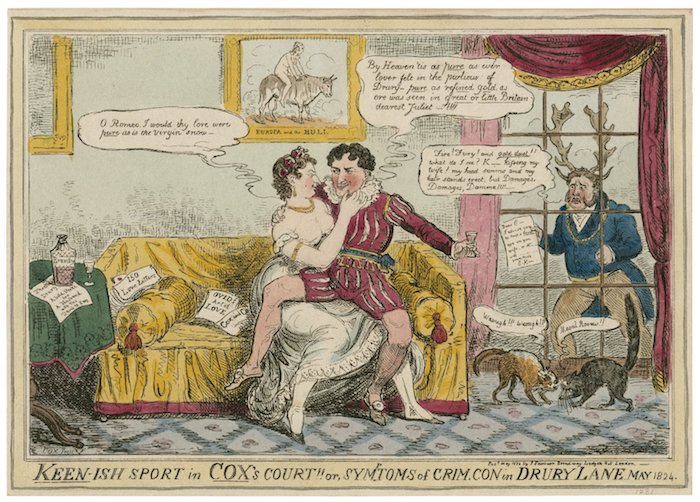
The properties to which Hazlitt’s and Coleridge’s commentaries attend mirror the way the press at large presented Kean: he was a subject who moved and shifted in time, whose defining trait was change, and who defied the cultural logics of actorly stasis that conventionally signaled upper-class universality. Such eventful mobility enacts a revisionary relationship to the playtext by performing an active cultural appropriation that privileges the present moment—call it the event of performance—over the idealized and abstracted cultural ideal of the Shakespearean text. John Keats attended to this temporalization in his own review of Kean, written for the Champion in 1817: “Other actors are continually thinking of their sum-total effect throughout a play. Kean delivers himself up to the instant feeling, without a shadow of a thought about any thing else” (231). Though valorized by Keats, such instantaneity was ideologically suspect for many of Kean’s critics because it was seen to privilege the present moment over an historically grounded tradition and to grant authority to the actor’s idiosyncratic style over inherited grammars of representation. Later in Kean’s career, when he was charged in a case of criminal conversation with Charlotte Cox, a cascade of published caricatures evinced the end point of such criticism, often showing Kean deploying Shakespearean quotation in the interest of seducing his paramour (see fig. 3). Textual accounts of the trial, complete with transcripts of testimony and the republication of alleged love letters between Kean and Charlotte—again quoting Shakespeare as a means of seduction—appeared in the Times and other periodicals.[5] In such accounts Kean’s acting style—its mobility, changefulness, emotional uncertainty—was translated into an inevitable degradation not only of British theatrical culture but of British virtue. Kean’s radical presentism was tantamount to moral depravity.
Kean’s debut on 26 January 1814 inaugurated a shift, born of Britain’s rapidly expanding theater scene and its attendant print culture, in how theater was described by reviewers and consumed by readers. More than a change in assessments of an actor’s prowess or theatrical production, this shift blurred the lines between the event of performance and its dissemination in print to a mass reading public, rendering a celebrity like Kean both the representative and the purveyor of new modes of cultural experience. What mattered was no longer simply how the actor conveyed the meaning of a sacralized national script, but how his presence on stage—seen and heard by the crowds in the house, and consumed as text by their reading counterparts in the larger metropole—displayed the changing nature of British public experience. The moment Kean stepped onto the Drury Lane stage as leading man in 1814, he demonstrated beyond doubt that theater had become news.
Appendix
Notes
- Both Baer and Hadley provide thorough accounts of the Old Price riots and of the public response to riots.
- Jeffrey Cox most prominently has described the emergence of a “Cockney school of poetry” aligned with figures such as Leigh Hunt, Percy Shelley, and John Keats. For a detailed discussion of Kean’s connections to this circle, see Kandl, Mulrooney.
- The definitive account of “illegitimate” theatrical culture in Romantic-period London is Jane Moody’s. Moody argues that, more than any other actor’s style, Kean’s importation of illegitimate modes of representation onto the legitimate stage helped make him a “metropolitan sensation” (229).
- For a discussion of the derisive quality of the comment, and its possible connection to Kean’s consumption of alcohol, see Tracy Davis “‘Reading Shakespeare by flashes of Lightning:’ Challenging the Foundations of Romantic Acting Theory.”
- Jacky Bratton provides a cogent analysis of Thomas Barnes’s attacks on Kean in the Times.
Works Cited
- Baer, Marc. Affiliate disclosure: Amazon links on this site are paid links. As an Amazon Associate I earn from qualifying purchases.Theatre and Disorder in Late Georgian London. Oxford: Clarendon Press, 1992. Print.
- Bratton, Jacky. “The Celebrity of Edmund Kean: An Institutional Story.” Theatre and Celebrity in Britain, 1660–2000. Eds. Mary Luckhurst and Jane Moody. New York: Palgrave, 2006. 90-106. Print.
- Coleridge, Samuel Taylor. Table Talk. Ed. Carl Woodring. The Collected Works of Samuel Taylor Coleridge. Vol. 14, Part 2. Princeton: Princeton UP, 1990. Print.
- Cox, Jeffrey N. Poetry and Politics in the Cockney School: Keats, Shelley, Hunt and their Circle. Cambridge: Cambridge UP, 1998. Print.
- Davis, Tracy C. “‘Reading Shakespeare by Flashes of Lightning’: Challenging the Foundations of Romantic Acting Theory.” ELH 62.4 (1995): 933–54. Print
- Hadley, Elaine. Melodramatic Tactics: Theatricalized Dissent in the English Marketplace, 1800–1885. Stanford: Stanford UP, 1995. Print.
- Hazlitt, William. The Complete Works of William Hazlitt. 21 vols. Ed. P.P. Howe after the edition of A.R. Waller and Arnold Glover. New York: AMS Press, 1967. Print.
- Kandl, John. “Plebeian Gusto, Negative Capability, and the Low Company of ‘Mr. Kean’: Keats’ Dramatic Review for the Champion (21 December 1817).” Nineteenth-Century Prose 28.2 (2001): 130–41. Print.
- Keats, John. The Poetical Works and Other Writings of John Keats. The Hampstead Edition. Ed. H. Buxton Forman. Revised Maurice Buxton Forman. Vol. 5. New York: Charles Scribner’s Sons, 1939. Print.
- Moody, Jane. Illegitimate Theatre in London, 1770–1840. Cambridge: Cambridge UP, 2000. Print.
- Mulrooney, Jonathan. “Keats in the Company of Kean.” Studies in Romanticism 42.2 (2003): 227–50. Print.
Originally published by BRANCH Collective (September 2017) under the terms of a Creative Commons Attribution 3.0 Unported license.
About the Author