Tracing the fallacy of 911 call analysis through the justice system, from Quantico to the courtroom.

By Brett Murphy
Reporter
ProPublica
I
Tracy Harpster, a deputy police chief from suburban Dayton, Ohio, was hunting for praise. He had a business to promote: a miracle method to determine when 911 callers are actually guilty of the crimes they are reporting. “I know what a guilty father, mother or boyfriend sounds like,” he once said.
Fact-based, independent journalism is needed now more than ever.
Harpster tells police and prosecutors around the country that they can do the same. Such linguistic detection is possible, he claims, if you know how to analyze callers’ speech patterns — their tone of voice, their pauses, their word choice, even their grammar. Stripped of its context, a misplaced word as innocuous as “hi” or “please” or “somebody” can reveal a murderer on the phone.
So far, researchers who have tried to corroborate Harpster’s claims have failed. The experts most familiar with his work warn that it shouldn’t be used to lock people up.
Prosecutors know it’s junk science too. But that hasn’t stopped some from promoting his methods and even deploying 911 call analysis in court to win convictions.
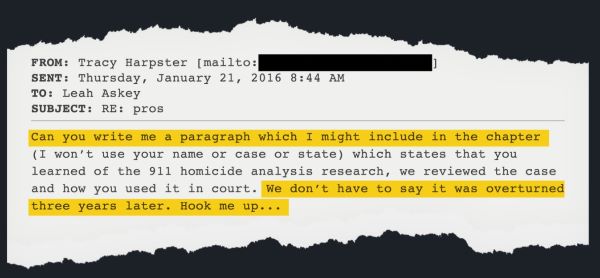
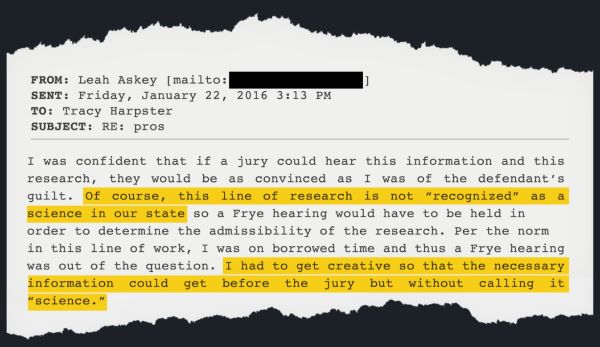
In 2016, Missouri prosecutor Leah Askey wrote Harpster an effusive email, bluntly detailing how she skirted legal rules to exploit his methods against unwitting defendants.
“Of course this line of research is not ‘recognized’ as a science in our state,” Askey wrote, explaining that she had sidestepped hearings that would have been required to assess the method’s legitimacy. She said she disguised 911 call analysis in court by “getting creative … without calling it ‘science.’”
“I was confident that if a jury could hear this information and this research,” she added, “they would be as convinced as I was of the defendant’s guilt.”
What Askey didn’t say in her endorsement was this: She had once tried using Harpster’s methods against Russ Faria, a man wrongfully convicted of killing his wife. At trial, Askey played a recording of Faria’s frantic 911 call for the jury and put a dispatch supervisor on the stand to testify that it sounded staged. Lawyers objected but the judge let the testimony in. Faria was convicted and sentenced to life in prison.
After he successfully appealed, Askey prosecuted him again — and again called the supervisor to testify about all the reasons she thought Faria was guilty based on his word choice and demeanor during the 911 call. It was Harpster’s “analytical class,” the supervisor said, that taught her “to evaluate a call to see what the outcome would be.”
This judge wouldn’t allow her to continue and cut the testimony short. Faria was acquitted. He’d spent three and a half years in prison for a murder he didn’t commit.
None of this bothered Harpster, who needed fresh kudos to repackage as marketing material and for a chapter in an upcoming book. “We don’t have to say it was overturned,” he told Askey when soliciting the endorsement. “Hook me up. … Make it sing!”
Junk science in the justice system is nothing new. But unvarnished correspondence about how prosecutors wield it is hard to come by. It can be next to impossible to see how law enforcement — in league with paid, self-styled “experts” — spreads new, often unproven methods. The system is at its most opaque when prosecutors know evidence is unfit for court but choose to game the rules, hoping judges and juries will believe it and vote to convict.
People like Faria, defense lawyers and sometimes even the judges are blindsided. “I don’t want what happened to me to happen to anyone else,” Faria told me.
Askey, who now goes by Leah Chaney and is no longer a prosecutor, did not answer questions about the case other than to say she didn’t know about Harpster’s work until after Faria’s first trial. She has denied allegations of misconduct in other media interviews.
I first stumbled on 911 call analysis while reporting on a police department in northern Louisiana. At the time, it didn’t sound plausible even as a one-off gambit, let alone something pervasive that law enforcement nationwide had embraced as legitimate.
I was wrong. People who call 911 don’t know it, but detectives and prosecutors are listening in, ready to assign guilt based on the words they hear. For the past decade, Harpster has traveled the country quietly sowing his methods into the justice system case by case, city by city, charging up to $3,500 for his eight-hour class, which is typically paid for with tax dollars. Hundreds in law enforcement have bought into the obscure program and I had a rare opportunity to track, in real time, how the chief architect was selling it.
Harpster makes some astonishing claims in his promotional flyers. He says he has personally consulted in more than 1,500 homicide investigations nationwide. He promises that his training will let 911 operators know if they are talking to a murderer, give detectives a new way to identify suspects, and arm prosecutors with evidence they can exploit at trial.
The program has little online presence. Searches for 911 call analysis in national court dockets come up virtually empty too. A public defender in Virginia said, “I have never heard of any of that claptrap in my jurisdiction.” Dozens of other defense attorneys had similar reactions. One thought the premise sounded as arbitrary as medieval trials by fire, when those suspected of crimes were judged by how well they could walk over burning coals or hold hot irons.
Could it be true that Harpster, a man with no scientific background and next to no previous homicide investigation experience, had successfully sold the modern equivalent to law enforcement across the U.S. almost without notice?
First, I put together a list of agencies that had recently hosted him. In the months that followed, I sent more than 80 open records requests and interviewed some 120 people. Thousands of emails, police reports and other documents led to a web of thousands more in new states. When agencies refused to turn over public records, ProPublica’s lawyers threatened litigation and in one case sued.
I followed the paper trail Harpster left as he traveled the country, working law enforcement’s back channels. A story unfolded about a credulous, at times reckless, justice system functioning as an open market for junk science. Those responsible for ensuring honest police work and fair trials — from training boards to the judiciary — have instead helped 911 call analysis metastasize. It became clear that almost no one had bothered to ask even basic questions about the program.
Outside of law enforcement circles, Harpster is elusive. He tries to keep his methods secret and doesn’t let outsiders sit in on his classes or look at his data. “The more civilians who know about it,” he told me once, “the more who will try to get away with murder.”
In reality, people have been wrongfully accused and convicted of murder after someone misinterpreted their call for help, while those who used 911 call analysis against them face little or no consequences. I documented more than 100 cases in 26 states where Harpster’s methods played a pivotal role in arrests, prosecutions and convictions — likely a fraction of the actual figure.
All of it began in an unexpected place.
II
In the winter of 2004, Harpster walked into the FBI Academy in Quantico, Virginia. He was one of dozens of local police officers from around the country who’d been invited to attend a 10-week training course called the National Academy. He listened to a lecture there given by an agent named Susan Adams, who the bureau had hired in the ’80s to teach interview and statement-analysis techniques.
Harpster was rapt. Then 43, he had spent most of his career with the Moraine, Ohio, police department. Moraine, population 6,500, is an unlikely crucible for a newfangled homicide investigative method, and Harpster is an unlikely figure to be the one who forged it. The city averages less than one murder a year.
Harpster had scant involvement in homicide investigations, according to his personnel file. The file shows a decorated career with commendations for good deeds like volunteering with underprivileged kids and organizing a Christmas food and gift drive for a family in need. He was once officer of the year, and he never took a single sick day.
After he left the FBI Academy that winter, Harpster enrolled at the University of Cincinnati to pursue a graduate degree in criminal justice. For his master’s thesis, he collected 100 recordings of 911 calls — half of the callers had been found guilty of something and the other half hadn’t. Harpster believed he could analyze these calls for clues. In his thesis’ acknowledgments, he said he wouldn’t have started the project without Adams, “the best teacher I’ve ever had.”
Based on patterns he heard in the tapes, Harpster said he was able to identify certain indicators that correlated with guilt and others with innocence. For instance, “Huh?” in response to a dispatcher’s question is an indicator of guilt in Harpster’s system. So is an isolated “please.” He identified 20 such indicators and then counted how often they appeared in his sample of guilty calls.
Using that same sample of recordings, Harpster, Adams and an FBI behavioral scientist named John Jarvis set out to publish a study in 2008. But even before their work was published in a peer-reviewed journal as an “exploratory analysis” — a common qualifier meant to invite more research — police departments around the country learned about it.
That’s because the FBI sent a version of the study directly to them in a bulletin, which was not labeled exploratory. It included contact information for Harpster and Adams. The publication, which the bureau says typically has a readership of 200,000 but is not supposed to be an endorsement, had immediate impact. “It was required reading by our detective and communications personnel,” a police chief in Illinois told Harpster.
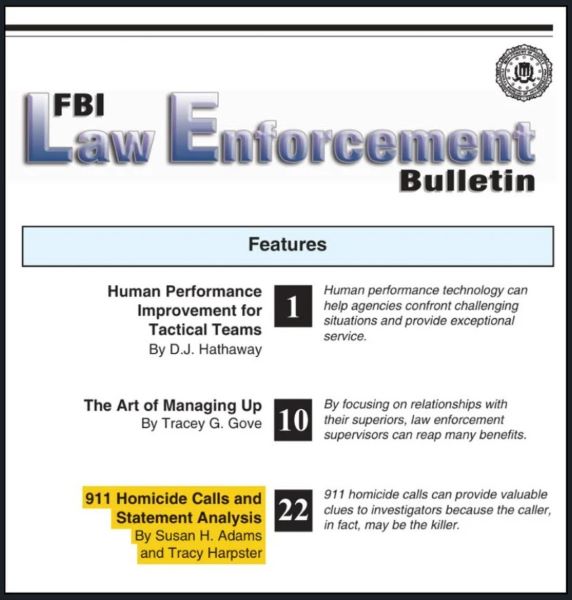
A sheriff’s sergeant in Colorado also read the FBI bulletin and, weeks later, asked Adams to analyze a 911 tape from a widow suspected of killing her husband. She and Harpster wrote a report of their findings.
The widow said the word “blood,” for example, and that’s a guilty indicator. (“Bleeding,” however, is not.) She said “somebody” at different points, which shows a lack of commitment. “Witnesses to a crime scene should be able to report their observations clearly,” Harpster and Adams wrote. She was inappropriately polite because she said “I’m sorry” and “thank you.” She interrupted herself, which “wastes valuable time and may add confusion.” She tried to divert attention by saying, “God, who would do this?” Harpster and Adams commented: “This is a curious and unexpected question.”
Their report became part of the police record — along with a significant amount of other evidence — and the prosecutor, Rich Tuttle, echoed their findings during trial. The widow was convicted of murder. Tuttle recently told me that he “did not directly use” 911 call analysis during trial because no witnesses testified about it.
But Tuttle once emailed Harpster about the impact his methods had. “We found your evaluation of the 911 call in this matter to be extremely insightful and helpful to our investigation and prosecution of the case,” Tuttle wrote.
The seeds were planted.
III
For more than 12 years, the nation’s premier law enforcement agency helped 911 call analysis grow unabated. FBI officials at a charity fundraiser have even auctioned a copy of the book Harpster and Adams wrote about it. Harpster says he has presented his material at the FBI National Academy. He frequently trades on the FBI name, and others cite the affiliation when spreading word about 911 call analysis.
Then, in a 2020 study, experts from the bureau’s Behavioral Analysis Unit finally tried to see whether the methods had any actual merit. They tested Harpster’s guilty indicators against a sample of emergency calls, mostly from military bases, to try to replicate what they called “groundbreaking 911 call analysis research.”
Instead, they ended up warning against using that research to bring actual cases. The indicators were so inconsistent, the experts said, that some went “in the opposite direction of what was previously found.”
This fall, a separate group of FBI experts in the same unit tested Harpster’s model, this time in missing child cases. Again, their findings contradicted his, so much so that they said applying 911 call analysis in real life “may exacerbate bias.”
Academic researchers at Villanova and James Madison universities have come to similar conclusions. Every study, five in total, clashed with Harpster’s. The verdict: There was no scientific evidence that 911 call analysis worked.
The FBI, which declined to comment for this article, published some of the dissent in another law enforcement bulletin. But the reversal has gone largely unnoticed. John Bailey, a police sergeant in Pennsylvania, was among the first to tap Harpster and Adams for help after learning about their technique from the FBI. He believed in it so much that he planned to have Harpster testify in front of a grand jury. (That didn’t ultimately happen.)
I recently called Bailey, now a judge, to ask if he knew about the FBI’s more recent studies undercutting the work it had once promoted. He did not. “This is how it originated — at the FBI Academy,” he said. “You telling me that makes me scratch my head.”
Jarvis, one of the original co-authors from the FBI, told me he hasn’t spoken to Harpster since they published their study. He said he advised Harpster and Adams at the time that more research needed to back up what they’d found.
Jarvis said he was uncomfortable with the method’s use in real cases. He was even more surprised that prosecutors have bought in. “I don’t see where that work rises to the level of success by the scientific community,” he said. “There’s no definitive answer as to whether this is useful.”
Adams left the bureau and is now a private communications consultant. She recently wrote me an email defending Harpster and their work together. As proof of Harpster’s qualifications, Adams cited all the times he has been invited to speak about the program and claimed they’ve analyzed hundreds of 911 tapes.
No single indicator can be used to determine the likelihood of innocence or guilt, Adams said. “Instead, our study examined indicators in combination, just as 911 call analysis should be used in combination with case facts to uncover the truth.”
But the more records I saw, the less true that seemed.
IV
It was easy to miss, a decades-old mystery solved by local police that made national headlines for a day before vanishing to the recesses of the internet. It’s the type of story that goes on to inspire “true crime” shows, always with a neat, satisfying ending. And the FBI was right in the middle of it.
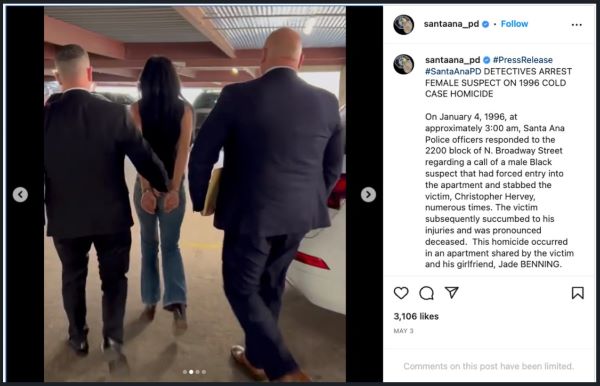
This spring, U.S. marshals followed Jade Benning, a 48-year-old mother of three with jet-black hair, as she picked up her youngest son from school in Austin, Texas. Benning sold vintage clothing in town, drove a red 1969 Camaro and owned a menagerie of rescue pets. After she left the school’s parking lot, the marshals pulled her over and told her she was under arrest for a murder that happened 26 years ago.
In the small hours of Jan. 4, 1996, Benning twice called 911 and said a burglar broke into her Santa Ana, California, apartment, stabbed her boyfriend to death and slashed her hand before running off into the night. A neighbor reported that they had seen someone fleeing the area around that time. But officers didn’t find a murder weapon and the case went cold. Years went by. Benning moved states and started a family.
After Benning’s arrest this spring, the Santa Ana Police Department posted an Instagram video of officers in suits walking a handcuffed Benning through a parking garage. The post included a vague statement: A cold case detective named Michael Gibbons had solved the murder. After receiving an anonymous letter, he “conducted extensive follow-up” and consulted forensic experts, the department said.
Benning, who has pleaded not guilty, sent her kids to live with their grandmother part time while headlines circulated about their mother’s arrest.
The police department and district attorney’s office haven’t explained who those experts are or what evidence Gibbons had discovered. Gibbons and the agencies did not respond to interview requests and the agencies refused to release records I asked for.
But Gibbons told someone. Days after the arrest, he sent an email to Harpster, thanking him for analyzing Benning’s 911 calls. “It significantly helped our district attorney to realize the indicators of guilt in the phone calls,” Gibbons wrote, “as well as suggestions on how to introduce the 911 calls to the jury during trial.” He alluded to other forensic experts but said Harpster’s consultation was “instrumental in swaying the prosecutor to file charges.”
Gibbons said he didn’t just find out about Harpster by chance: The FBI’s Behavioral Analysis Unit recommended him. Gibbons’ email came two years after the bureau’s own experts in that same division first publicly warned law enforcement not to use 911 call analysis in actual cases.
V
Junk science can catch fire in the legal system once so-called experts are allowed to take the stand in a single trial. Prosecutors and judges in future cases cite the previous appearance as precedent. But 911 call analysis was vexing because it didn’t look like Harpster had ever actually testified.
In 2009, Harpster learned about a double homicide in Woodbury County, Iowa, from a television documentary. He offered his services to the lead detective, saying he knew the defendant was guilty “solely upon his analysis of the defendant’s 911 call,” an assistant prosecutor for the county, Jill Esteves, noted later in an email.
Esteves’ office bought it. Prosecutors there tapped Harpster to consult and testify as an expert on a different case soon after, emails show. Harpster said he had a better idea. In surprisingly blunt language, Esteves spelled out her interpretation.
“He knows there will be a great legal hurdle getting the research admitted,” she wrote in an email to a colleague in another county, who also wanted Harpster to testify. “He doesn’t want a legal precedent prohibiting the admission of his research.” Earlier in 2009, a judge in Alabama had blocked Harpster from taking the stand because there were no other studies supporting his work.
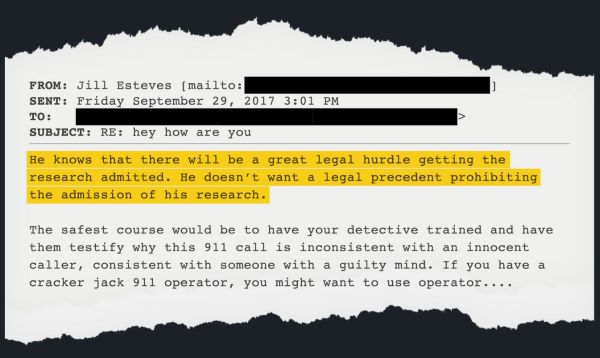
So instead of testifying himself, Harpster began to teach others how to analyze 911 calls. His pupils are prosecutors, detectives, coroners and dispatchers. They are now the ambassadors who could present his work in court while Harpster himself is insulated from scrutiny. “No cross examination when you lecture,” Esteves quipped.
When I asked Esteves about this, she didn’t respond. But a colleague in her office, Mark Campbell, defended 911 call analysis. “Tracy Harpster’s work in analyzing 911 calls is new,” he wrote in an email, “but the need for attorneys, judges and juries to evaluate what witnesses say to determine their credibility is as old as the trial court system.” Campbell said he didn’t know of other studies in the field but that wasn’t relevant because much of 911 call analysis is similar to exercising common sense, “no different than what attorneys and judges have been pointing out since witnesses have been used.”
As Adams faded into the background, Harpster took their work on tour, from Florida to Alaska, to university lecture halls and international homicide conferences, city police academies and statewide coroners’ seminars. The extended curriculum is a two-day, 16-hour course that includes basic and advanced training.
Harpster has a motto he likes to say during his lectures: Police have but one master, the truth. A detective from Wisconsin told him that he’d hung the slogan up on his office wall.
In class, there’s a projector screen with the course title: “Is the caller the killer?” The bold, red font looks like dripping blood. He walks attendees through the indicators of guilt on a checklist that he and Adams invented called the COPS Scale, for Considering Offender Probability in Statements. It’s a one-page worksheet that they copyrighted. “COPS Scale don’t lie,” Harpster has told students, “boys do.”
Then the students listen to real 911 tapes, marking indicators on the sheet as they go. He displays two options on the screen, also in bold, red font: “guilty” or “innocent.”
VI
Figuring out what his students went on to do with the training took some reverse engineering. There’s no list of 911 call analysis appearances and no way to easily search local court records. Police departments don’t track it either.
But Harpster does. Former students send him endorsements describing how they’ve used 911 call analysis in real cases. Then he repurposes those as marketing material when emailing law enforcement in other cities and states. It’s a feedback loop.
In emails, Harpster pitches both the curriculum and himself. “This training is unique and nobody else is doing it,” he told a local police training board in Illinois, “because I’m the only one who has done the research.”
He claims that 1 in 3 people who call 911 to report a death are actually murderers. No law enforcement officials in the records I’ve seen have questioned this figure, and many departments repeat it when promoting the training internally. In his thesis, Harpster originally said this number was 1 in 5 and attributed the figure to an unpublished study by a now-dead detective and professor in Washington state. I found nothing to support either statistic.
Harpster makes himself available day and night to take phone calls from police and prosecutors looking to validate a hunch or strategize for trial. He once hosted a former student from Florida at his lakeside vacation house in Michigan, where he claimed on his Facebook page that they “solved a murder.” Last year, a detective called him for input while standing over someone’s body at a crime scene.
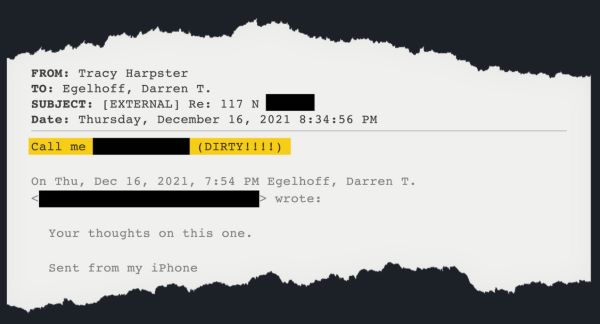
Police often email him 911 tapes for consultations — men and women wailing on the phone as they plead with the dispatcher to save a loved one. Sometimes it’s a parent holding a dead child. In one case, Harpster listened to an Ohio mother’s desperate call for help and then wrote back, simply, “Call me. … DIRTY!!!!” The mother was not charged.
His methods have now surfaced in at least 26 states, where many students embrace him like an oracle. They write in emails and course evaluations that his training is the best they’ve ever attended. They laud the “science” and send Harpster tales of arrests, prosecutions and convictions that they attribute at least in part to his program.
A group of North Dakota dispatchers listened to a 911 tape the day after Harpster’s class and decided the caller “didn’t seem to be appropriately shocked or upset” on the phone when reporting a homicide. One jumped up and down, shouting, “He’s guilty. He did it!!”
A police chief in Michigan said Harpster’s class paid off immediately after a man called 911 and said he had just found his mother and sister dead. “He made the mistake of saying ‘I need help,’” the chief explained.
A detective in Washington state, Marty Garland, told Harpster that a young mother had called 911 in November 2018 after her infant stopped breathing in his sleep. There was nothing suspicious at the scene and no detectives were dispatched, Garland wrote. Three separate pathologists were unable to rule the death a homicide based on the physical evidence. (One of those pathologists, hired by police, changed his conclusion to death by smothering after learning about some of the mother’s statements, which were related to him by police.)
But Garland had recently taken Harpster’s class and listened to a tape of the call. He noticed problems “from literally the first word by the ‘distraught mother.’” She had said “hi” to the dispatcher, which is considered a guilty indicator because it’s too polite. Garland shared his findings with a supervisor, who recategorized the baby’s death as suspicious. Harpster also consulted on the case.
Prosecutors charged the mother with second-degree murder, which carries a maximum sentence of life in prison. She took a plea deal — without admitting guilt — that resulted in a manslaughter conviction and she served about two years. “We would never have known the truth,” Garland wrote to Harpster, “if it hadn’t been for your book and your excellent training.”
This theme came up often in the records: Harpster and his acolytes position 911 call analysis in the no man’s land between intent and accident. With little physical evidence, they can claim, under the guise of science, to know that a suspect lied on the phone. Once murder is on the table, the accused may feel they have no choice but to plead to manslaughter to avoid a life sentence.
When I called Garland to ask about the case, he told me, “I can’t talk about it.”
VII
Harpster is at once fiercely proud of his program and at the same time possessive of the data behind it. In today’s research community, it’s standard practice to follow the scientific method and share data. But he has refused those who ask.
Harpster once explained to a prosecutor one of the reasons he insists on secrecy: He thinks academics try to steal his work and claim it as their own to make money. “It never works out for them,” he wrote in an email, “because unless you have actually analyzed ALL the data, you will have no idea what the heck you are doing.”
His original study was based on just 100 emergency calls. Almost two-thirds of the calls came from Ohio and two-thirds of the callers were white. Experts told me that’s nowhere near enough data to draw conclusions from because that sample fails to account for who a 911 caller is and how that might affect the way they speak: their race, upbringing, geography, dialect, education. Not to mention that some callers may have autism or otherwise be neurodivergent, which could also affect their speech patterns. “So many things would weigh into this,” said Dr. Arthur Kleinman, a professor of anthropology and psychiatry at Harvard University.
Harpster and his co-authors also didn’t try to validate their model with separate data before publishing the study. In other words, they tested their list of guilty indicators on the same set of data they’d used to build it. Statisticians call that “double dipping.”
The experts said all of this isn’t necessarily dangerous as long as the methods stay academic, and studying 911 calls may very well be a worthwhile pursuit. “But you simply wouldn’t want to use highly exploratory work like this to inform practice without more evidence, even in a low-stakes situation,” said Michael Frank, a psychologist at Stanford University who is writing a book on statistical methods. “Let alone in high-stakes criminal justice situations.”
A team of researchers from Arizona State University and John Jay College of Criminal Justice recently received a federal grant to study 1,000 911 calls. In their grant application, they wrote about the potential danger of misinterpreting witness statements given “the countless accounts of how this presumed guilt can start a chain reaction of confirmation bias.”
In September, they asked Harpster for his data. He responded: “We never forward the data.”
The team at ASU is looking into whether police are any better at identifying liars on the phone than the rest of us might be. “We think there’s no normal way to act on a 911 call,” said the lead investigator, Jessica Salerno, a social psychologist at ASU. Given the gamut of human emotion, she explained, anyone claiming to know the right and wrong way to speak during an emergency has seen too much television.
Like most of the experts I talked to, Salerno didn’t know that Harpster’s model had already been adopted by police and prosecutors across the country. She didn’t know people were being arrested and charged because of it.
“If this were to get out,” Salerno said, “I feel like no one would ever call 911 again.”
VIII
Harpster’s supporters say it’s easy to cast shade from the ivory tower.
When Jason Kiddey was a young detective in Fremont, Ohio, he saw Harpster speak at the state’s training academy. “I latched on to just about every word he said,” Kiddey told me. He was so impressed that he reached out to Harpster to tell him.
It was late 2012 and Kiddey had just finished interrogating a widower, Jason Risenburg, for almost six hours before Risenburg admitted to giving his wife the methadone that had killed her. “I also did what you asked and told him about the 911 call analysis and he just looked at me like I had no clue what I was talking about,” Kiddey wrote in an email to Harpster. “After throwing down the handout you gave me, he cracked. …… True story!”
Before the interrogation took place, Kiddey’s only evidence was that 911 tape, he told me. Prosecutors charged Risenburg with murder and he took a plea deal for manslaughter. He was sentenced to 11 years in prison, where he remains today. “Because of your training,” Kiddey wrote to Harpster in another email, “a man is sitting in prison for killing his wife.”
He now considers Harpster a mentor and says 911 call analysis is a good tool to reveal clues. “I don’t weigh my case on that,” Kiddey said. “It’s a building block.”
In a phone call last July, Harpster defended his program with pride. It was clear from talking with him that he believes deeply in its value and is sure that he has helped bring killers to justice and offer peace to grieving families. “It’s my life’s work,” he told me.
Harpster said critics don’t understand his methods or how to use them. He said he helps defense attorneys and prosecutors alike and “the research is designed to find the truth wherever it goes.”
Harpster also believes that he’s the final authority on the subject, which makes him wary of scrutiny. I asked to sit in on one of his classes. No, he said, that’s out of the question. They’re only for law enforcement. During the height of the pandemic, Harpster told police he didn’t want to host virtual classes because he feared his course materials would leak out.
There’s also the book he and Adams co-wrote, currently listed on Amazon. “It’s really a textbook for law enforcement,” he said. “But it doesn’t help law enforcement if everybody out there uses it to defeat law enforcement.”
“I don’t want murderers to get away with killing babies,” he told me.
We agreed to talk again soon.
IX
On a cold, clear night in February 2014, Kathy Carpenter sped from a secluded house in the Rocky Mountains and toward the police station in downtown Aspen. She clutched the wheel with one hand and a cellphone with the other. “OK my, my, my friend had a — I found my friend in the closet and she’s dead,” Carpenter told a 911 dispatcher between wails.
Her friend Nancy Pfister, a ski resort heiress and philanthropist, had been bludgeoned to death. Local police asked the Colorado Bureau of Investigation to help find out who did it. Kirby Lewis, agent in charge with CBI and one of Harpster’s earliest students, stepped in to analyze Carpenter’s call.
This is what he noted in a report: Carpenter said “help me”; she interrupted herself; she didn’t immediately answer when the dispatcher asked for the address. She provided “extraneous information” about Pfister’s dog. When the dispatcher asked if a defibrillator was in the house, Carpenter paused before saying, “Is there what?”
Lewis found 39 guilty indicators and zero indicators of innocence. Carpenter was arrested eight days later. Newspapers and television stations published the 56-year-old’s mugshot.
She spent three months in jail before someone else confessed to the crime.
Even when people weren’t convicted, some have faced irreparable harm after others decided they chose the wrong words on the phone. Carpenter recently told me the ordeal ruined her life. She lost her job as a bank teller, along with all of her savings and her home. Her car was repossessed. She was diagnosed with post-traumatic stress disorder. She had to move in with her mother across the state and now disguises herself in public. People still call her a murderer, she said. “I just want to go into solitude and just hide.”
Lewis didn’t respond to questions or interview requests and CBI declined to comment. His email correspondence and resume suggest he’s a true believer in 911 call analysis, part of a cohort of former students who have become boosters of the program.
Lewis has said analyses of 911 calls shouldn’t be considered evidence but rather a suggestion of what a caller knows — an “investigative lead.” That may explain why the Carpenter case didn’t dampen his faith in the program. Since Carpenter was released from jail, Lewis has performed more than two dozen analyses of 911 calls for other departments in Colorado.
He also still trades notes with Harpster over email. Their correspondence shows the lengths some powerful officials have gone to set aside their own better judgment to pursue convictions. In one exchange, Harpster told Lewis that he had spent two hours on the phone with some officers and a prosecutor in Indiana. After the meeting, the prosecutor remarked that Harpster’s ideas sounded like “voodoo magic.”
“Flash forward a year,” Harpster wrote, “that same prosecutor called me up to see if I would testify in the case.”
X
A document filed away in a Michigan appeals court was the first sign that some judges — the supposed gatekeepers of the justice system — have accepted 911 call analysis as actual expert testimony at trial.
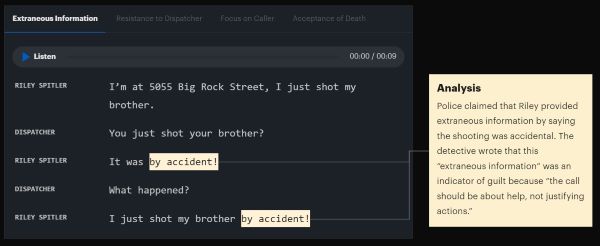
One night in early December 2014, Riley Spitler, a scrawny 16-year-old from the suburbs, was playing with a gun when he accidentally shot his older brother, Patrick. Riley’s call for help was nearly incoherent. Two dispatchers tried to calm him down. “I think I killed him,” he screamed. “Oh my God my life is over.” In shock, he couldn’t figure out how to open the glass front door from the inside so he shattered it with his hand.
Riley’s parents met him at the hospital and told him Patrick was dead. Riley sobbed so loudly the nurses could hear him down the hallway. In the days that followed, he told social workers he wouldn’t ever forgive himself, according to notes on their conversations. “I should be dead,” Riley said. “He should be alive.”
Police arrested Riley on murder charges — not manslaughter, which comes with a much lower possible prison sentence. The day after his arrest, Riley tried to kill himself in jail.
At Riley’s trial in 2016, prosecutors painted him as a drug-dealing, gun-toting teen who resented his popular brother so much that he murdered him and then started lying about it the moment he called 911. A detective who assisted on the case, Joseph Merritt, had taken Harpster’s course four years earlier. Since then, Merritt said in court, he’s applied the methods in 4 out of every 5 cases — more than 100 times. Prosecutors told the judge that Merritt should be able to testify as an expert about the guilty indicators he had identified in Riley’s call that night.
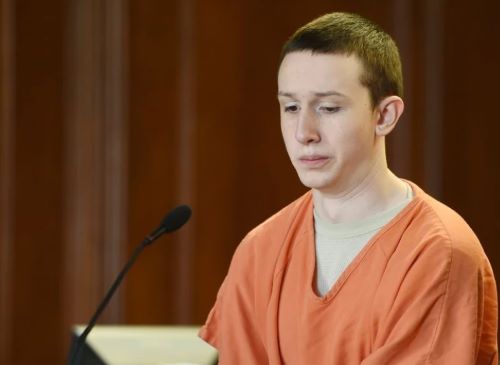
For instance, when the dispatcher asked, “What happened that he got shot?” Riley responded, “What hap— What do you mean?” This, Merritt wrote in an email to prosecutors, was an attempt to resist the dispatcher. Saying things like “my life is over” showed that he was concerned with himself and not his brother. “Very ‘me’ focused,” Merritt wrote. Riley said again and again that he thought his brother was dead. This is considered to be another guilty indicator known as “acceptance of death.”
Like most states, Michigan courts’ rules for evidence — adopted from the Daubert standard, which was named after a Supreme Court decision issued almost 30 years ago — say trial judges are responsible for making sure expert testimony has a reliable foundation.
Prosecutors in Lyon County, Nevada, once wanted a detective trained by Harpster to testify about the 911 call analysis used against a man accused of shooting his wife. The judge wouldn’t allow it. “I don’t see any reliable methodology or science,” he said. “I’m not going to let you say that it’s more likely that someone who is guilty or innocent or is more suspicious or less suspicious.”
The judge in Riley’s case, a former prosecutor named John McBain, was more credulous. He let Merritt testify as an expert and accepted 911 call analysis on its face. McBain explained his reasoning: Harpster’s course is recognized by the Michigan Commission on Law Enforcement Standards. This, McBain said, was proof of 911 call analysis’ value.
Joe Kempa, the commission’s acting deputy executive director, told me his agency does not technically certify or accredit courses — it just funds them. There is little review of the curriculum, he said, because the agency approves up to 10 courses a day from too many fields to count. Accrediting each would be too hard. As long as a course is “in the genre of policing” without posing an obvious health threat, it will likely be approved for state funds, he said.
Riley was convicted of second-degree murder. McBain sentenced him to 20 to 40 years in prison. McBain’s office didn’t respond to multiple interview requests.
Riley appealed on the grounds that Merritt’s testimony about the 911 call and other statement analysis techniques never should have been admitted. “This case is about junk science,” Riley’s attorney argued in court records, “used to convict a 16-year-old of murder.” The appellate judges threw out the murder conviction. Riley was resentenced for manslaughter and then released from prison in 2020.
Across the country, trial judges seldom restrict expert testimony brought in by prosecutors, the National Academy of Sciences found after reviewing publicly available federal rulings in 2009. The Daubert standard is applied unevenly because many judges don’t know how to spot sound science, the academy found. As one of the country’s leading experts put it later: “The justice system may be institutionally incapable of applying Daubert in criminal cases.”
Today, Riley is 24. He’s married with a newborn. He has a real estate license. He packed on pounds of muscle in prison and most people in town don’t recognize him anymore. Riley likes it that way.
After he was convicted, he felt despondent about both his brother’s death and how the outside world saw him. “People made me feel like a monster,” Riley told me. He replayed the trial over and over in his head, including Merritt’s testimony. He spent hours in the prison library studying Michigan’s rules on evidence standards.
Riley says McBain should have known 911 call analysis didn’t meet those standards. “It’s just insane that a judge wouldn’t be the wiser to that,” he said. “But that’s our system.”
After he learned of the public records requests I had sent to his department, Merritt called me. I told him about the story I was reporting and he said he’s not allowed to comment on the case. He didn’t respond to other interview requests later. The chief prosecutor in the county didn’t respond to my messages either.
In 2018 — one year after Riley’s conviction was overturned — Merritt took Harpster’s course again.
XI
“It’s kind of like a human lie detector test.” That’s how a prosecutor in Michigan described 911 call analysis in a 2016 email exchange, acknowledging that he knew the COPS Scale wouldn’t be admissible in most jurisdictions. The question, then, was how to get the method into trial without litigating the science behind it or teeing up an appeal.
In chains of emails, they described a playbook to overcome this: First, identify law enforcement witnesses who have taken Harpster’s course. Then tell them how to testify about the guilty indicators by broadly referencing training and experience. As Esteves, the prosecutor in Iowa, put it in an email: “Have them testify why this 911 call is inconsistent with an innocent caller, consistent with someone with a guilty mind.”
Next, prime jurors during jury selection and opening arguments about how a normal person should and shouldn’t react in an emergency. Give them a transcript of the 911 call and then play the audio. “When they hear it,” a prosecutor in Louisiana once told Harpster, “it will be like a Dr. Phil ‘a-ha’ moment.” Finally, remind jurors about the indicators during closing arguments. “Reinforce all the incriminating sections of the call,” another prosecutor wrote, “omissions, lack of emotion, over emotion, failure to act appropriately.”
“Juries love it, it’s easy for them to understand,” Harpster once explained to a prosecutor, “unlike DNA which puts them to sleep.”
Phil Dixon, a career defense attorney who trains lawyers at the University of North Carolina’s School of Government, told me this is what makes 911 call analysis so pernicious: It can look very much like regular opinion testimony from a witness. But when prosecutors cross the line and intentionally circumvent court rules for evidence standards, he said, that’s cause for concern. He called it “attempting to clothe expert opinion in the guise of lay testimony.”
In many places, when prosecutors don’t introduce witnesses as experts, they also don’t have to disclose discovery material like consultations with Harpster or any analysis of the 911 tape. Without those disclosures, defense attorneys are caught off guard during trial. It also helps explain how 911 call analysis has spread far and wide almost undetected.
The former chief trial attorney in Macomb County, Michigan, told Harpster that she won convictions against parents in two separate child death cases partly thanks to him. In one case, she said she put a dispatcher, who’d been trained by Harpster, on the stand to testify. “This dispatcher had gained the tools and the knowledge from your class to make a HUGE impact on the prosecution of my child death case!” she wrote. Describing another case, the prosecutor said: “I used many of your points in my closing argument to show the guilt of the defendant and got a guilty verdict!”
Another prosecutor in Ohio said he huddled up with other local prosecutors who had taken the training course and listened to a 911 tape. “All of us finding it to be dirty, I called upon Tracy Harpster,” she wrote, explaining how Harpster helped prepare them for juror examinations and questions for witnesses about the 911 call. “We were able to direct the jury to the parts of the call that indicated a guilty party,” the prosecutor wrote. “Eventually we secured a guilty verdict.”
Both prosecutors either declined to comment or did not respond to interview requests.
“This is unconscionable,” David Faigman, dean of the University of California Hastings College of the Law, told me. As a leading authority on the legal standards for evidence, he’s usually one of the first to learn about new junk science. But even he didn’t know how some prosecutors were leveraging 911 call analysis. “There are so many things wrong with this,” Faigman said, “it’s hard to know where to begin.”
Former federal prosecutor Miriam Krinsky, who is now the executive director of Fair and Just Prosecution, said these prosecutors are supposed to be “ministers of justice” and should have known better. “We need to be very careful about things such as this.”
It’s not an accident that some prosecutors would put stock in the program. The Ohio Supreme Court has approved Harpster’s course for continuing education credits multiple times. That adds to its legitimacy because prosecutors need those credits to remain in good standing.
In 2018, Harpster emailed a local prosecutor, Nancy Moore, and asked her to sponsor his course by sending in the application forms with her signature, along with his resume and some class information.
About a week later, the court approved the program. Lyn Tolan, the court’s public information director, told me it’s the responsibility of the sponsor — not the court — to evaluate programs that the court approves. She said she was unaware of the independent studies of 911 calls. I asked what steps court officials took to find that information. Tolan repeated, “We rely on the sponsor for that.”
Moore didn’t respond to interview requests. She is now the state’s deputy inspector general. At least 20 Ohio prosecutors attended the training she sponsored for Harpster in 2018. One of them became a federal prosecutor.
Another is now a judge.
XII
Time and again, many of those who host Harpster have not asked even basic questions about the program — or apparently done a cursory internet search for the man who helped create it. If they had, they’d have found his Facebook page.
On it, Harpster has openly espoused misogynistic, transphobic, Islamophobic and anti-immigrant views. He has called peaceful protesters “filthy scum,” and several posts have been flagged as false information. Ironically, he’s also singled out the government agency that launched his work. “The FBI is corrupt,” he wrote once.
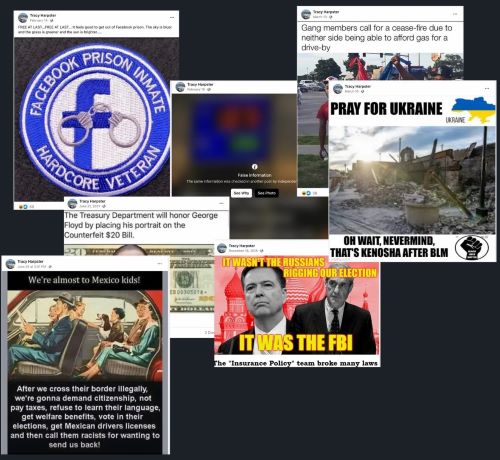
Soon after the one-year anniversary of George Floyd’s death, Harpster shared a meme with Floyd’s face on a $20 bill that said “Treasury Department will honor George Floyd by placing his portrait on the counterfeit $20.” Floyd was originally accused of trying to use a counterfeit bill before he was murdered by a police officer.
Since fall 2021, Harpster has been temporarily banned from posting on Facebook at least twice for breaking the site’s rules. One suspension was for sharing a video of someone accidentally shooting themselves and the reason for the other is unclear.
All the while, he has maintained a steady stream of training sessions, often at police conferences. Those conferences, I discovered, appear to be one of the most efficient platforms for spreading junk science. Harpster spoke at more than 130 between 2006 and 2017, according to his resume.
One weekend in October 2019, he addressed more than 100 Arizona police officers and prosecutors at the Orleans Hotel and Casino in Las Vegas. They worked at some of the most powerful agencies in the state, including a local FBI office and the state attorney general’s office.
Casey Rucker, then a detective with the Flagstaff Police Department, was also vice president of the Arizona Homicide Investigators Association, which organized the event. Rucker coordinated an appearance by Harpster where he presented his material. He was paid $1,750.
Rucker also sponsored the seminar for education credits with the state’s Peace Officers Standards and Training Board. It’s another mark of legitimacy. The board told me that it didn’t review the program’s qualifications and instead left that up to Rucker and his home agency in Flagstaff. “Each chief or sheriff has the ability to decide the training needed by the men and women in their organization,” Matt Giordano, executive director of the board, told me in an email.
Flagstaff police asked Harpster for a course outline and presentation slides, but it’s unclear what other steps the department took to evaluate the curriculum. The department’s legal adviser said Rucker believes he discussed the sponsorship with a former supervisor to get approval. Rucker is now retired and didn’t respond to interview requests.
The conference had swift impact. At least three attendees reached out to Harpster afterwards, including a cold case detective who credited him with single-handedly changing the direction of a murder investigation.
Nathan Moffat, president of the association that put on the conference, said the extent of his vetting was talking to other groups that had sponsored Harpster previously. He said the reviews were good: Audiences found Harpster entertaining and well-informed.
Moffat, who is also a career detective, told me he’s personally never used 911 call analysis and distanced himself and the association from the program. “The only normal reaction is to not expect any specific reaction,” he said. “If someone tried testifying as an expert after the class, that’s mortifying.”
XIII
Since we first spoke by phone back in July, Harpster had been dodging me. He said in a text that he was on vacation and wouldn’t be available to sit for an interview for months.
ProPublica was getting closer to publishing a story about Jessica Logan, a young mother in Illinois convicted of murdering her baby after Harpster’s methods were used against her. And I wanted to make sure Harpster had every chance to address what I’d found since we last spoke.
In chatting with detectives, Harpster occasionally mentions his vacation house on a lake in Michigan. So I searched lakeside property records and found a deed with his name on it. There was an address.
On a beautiful Saturday over Labor Day weekend, I drove about four hours north from Detroit to a bucolic neighborhood near the bridge to the Upper Peninsula. After I’d taken a few wrong turns, some neighbors pointed me down a dirt road that looked more like an ATV trail. It opened to a grass clearing with a crystal lake and cedar trees on the other side. Families were barbecuing along the shore. Boats motored by. I walked to the closest house and knocked.
Harpster opened the screen door. He’s a brawny guy with thick arms and a tight, white goatee. His head is cleanshaven now where there were once dark curls. I’d seen pictures of him before on his Facebook page, holding fish or posing alongside students of his program. He likes to get beers with them after class.
On my list of things to talk about were his relationship with law enforcement, with the FBI and with Adams; his emails with prosecutors; judges like McBain; the scientists and their problems with his data; the conferences and the many agencies that have given him the rubber stamp over the years; and the money he’s made off all of it.
Most importantly, there was Russ Faria, Jade Benning, Riley Spitler, Kathy Carpenter and 100 other similar cases I’d found around the country. Did he know these names?
In my six months of reporting, nobody had been willing to take responsibility for inviting 911 call analysis into the justice system or for the repercussions that followed. It seemed the buck didn’t stop anywhere. But it had started here, with him.
After I introduced myself, Harpster shook his head solemnly and said there would be no discussion. “I’m disappointed you would show up here unannounced,” Harpster told me before closing the door. “I’m on vacation.”
Three days later, he taught a 911 call analysis course in Texas.
Originally published by ProPublica, 12.28.2022, under a Creative Commons Attribution-NonCommercial-NoDerivs 3.0 United States license.
About the Author