There are psychological factors and needs at play beyond the need for proof.

By Dr. Matthew Schmalz
Associate Professor of Religion
College of the Holy Cross
Introduction
Claims of appearances of the Virgin Mary and weeping statues have been common in Catholicism. And now they’re going to get a closer look – but on a worldwide scale.
The Pontificia Academia Mariana Internationalis, or PAMI, recently announced an “observatory” to investigate claims of appearances of the Virgin Mary and reports of statues of her weeping oil and blood.
This announcement extends PAMI’s mission of promoting devotion to Mary and study of phenomena related to her. While still waiting for full Vatican approval, the observatory will train investigators to study mystical phenomena in cooperation with church authorities – for example, trying to determine the substance of reported tears.
Investigating the supernatural has always been a delicate task in the Catholic Church, which has to balance the faith of believers with the possibility of fraud.
Marian Apparitions
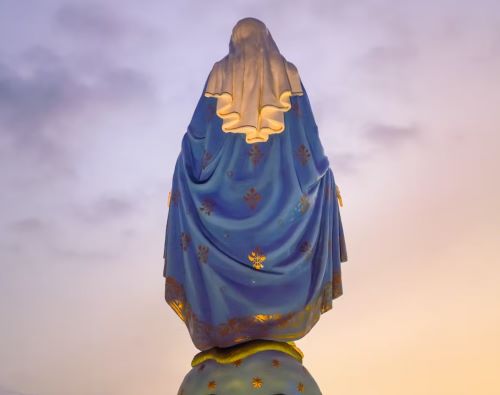
Catholics believe Mary is the mother of Jesus Christ, and the mother of God, who still makes her presence known. And the Catholic Church has officially recognized a number of sites where Mary has reportedly appeared around the globe.
The image of Our Lady of Guadalupe on a cloak in Mexico City has long been revered by Catholics as a miracle confirming Mary’s appearance to the peasant Juan Diego in 1531. In Fatima, Portugal, in 1917, three children claimed that the Virgin Mary had visited them several times. Crowds drawn by the children’s prophecy that Mary would reappear and perform a miracle reported seeing the sun “dance in the sky.”
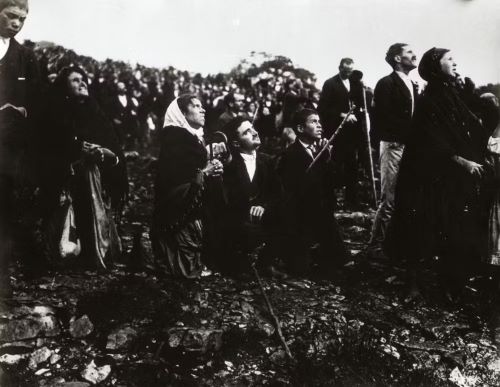
The most recent Marian apparition that a Catholic bishop has declared “worthy of belief” was in Buenos Aires province, Argentina, in 2016. A local Catholic woman told her priest that visions had begun with rosary prayer beads glowing in multiple homes and progressed to Mary warning her of humanity’s “self-destruction.”
Mary’s Tears
There is also a long history of claims of weeping Mary statues. A well-known example is the Madonna of Syracuse, Sicily – a plaster statue that seemed to shed tears. Investigators appointed by the church said the liquid was chemically similar to human tears. The shrine now housing the image is shaped like a tear drop.
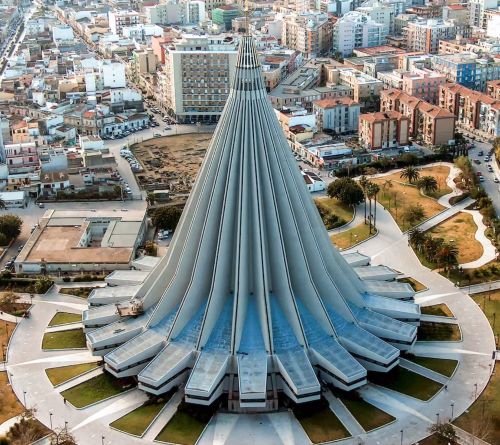
Recently, weeping statues have been reported in places as distant from each other as Paszto, Hungary, and Hobbs, New Mexico. It is, however, rare for the Catholic Church to say that an apparently weeping statue has a supernatural cause.
Mary’s tears have special significance for Catholics. She is often pictured as crying over the sins of the world and the pain she endured in her earthly life. Mary’s earthly sorrows are depicted by seven swords piercing her flaming heart.
Given Mary’s religious and symbolic significance, it is not surprising for a supposed apparition site or a weeping statue to become an object of devotion.
And when this happens, the local bishop sometimes decides to investigate.
The Possibility of Fraud
In examining claims of the supernatural, bishops follow standards set by the Vatican’s Congregation for the Doctrine of the Faith, which oversees Catholic doctrine. Perhaps because they address controversial issues, the standards were only made public in 2012 – nearly 35 years after they were first implemented.
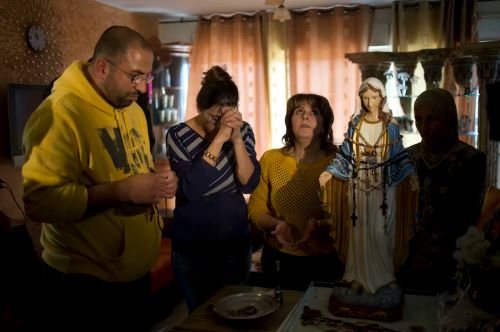
The bishop, or a committee appointed by him, evaluates the alleged supernatural phenomenon. This involves interviewing witnesses and, sometimes, scientific tests. Impact on the community is also considered. Positive aspects include reports of physical healings and religious conversions, or a general deepening of faith among Catholics. Negative aspects would include selling oil from a purportedly weeping statue or claiming a message from Mary that goes against Catholic doctrine.
A well-known case of an apparition that the Catholic Church rejected concerns the visions of Veronica Lueken, the Brooklyn “Bayside Seer,” who died in 1995. Lueken reported a number of messages from Mary that concerned church authorities. For example, Lueken claimed in 1972 that Mary had told her that the pope was, in fact, an imposter made to look like the true pope, Paul VI, through plastic surgery. Although belief in the messages endures among a small number of Catholics, the local bishop deemed the apparitions not credible.
When it comes to weeping statues, one of the primary questions is whether the event has been staged. For example, in two cases of statues that supposedly had wept blood – one in Canada in 1986 and another in Italy in 2006 – the blood turned out be that of the statue’s owner.
Liquids can also be injected into the porous material of statues and later seep out as “tears.” Oil that is mixed with fat can be applied to a statue’s eyes, which will “weep” when ambient temperatures rise.
Searching for Meaning
The Pontificia Academia Mariana Internationalis seems to be searching for proof of supernatural signs, which certainly draw intellectual curiosity and media attention.
But as a scholar of global Catholicism who has written about claims of the supernatural, I think it’s also important to understand what brings people to an apparition site or weeping statue in the first place.
In my hometown of Worcester, Massachusetts, statues and pictures have appeared to weep oil and blood at the home of the late Audrey Santo, who died in 2007 at the age of 23. As a child, “Little Audrey” was left mute and paralyzed after a swimming pool accident. In spite of her physical condition, pilgrims who came to see her believed that she was praying for them.
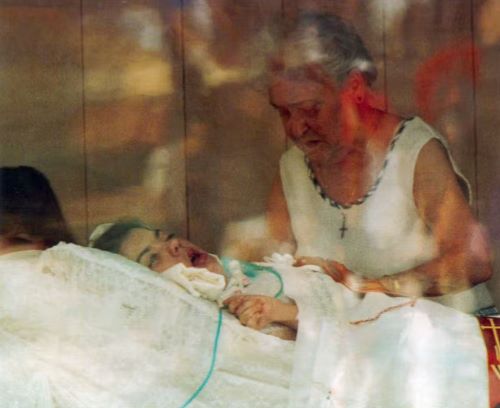
After Santo’s death, a foundation was established to promote her cause for sainthood, believing that the statues and pictures in her home were signs that God has specially blessed her.
In my writings about the case of Santo, I was definitely tempted to focus on talk of the supernatural. And the claims surrounding Little Audrey are still debated among Catholics as her sainthood cause stalls. But what I found most interesting was listening to people share why weeping statues were so meaningful in their personal lives.
At the Santo home, the people I talked to shared moving personal stories of pain and sadness, hope and healing. In the end, the sense of togetherness in and through suffering was far more important than talk of scientific proofs of the supernatural.
Originally published by The Conversation, 04.21.2023, under the terms of a Creative Commons Attribution/No derivatives license.
About the Author