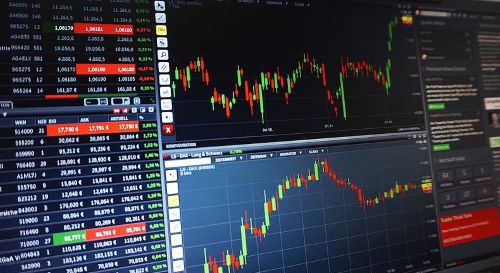
Moving averages do not predict where the market will go. Instead, smart day traders treat them as high-speed filters for market structure. These indicators help you manage volatility and risk by providing a visual anchor for price.
In this guide, we will focus on the practical, execution-driven use of moving averages. You will learn how to use these tools to manage speed and identify entries without falling into the trap of over-analysis.
SMA vs. EMA: Choosing the Right Moving Average for Day Trading
A Simple Moving Average (SMA) calculates the average price over a set period, giving equal weight to each day. An Exponential Moving Average (EMA) applies more weight to the most recent price data.
- Simple Moving Average (SMA): The SMA serves as a “smoothed” reference point. Because it reacts slowly, it excels at defining key structural levels that many market participants monitor.
- Exponential Moving Average (EMA): The EMA is momentum-sensitive. It hugs the price action closely. Traders use it to capture quick shifts in sentiment before the move ends.
Instead of debating which is superior, choose the tool that best fits your goal. If you want to track a fast trend, use an EMA. If you need to find a major level where the “whole market” might react, use an SMA.
Day Trading Moving Average: Quick Comparison
Use this table to understand how different averages behave during the trading session.
| Moving Average | Type | Best Use Case | Typical Market Reaction |
| 9 Period | EMA | Tracking aggressive momentum | Sharp bounces or quick failures during “runaway” trends. |
| 20 Period | EMA | Identifying the “Mean” | Price often stabilizes here before a secondary move. |
| 50 Period | SMA | Mid-day support/resistance | Large orders often sit here, causing a price slowdown. |
| 200 Period | SMA | Ultimate bias anchor | Significant “bounce” or “break” that shifts the daily narrative. |
How Day Traders Use Fast Moving Averages for Momentum and Entries
Active traders use fast EMAs to stay aligned with the current trend. These tools prevent you from chasing price. Instead of buying at the top, you wait for the price to return to the average.
- Using the 9 EMA to Track Rapid Intraday Momentum
The 9 EMA is your “speed” indicator. When the price stays above a rising 9 EMA, the trend is strong. If price pulls back and touches this line without breaking it, you have a potential entry point for a momentum play.
- Using the 20 EMA as an Intraday Mean and Pullback Level
The 20 EMA acts as a home base for the price. In a steady trend, the price eventually returns to this line, attracting new buyers. Traders often wait for the price to touch the 20 EMA and display a reversal signal (such as a specific candle pattern) before deciding to enter a trade.
- How Chart Timeframes Affect 9 and 20 EMA Signals
A 9 EMA on a 1-minute chart is extremely sensitive and prone to noise. The same 9 EMA on a 5-minute or 15-minute chart provides more reliable structural data. Always align your fast EMA signals with the higher timeframe trend to increase your win rate.
Why the 50 and 200 Moving Averages Matter to Institutions
Even if you trade small amounts, you must watch the levels that banks and big funds track. Institutional algorithms often trigger at the 50 and 200 SMA levels.
- The 50 SMA: Intraday Support and Resistance
The 50 SMA is a medium-term line. During the middle of the day, the price often “rests” at this level. If the price breaks the 50 SMA on high volume, it indicates the market’s power has shifted.
- The 200 SMA: Intraday Market Direction
The 200 SMA is the ultimate line in the sand. If the price stays above this line, the market’s mood is positive. Professional traders rarely bet against the direction of the 200 SMA.
These levels work because everyone expects them to work. Since thousands of traders place orders at the 200 SMA, it creates a “crowd” of buyers or sellers. This causes the sharp bounces you see on your screen.
Tactical Strategies: Crossovers vs. Pullbacks
Your strategy choice depends on current market conditions.
- The 9/20 Crossover: When the 9 EMA crosses above the 20 EMA, it signals a potential trend start. This is a classic entry signal for new trends.
- The Pullback Play: You wait for a strong trend to establish. When the price dips back to the 20 EMA, you enter. This keeps your risk low because your stop-loss sits just below the average.
- Risk Management: Never enter a trade based on a moving average alone. Always ensure price action confirms the move. For example, wait for a large green candle to “swallow” the previous red one at the 20 EMA. This is your visual proof that buyers are back in control.
When traders ask which moving average is best for their strategy, the answer usually depends on whether they prefer to catch the start of a move or join an existing one.
What are the Challenges and Limitations Associated with Moving Averages?
Moving averages are not perfect. You must understand their flaws to avoid “indicator trap” losses.
- Lag: Moving averages use past data. By the time a crossover happens, a large portion of the move might be over.
- Whipsaws: In a sideways or “choppy” market, moving averages flatten out. Price will cross above and below them repeatedly, which triggers false signals.
- Over-reliance: Some traders ignore volume or price levels. A moving average touch is meaningless if it happens on low volume or in the middle of a known resistance zone.
Final Thoughts
Moving averages react to price. They do not dictate it. Use these tools to filter out market noise and manage your risk, but remember that a moving average is only as good as the context around it.
When you combine these indicators with volume analysis and clear support levels, you will build a much more robust intraday strategy. Find a specific setup that works for you and follow it with discipline.
About the Author