They are putting the nation’s voter rolls online while making unsupported claims suggesting election fraud.

By Megan O’Matz
Reporter
ProPublica
Voter Reference Foundation
At a wedding hall in rural northwest Wisconsin, an evangelist hollered a question to an eager crowd of conferencegoers: “Who thinks Wisconsin can be saved?”
He was answered with enthusiastic whistles and cheers. The truth, he said, would be revealed. “We need transparency!”
The subject: the nation’s election systems. The preacher was among a group of conservative speakers, including politicians, data gurus and former military officers, who theorized on the mechanics of voter fraud in general — and specifically distrust in the voter rolls, the official lists of eligible voters.
“Voter rolls are very, very important to the process,” Florida software and database engineer Jeff O’Donnell told the gathering of 300 in late January in Chippewa Falls, deeming the rolls “the ground zero” of what he called Democratic plots to steal elections. The only way former President Donald Trump could have lost his reelection campaign in 2020, O’Donnell said in an interview, was if voter rolls had been inflated with people who shouldn’t have been able to cast ballots.
Ever since Trump failed to convince the world that he lost the 2020 election because of fraud, like-minded people across the country have been taking up the same rallying cry, revisiting that vote with an eye toward what will happen in 2022.
Now, a new group is stepping into a more conspicuous role in that world by providing easily accessible tools for people in Wisconsin, other Midwest battleground states and, eventually, the entire country to forge ahead with a quest to prove election irregularities.
Calling its work unprecedented, the Voter Reference Foundation is analyzing state voter rolls in search of discrepancies between the number of ballots cast and the number of voters credited by the rolls as having participated in the Nov. 3, 2020 election.
The foundation, led by a former Trump campaign official and founded less than a year ago, has dismissed objections from election officials that its methodology is flawed and its actions may be illegal, ProPublica found. But with its inquiries and insinuations, VoteRef, as it is known, has added to the volume in the echo chamber.
Its instrument is the voter rolls, released line by line, for all to see.
In early August, the foundation published on its website the names, birthdates, addresses and voting histories for 2 million Nevada voters, information that is normally public but only available on request, for a fee. It claimed to have found a significant discrepancy between the number of voters and the number of ballots cast, despite being warned by state election officials that its findings were “fundamentally incorrect.”
In the months since, VoteRef has reported similar discrepancies in rolls posted for 17 other states, including the 2020 election battlegrounds of Michigan, Georgia, Ohio and Wisconsin. It intends to post the rolls of all 50 states by year’s end.
“Voter File Transparency site adds Michigan; large discrepancy found,” read a headline on a Dec. 6 press release put out by the organization, which is led by Gina Swoboda, a high-ranking officer in the Republican Party of Arizona.
The project is still in its early stages, and the people at the Chippewa Falls conference did not mention VoteRef specifically.
Still, the VoteRef initiative is an important indication of how some influential and well-funded Republicans across the country plan to encourage crowdsourcing of voter rolls to find what they consider errors and anomalies, then dispute voter registrations of specific individuals. Visitors to the VoteRef site are able to scroll through data on more than 85 million people in a free, easy-to-use format. The VoteRef data includes personal identifying information of every voter and the years they voted, but not how they voted.
VoteRef’s methods have already led to pushback from state officials. The New Mexico Secretary of State believes posting data about individual voters online is not a permissible use under state law and has referred the matter to the state attorney general for criminal investigation.
And an attorney for the Pennsylvania Department of State notified VoteRef in January that state law prohibits publishing the voter rolls on the internet and asked that the data be removed. VoteRef complied.
ProPublica contacted election officials in a dozen of the states where VoteRef has examined voter rolls, and in every case the officials said that the methodology used to identify the discrepancies was flawed, the data incomplete or the math wrong. The officials, a mix of Democrats and Republicans, were in Colorado, Connecticut, Georgia, Michigan, Nevada, New Jersey, New Mexico, North Carolina, Ohio, Pennsylvania, Virginia and Wisconsin.
“The accuracy and integrity of Michigan’s election has been confirmed by hundreds of audits, numerous courts and a GOP-led Oversight Committee analysis,” said Tracy Wimmer, director of media relations for Michigan’s secretary of state.
“This is simply another meritless example of election misinformation being disseminated to undermine well-founded faith in Michigan’s election system, and from an organization led by at least one former member of the Trump campaign,” Wimmer said.
VoteRef, records show, is an initiative of the conservative nonprofit group Restoration Action and its related political action committee, both led by Doug Truax, an Illinois insurance broker and podcaster who ran unsuccessfully in the state’s GOP primary for the U.S. Senate in 2014.
A ProPublica review found that VoteRef’s origins and funders are closely linked to a super PAC predominantly funded by billionaire Richard Uihlein, founder of the mammoth Wisconsin-based packaging supply company Uline. A descendant of one of the founders of the Joseph Schlitz Brewing Company, Uihlein is a major Trump supporter and a key player in Wisconsin and Illinois politics. Among his political donations: $800,000 in September 2020 to the Tea Party Patriots political action committee, a group that helped organize the Jan. 6 rally that led to the Capitol insurrection.
Uihlein and his wife, Elizabeth Uihlein, have contributed in excess of $30 million combined over two decades to mainly Republican candidates on the state and local level, particularly in Illinois and Wisconsin, according to OpenSecrets, a nonpartisan organization that tracks campaign donor information. The total includes money given to groups that advocate on behalf of candidates as well as direct contributions.

Voter rolls are public information, typically used by campaigns to identify potential supporters, target messages or persuade people to go to the polls. Journalists and some businesses also at times use the rolls for newsgathering or commercial purposes.
VoteRef has said its aim is to increase transparency in the elections process, echoing the language used to justify door-to-door address checks, painstaking ballot audits and other efforts that Trump supporters are continuing to employ to parse the 2020 election. To publicize the results of its analysis of ballot inconsistencies, it crafted press releases that then were parroted on sites that purport to be legitimate news outlets and were connected to a media network that received large sums of money from VoteRef.
“VoteRef is the beginning of a new era of American election transparency,” Swoboda, VoteRef’s executive director, said in its Nevada press release. “We have an absolute right to see everything behind the curtain.”
Until a few months before the 2020 election, Swoboda, a resident of Scottsdale, a Phoenix suburb, was a professional in Arizona’s election system, working as the campaign finance and lobbying supervisor in the Arizona Secretary of State’s Office.
Swoboda then served as Election Day operations director for the Trump campaign in Arizona, according to a sworn court affidavit she gave in Arizona in November 2020 as part of Trump’s legal challenge to election results there. She described how she took complaints from people who thought poll workers allowed defective ballots to be submitted, in what later became known as “SharpieGate.” (Votes made with a Sharpie do count, the state said.)
She and others associated with VoteRef declined to be interviewed for this story. But Swoboda did respond via email.
“In each of the states we’ve researched to date, the election data math simply doesn’t add up,” she wrote. “That requires reform. We seek to spur this reform through the sustained spotlighting of inaccuracies or wrongdoing.”
Flawed Methodology
As of late February, VoteRef showed 431,173 more ballots cast overall than people credited by voter rolls with having participated in the 2020 election.
To those unschooled in the mechanics of elections, VoteRef’s approach could seem reasonable: Compare the total number of ballots cast in the Nov. 3, 2020 election with the number of current voters on the rolls who have recorded histories of having participated in the vote.
For example, the VoteRef table for Nevada shows 8,952 more ballots cast than individuals credited with voting, based on histories obtained in February 2021.
“Theoretically, these numbers should match,” VoteRef claimed in an August press release.
But there are valid reasons the numbers do not match.
Nevada election officials explained it this way in a press release: “If ‘John Doe’ votes and has his ballot counted in Lander County, then moves to Mineral County, once he is registered in Mineral County, he will show no vote history because he has no vote history in Mineral County. The farther away from the election the data is acquired, the more it will have changed.”
In Connecticut, there were 1,839,714 ballots cast in 2020, according to VoteRef, but the group’s examination of voter histories in October, 2021, showed 1,802,458 people voting. VoteRef’s conclusion is that there was a discrepancy of 37,256 ballots.
But state election officials said that the registration database is “live,” and voting histories of those who moved out of state or died in the months after the election would have been removed from the rolls, accounting for the discrepancy.
“The list is not a static list,” said Connecticut Secretary of State Denise Merrill. “It changes all the time.”
In Michigan, where VoteRef found a difference of more than 74,000 votes, an elections official said that state’s qualified voter file also constantly changes as it’s updated, making the data the foundation relied on in late May 2021 — more than six months after the election — out of date.
In a recent email to ProPublica, Swoboda conceded as much.
“It’s up to election officials who run election offices to reconcile their data, not the Voter Reference Foundation, which merely publishes their information in a consumer-friendly format,” she said. “Of course, our election experts are well aware of the time lag between certification and data pulls — we posted the documents online for all to see!”
Federal law requires that election supervisors make reasonable efforts to update voter lists, but provides leeway in how states carry out the task. The law prohibits administrators from removing people for simply not voting in repeated elections, unless notices go unanswered and officials wait for two federal election cycles before putting the voters on an inactive list.
Counties haven’t always done a good job, however, in maintaining the voter rolls, leading some people to distrust the system. One of VoteRef’s key aims is to task ordinary people with the chore of finding anomalies.
Scrutinizing Voter Rolls and Neighbors
In announcing the launch of its website, the Voter Reference Foundation touted it as a “first of its kind” searchable tool for all 50 states “that will finally give American citizens a way to examine crucial voting records.”
“Citizens will be able to check their voting status, voting history, and those of their neighbors, friends and others. They will be able to ‘crowd-source’ any errors,” the press release stated.
The group’s backers have encouraged scrutiny outside of one’s own household.
“With VoteRef.com you can find out who voted and who didn’t. Did your aunt who died 10 years ago ‘vote’ after she died? Did your ‘neighbor’ who moved to another state vote? Did 55 votes emerge from a five-unit apartment complex?” Jeffrey Carter, a partner in a venture capital group who earlier had appeared on Truax’s podcast, wrote on the newsletter site Substack in December.
Matt Batzel, whose organization American Majority recently highlighted VoteRef’s efforts in Wisconsin, said in an interview with ProPublica that VoteRef’s vision is for citizens to detect and then report potential problems with the voter rolls, such as people who are registered to vote at vacant lots or unusually high numbers of votes coming from nursing homes.
Election experts say the type of work being done by VoteRef risks leading to further misinformation or being weaponized by people trying to undermine the legitimacy of the past election or give the sense that voter fraud is a more encompassing problem than it’s proven to be. Or it could be used to harass or intimidate valid voters under the guise of challenging their legitimacy.
Even without any clear evidence of fraud during the 2020 election, the vast, decentralized election system still is drawing scrutiny from those who believe that the system can be easily manipulated. At the daylong voter integrity conference in Chippewa Falls, speakers invoked war imagery, spoke of coverups, and urged people to “expose the tactics” of the political left. The group — saluted via video by Trump acolyte and MyPillow CEO Mike Lindell — is seeking to put like-minded individuals in vote-certifying secretary of state offices nationwide.
The voter rolls have been targeted, too, by others in Wisconsin, including special counsel Michael J. Gableman, a former state Supreme Court justice and Trump supporter who the state’s Republican Assembly speaker appointed in June to conduct a review of Wisconsin’s administration of the 2020 election. On March 1, Gableman released a report blasting what he called “opaque, confusing, and often botched election processes.”
Gableman urged the Legislature to consider legal methods to enable citizens or civil rights groups to help maintain election databases.
“As it stands, there is no clear method for individuals with facial evidence of inaccurate voter rolls to enter state court and seek to fix that problem,” he wrote. He envisioned a system that “could even provide nominal rewards for successful voter roll challenges.”
While information about voters is available in most states, it comes at a cost and with limits on how it can be distributed to avoid having some private information be easily accessible.
In January, an official with the Pennsylvania Department of State wrote to Truax warning that it appeared that the Voter Reference Foundation had “unlawfully posted Pennsylvania-voter information on its website” and demanding that the organization “take immediate action” to remove the information.
Soon, Pennsylvania data disappeared from the website. Swoboda declined to answer questions about the matter. Attempts to reach Truax were unsuccessful.
In New Mexico, Secretary of State Maggie Toulouse Oliver also said the undertaking is not an allowable use of voter data. By state law, she said, the rolls can only be used for governmental or campaign purposes.
“Having voter registration data ‘blasted out across the internet’ violates state law limiting use of the voter rolls solely for campaign or government activities,” she said. In December, Toulouse Oliver’s office referred the matter to the state attorney general for investigation and possible prosecution.
Associates of the Voter Reference Foundation dismiss these privacy concerns.
“You are joking, right?” said Bill Wilson, chairman of the conservative-leaning Market Research Foundation of Fairfax, Virginia, which paid more than $11,000 to the state of Virginia in March 2021 for the voter roll data and shared it with the Voter Reference Foundation.
“Big tech, both political parties and big media have no interest or concern for privacy and have mountains of data on individuals that is shared and sold on an hourly basis. You called me at my home, after all.’’
Support in GOP Circles
Restoration Action/PAC describes itself on its website as an “effective dynamo against those trying to destroy our country.” It produces ads on behalf of state and national candidates, castigates Planned Parenthood, “biased liberal media” and “Big Tech” and advocates for fair elections.
Truax, the group’s head, frequently assumes the role of news anchor to host the First Right video podcast, interviewing far-right conservatives. In early June last year, he introduced his audience to VoteRef, telling them: “We helped create the organization, and we’ll have much more to say about it in the coming weeks.”
Richard Uihlein’s quiet role was essential. He’s been the primary funder of Restoration PAC since its inception in 2015, contributing at least $44 million, according to the data from OpenSecrets. In May 2021, Federal Election Commission records show, Uihlein donated $1.5 million to Restoration PAC. That same month, the Voter Reference Foundation was incorporated in Ohio.
Two weeks after the Uihlein donation, money started flowing from Restoration PAC to a media network that did some data procurement and analysis for VoteRef, with payments totalling more than $955,000 as of the end of 2021, the FEC records show.
The network, which includes Pipeline Media, is operated by Bradley Cameron, a Texas business strategist, state corporation records show. Brian Timpone is listed as a manager at Pipeline Media. He made headlines a decade ago after his firm, then called Journatic, came under fire for outsourcing hyperlocal news offshore using phony bylines.
In recent months, VoteRef has released press releases about its activities that have been turned into stories on sites owned by Metric Media, which Cameron leads, according to his online profile. The sites mimic legitimate news outlets but print press releases, shun bylines, do little to no original reporting and rely on automated data. “New website to publish which Arlington residents voted, did not vote in gubernatorial election,” read an Oct. 28 headline in the Central Nova News of Virginia, a Metric Media site.
Uihlein did not respond to calls or emails from ProPublica seeking comment. Cameron and Timpone also did not reply to messages seeking an interview.
Political figures with ties to Trump have been touting the efforts of VoteRef.
Among them: former Virginia Attorney General Ken Cuccinelli, an immigration hard-liner appointed by Trump to serve as acting head of U.S. Citizenship and Immigration Services.
Cuccinelli now heads the Election Transparency Initiative, a Virginia organization opposed to expanding early voting or easing registration requirements. The initiative, a project of the conservative group Susan B. Anthony List, says it partners with The Heritage Foundation’s political arm.
Cuccinelli spoke in September to about 100 party loyalists at a gathering at a suburban Milwaukee hotel about how they could use the VoteRef tools and become involved in securing the elections process.
Similarly, J. Hogan Gidley, former national press secretary for the 2020 Trump campaign, promoted the work of VoteRef on Philadelphia conservative talk radio before Christmas.
“We’re doing some work with them, too. We know the folks over there really well,” said Gidley, who is now with the America First Policy Institute, a nonprofit packed with Trump administration alums.
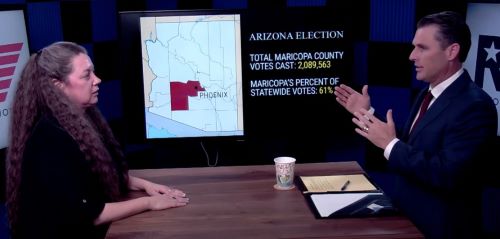
Truax, meanwhile, brought in Swoboda for his podcast last summer. They talked about the Arizona ballot audit and briefly referenced her work with the Voter Reference Foundation.
“It always feels like to me that the states, in general, have gotten a little sloppy in different areas and just you know nobody’s really paying a lot of attention to it,” Truax said.
He added: “Now I think as conservatives we’re in a place we really got to pay a lot more attention. There’s a lot of energy now on this.”
Originally published by ProPublica, 03.07.2021, under a Creative Commons Attribution-NonCommercial-NoDerivs 3.0 United States license.
About the Author