The pending real-life impact is immeasurable.

By Rebecca Mears, J.D.
Director, Democracy
Center for American Progress

By Zachary Geiger
Structural Reform and Governance Intern
Center for American Progress
The Power of One Vote
Overview
There is a common belief that voting does not matter because one vote cannot really make a difference.1 After all, more than 158 million people voted in the 2020 presidential election.2 In the face of such astronomical numbers, it may not feel that a single vote matters; but the truth is it does. Center for American Progress analysis of election data for U.S. Senate elections from 1976 to January 5, 2021, U.S. House elections from 1976 to 2022, and state office-level returns in 2016 compiled by the MIT Election Lab reveals that while large margins decide many elections, key elections often come down to just a handful of votes:3
• From 1976 to January 5, 2021, more than 85 U.S. Senate elections were decided by less than 3 percent of all votes cast.4
• From 1976 to 2022, more than 410 U.S. House elections were decided by less than 3 percent of all votes cast.5
• In the year 2016 alone, more than 340 state office elections were decided by fewer than 500 votes; of those, more than 85 were determined by fewer than 100 votes.6
• Although the data analyzed for this report did not cover local elections, local elections often come down to exceptionally slim margins. For example, in November 2021, 18 local elections in Ohio—12 candidate races and six local measures—ended in a tie.7
This report explores the real-life impact of some of these close elections. Even though millions of Americans vote in presidential elections, the winner can be elected by just a handful of voters—less than the attendance for a baseball game or concert. This report examines examples of the policy impacts that these few votes can have, including how 312 votes cast in one state helped more than 40 million Americans access affordable health care, how 321 votes cast in one state legislative race in Minnesota helped shape the state’s laws, and how party control of the Virginia House of Delegates came down to a tie in one legislative race—meaning just one more person showing up to vote could have decided party control. Finally, the report discusses the importance of local elections and why voting in these elections is extremely powerful.
Federal Elections
Presidential Elections
In the United States, the president is not elected based on the total number of votes Americans cast, but rather an antiquated system known as the Electoral College, whereby each state is allocated Electoral College votes equal to its number of U.S. senators and representatives.8 There are a total of 538 Electoral College votes; for a candidate to be elected president, they must receive a majority—at least 270—of these votes. This system means that the winner of the presidential election is not always the candidate receiving the most votes. In fact, five times throughout history, the candidate who received fewer total votes was elected president.9
This system also means that not all voters have the same power in presidential elections. The Electoral College inflates the importance of a handful of “battleground” or “swing” states—highly contested states with enough Electoral College votes to sway an election—while reducing the power of votes in other states. As a result, the past few presidential elections have been closer than many realize.

For example, more than 158 million people voted in the 2020 presidential election.10 In fact, of the 158 million votes cast in 2020, the election was ultimately decided by just 42,918 votes.11 To put that number in perspective, it is just slightly more than the average attendance of a Los Angeles Dodgers game in 2023.12 Although Joe Biden received over 7 million more votes than Donald Trump, he was actually elected president because he received 306 Electoral College votes—more than the 270 votes needed. After breaking down the states where Biden won Electoral College votes by the narrowest margins, it can be reasoned that he won the presidency by just 42,918 votes cast across three states, securing Georgia by 0.23 percent (11,779 votes),13 Arizona by 0.3 percent (10,457 votes),14 and Wisconsin by 0.63 percent (20,682 votes).15 As a percentage of the total votes cast for president across the country, Joe Biden won the Electoral College thanks to a key battleground state margin of just 0.03 percent of the 158 million total votes cast nationwide.
In 2016, Donald Trump became president because he secured more Electoral College votes—despite the fact that Hillary Clinton received almost 2.9 million more total votes than Trump. After breaking down the votes behind the Electoral College, one finds that Trump became president because of 77,744 votes cast across three states; that is just a few thousand more people than the attendance for Taylor Swift’s “Eras” tour in Pittsburgh on June 17, 2023.16 Specifically, Trump won the Electoral College votes from Michigan by 0.23 percent (10,704 votes),17 Pennsylvania by 0.72 percent (44,292 votes),18 and Wisconsin by 0.77 percent (22,748 votes).19 Taken as a percentage of the total votes cast for president across the country, Trump won by just 0.06 percent of the 137 million votes cast.
Then, there is the most closely decided presidential election in recent memory: the 2000 presidential election between George W. Bush and Al Gore. While more than 100 million voters cast ballots, the election was so close that it came down to a margin of just 537 votes in Florida.20 Due to a confusing “butterfly ballot” design, a problematic card-punch system that led to unclearly marked votes, and the U.S. Supreme Court halting a recount, to this day, there remains a heated dispute about whether the 537-vote margin should be considered the accurate final vote total.21 Regardless of where one finds themselves in this debate, if just a few-hundred additional individuals had voted for Gore, the country would have had a different president and perhaps could have been spared the uncertainty that continues to loom over this election.22
Although voters in battleground states may find these to be compelling examples of why their votes matter in presidential elections, individuals who do not live in these states may feel the opposite—that their vote does not matter. Moreover, states considered to be “battleground” or “swing” states shift over time. For example, Missouri was considered a swing state throughout most of the 20th century.23 Even as recently as 2008, political parties spent millions of dollars in Missouri trying to win its Electoral College votes,24 with John McCain narrowly beating out Barack Obama by 4,000 votes.25 However, after that cycle, Missouri lost its swing state status and has not reclaimed it: Currently, Missouri is considered a safely red state, with Republican presidential candidates having won it by large margins over the past few elections cycles.26
Policymakers and advocates have suggested abolishing the Electoral College and determining the winner of the presidency based on which candidate gets the most votes nationwide.27 This would help ensure that a vote for the president carries the same weight regardless of the state a voter lives in.
In the meantime, Americans living in non-swing states should not lose heart. Voting for the president is still an essential method for Americans to voice their opinion about the candidates and the policies they represent. Additionally, many other offices are up for election at the same time as the presidential election. Not only are votes more potent in these state and local elections, but the outcomes of these elections also often have a much more direct impact on daily life than the presidency.
U.S. Senate Elections
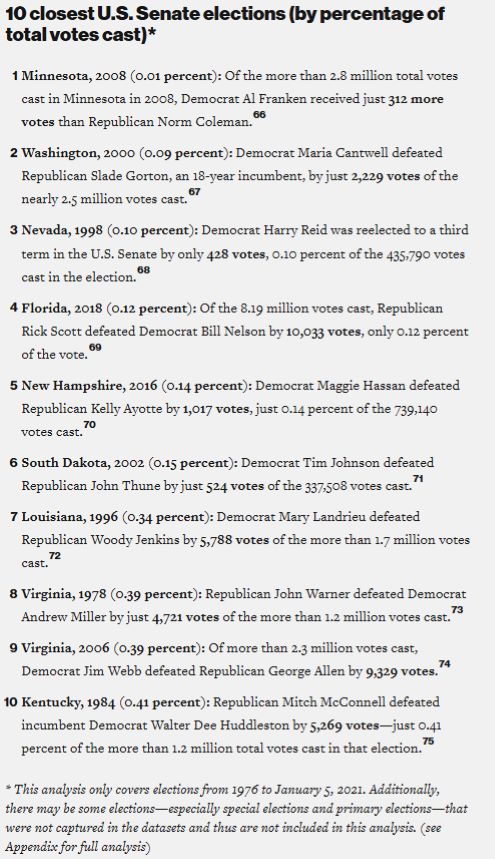
As noted above, from 1976 to January 5, 2021, more than 85 U.S. Senate elections were decided by less than 3 percent of all votes cast.28 In many of these races, just a handful of votes not only determined who was elected but also helped shape national policy for decades.
312 votes helped more than 40 million Americans access affordable health care
In Minnesota’s 2008 U.S. Senate race, Al Franken ran against Republican incumbent Norm Coleman. The hotly contested election was so close that it took a recount and months of litigation before a court ultimately determined that Franken had received 1,212,629 votes while Coleman had received 1,212,317, meaning Franken won the election by just 312 votes.29
The significance of that election is that Franken’s win gave Senate Democrats a 60-40 majority and a way to bypass the filibuster—a tool in the U.S. Senate that allows any senator to halt the legislative process simply by objecting to a proposed bill. If a bill does not have 60 votes to overcome that objection, it cannot move forward. As explained in a recent CAP report about the filibuster, this means a small group of senators unrepresentative of the country as a whole “can abuse the filibuster to prevent almost any legislation from being passed by Congress.”30 For instance, the 21 least populous states have enough senators to prevent the majority from getting 60 votes, yet these states make up “only 11 percent of the country’s population and only 7 percent of the country’s Black population.”31 Franken’s election gave Senate Democrats a filibuster-proof 60 votes in the U.S. Senate, allowing the Senate to pass the Patient Protection and Affordable Care Act (ACA) on December 24, 2009, by a vote of 60-39.32
The ACA helped the nation’s uninsured rate drop “from 17.8 percent in 2010 to an all-time low of 7.2 percent in the second quarter of 2023.”33 Provisions such as those to expand Medicaid eligibility and allow young adults to stay on their parents’ plans until age 26 opened new pathways to comprehensive coverage for millions of previously uninsured Americans. In particular, the law’s premium tax credits and cost-sharing reductions made buying and using insurance more affordable for lower-income adults and families who buy insurance on their own by reducing their premiums and out-of-pocket costs.34
Not only has the ACA drastically reduced the uninsured rate across the country; it has also prevented insurers from discriminating against people with preexisting conditions, including an estimated 135 million people under the age of 65.35 In addition, the ACA prohibits gender rating—a practice by which individual market insurers charge women up to 1.5 times more than men for health insurance—and prevents insurers from creating coverage limits, which has been particularly beneficial for the millions of Americans with disabilities.36
A vote margin of 0.41 percent played a hand in the creation of an extremist Supreme Court that stripped Americans of reproductive rights
In Kentucky’s 1984 U.S. Senate race, Republican Mitch McConnell defeated incumbent Democrat Walter Dee Huddleston by 5,269 votes—just 0.41 percent of the total votes cast in that election.37 That election was remarkable in a few ways. First, it was the only Democratic seat that flipped Republican during the 1984 U.S. Senate election cycle.38 Second, McConnell was the first Republican to win a statewide election in Kentucky since 1968.39
Most critically, this was Mitch McConnell’s very first election to the U.S. Senate.40 Fast forward 40 years: McConnell is still in the U.S. Senate, serving as his party’s leader since 2006, making him the longest-serving Senate party leader in American history and a major source of power in policymaking.41 Although McConnell has played a significant role in U.S. politics over the past 40 years, he has been most influential in shaping the U.S. Supreme Court into a bastion of extreme right-wing ideology.42 When Justice Antonin Scalia passed away in early 2016, McConnell used his power to subvert the traditional system of appointing justices to the Supreme Court. McConnell united Senate Republicans to block President Obama from appointing a justice and kept the seat open until Donald Trump was elected in 2016, thus allowing a right-wing justice to be seated.
The basis for this move was a fabricated principle that a Supreme Court justice should not be appointed during presidential election years,43 a principle that McConnell ignored just a few years later when Justice Ruth Bader Ginsburg passed away eight weeks before the 2020 presidential election. This time, McConnell rushed to get another right-wing justice seated on the Supreme Court: Amy Coney Barrett, who was nominated and had one of the fastest confirmations in history.44
In just a few years, McConnell oversaw the appointment of three new Supreme Court justices, solidifying a radical 6-3 right-wing majority.45 That majority has been responsible for rulings that repealed Roe v. Wade, stripping Americans of reproductive rights;46 granted presidents sweeping criminal immunity;47 gutted the ability of public agencies and Congress to protect Americans;48 deemed affirmative action in college and university admissions to be unconstitutional;49 struck down commonsense state laws concerning gun ownership;50 rejected the Environmental Protection Agency’s authority to address climate change;51 and more.52
A Few Votes Can Shift National Power Dynamics
Votes have impacts beyond the election in which they are cast. Just a handful of seats often decide party control of the U.S. Senate, for example. Indeed, as of July 2024, Republicans hold 49 Senate seats, while Democrats hold 47 and independents hold four; but since the four independent senators caucus with the Democrats, Democrats control the Senate by a slim margin.53 Over the past 45 years, there have been 23 different Congresses, six—or roughly one-quarter—of which saw party control in the U.S. Senate determined by two seats or less.54
Just a handful of votes can, therefore, shift the balance of power within governing bodies. For example, in Washington’s U.S. Senate election in 2000, Democrat Maria Cantwell defeated Republican Slade Gorton, an 18-year incumbent, by just 2,229 votes out of nearly 2.5 million votes cast—a margin of 0.09 percent.55 Cantwell’s race made Washington the third state at the time to be represented by women in both U.S. Senate seats56 and created a 50-50 tie in the Senate.57
Small numbers of votes can also shift national power dynamics because of how elections shape political party leadership. A few examples:
• In 2004, Republican John Thune defeated Democrat Tom Daschle by 4,508 votes—a margin of 1.15 percent—in the South Dakota U.S. Senate race.58 At the time, Daschle was the Senate minority leader. This election marked the first time since 1952 that a Senate party leader lost reelection.59 Thune has remained in the Senate since this election and is currently the Senate minority whip.60
• In 1998, in Nevada, Democrat Harry Reid was reelected to a third term in the U.S. Senate by only 428 votes, 0.10 percent of the total 435,790 votes cast in the election.61 Reid served as the Democratic whip in the Senate from 1999 to 2005 and as the Democratic leader in the Senate from 2005 to 2015.62
• In Florida, out of 8.19 million votes cast in 2018, Republican Rick Scott defeated Democrat Bill Nelson by 10,033 votes, only 0.12 percent of the vote.63 Rick Scott’s victory meant that, for the first time since 1875, Republicans held both of Florida’s U.S. Senate seats.64 During this term, Scott served as the chairman of the National Republican Senatorial Committee from 2021 to 2023.65
U.S. House Elections
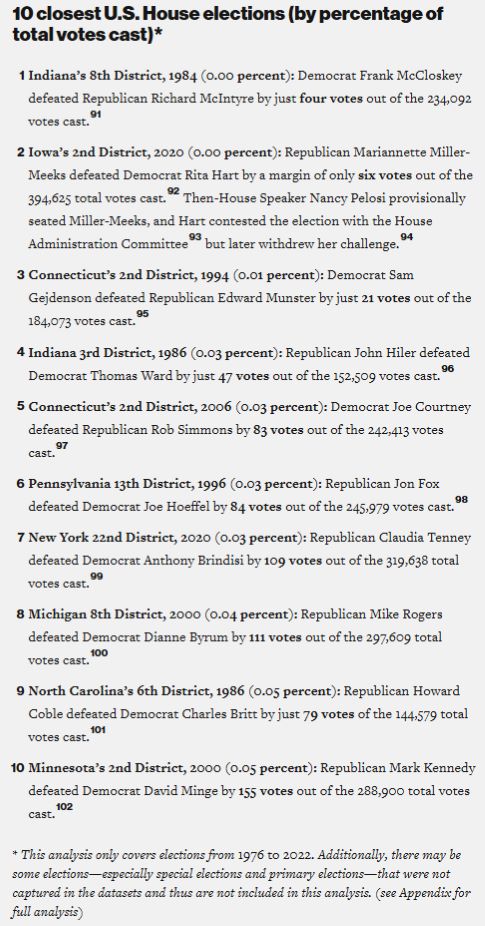
From 1976 to 2022, more than 410 U.S. House elections were decided by less than 3 percent of all votes cast.76
Close elections can happen anytime and anywhere: A tied vote in California in 2024
A recent election in California demonstrates just how close elections can be, even in a state where there are 22,171,899 registered voters.77
In March 2024, California held its federal primary elections, with the top two candidates receiving the most votes moving on to the general election. In the election for California’s 16th Congressional District, Democrat Sam Liccardo received the most votes, securing a spot in the general election. However, after the initial vote tally, two other Democratic candidates—Evan Low and Joe Simitian—tied for second place with 30,249 votes each.78 After a recount, the results revealed that Low’s total should have been 12 votes higher and Joe Simitian’s should have been seven votes higher. Thus, Low secured the second spot on the general election ballot by just five votes.79
Of the roughly 444,279 registered voters in the district,80 182,188 voters cast a ballot in the primary for California’s 16th Congressional District,81 and out of all votes cast, the deciding factor between which candidate would move on to the general election was just five votes. As both Low and Simitian stated when asked about the tie: “Every vote counts.”82
Four votes changed the way post-election processes are viewed
Indiana’s 8th Congressional District was once known as the “Bloody Eighth” because of the propensity of voters to vote incumbents out of office. In the decade before 1984, the district picked five different representatives, toggling from a Republican to a Democrat to a different Democrat to another Republican to a Democrat.83 And the 1984 election for this seat was just as dramatic as the district’s nickname.
The margin of votes separating Democrat Frank McCloskey and Republican Richard McIntyre was so small that after an initial recanvass and recount, a task force in the U.S. House of Representatives conducted another recount. Just a handful of votes could have flipped the results, so Democrats and Republicans fought hard over the recount process, arguing which ballots to count and how. Ultimately, a three-member task force determined that the final vote count was McCloskey: 116,645, McIntyre: 116,641—a four-vote victory for McCloskey.84 In fact, the margin of victory was so close that it rounded to 0.00 percent of the total votes cast.
The 1984 Indiana 8th election was dubbed by Politico to be a “foundational moment in modern politics” given its far-reaching impact on the perception of post-election processes and partisan polarization generally.85 The contentious recount process led some to claim the election was “stolen”—a narrative used by many who disagree with election results today.
Eight years of close elections in North Carolina’s 11th District
North Carolina’s 11th U.S. Congressional District provides several examples of close House elections. From 1982 to 1990, the seat changed political hands multiple times, and each election was determined by a margin of less than 3 percent:
• In 1982, Democrat James Clarke defeated the incumbent Republican Bill Hendon by 1,325 votes, just 0.77 percent of the 171,047 votes cast.86
• Two years later, in 1984, Clarke and Hendon faced off again, but this time, Hendon defeated Clarke by 4,314 votes, just 1.95 percent of the votes cast.87
• The two men faced off a third time in 1986, with Clarke defeating Hendon by 2,506 votes, about 1.39 percent of the votes cast.88
In 1988, Clarke faced off against a new challenger, Republican Charles Taylor, and the two had similarly close elections:
• In 1988, Clarke won reelection by just 1,529 votes, or 0.71 percent of votes cast.89
• Undeterred, Taylor ran against Clarke again in 1990, but this time, Taylor won by 2,673 votes, or 1.33 percent of votes cast.90
State-Level Elections
In the year 2016 alone, more than 340 state office elections were decided by fewer than 500 votes; of those, more than 85 were determined by fewer than 100 votes.103
321 votes gave Minnesotans abortion rights, bold action on climate change, voting rights, commonsense firearm regulations, and more
The legislative achievements of Minnesota’s 2023–2024 session exemplify the power of one vote. The state’s Democratic-Farmer-Labor (DFL) Party—an affiliate of the Democratic Party104—won a trifecta in state government for the first time since 2014. The DFL retained the governor’s mansion and the state House of Representatives and reclaimed control of the state Senate by a one-vote margin—34 to 33—in the 2022 midterm elections.105 This was made possible by the race in State Senate District 41, where DFL candidate Judy Seeberger defeated her Republican opponent by a razor-thin 321 votes.106 That is, 321 Minnesotans made the difference between unified DFL control and continued divided government in the state’s capital. With full control of the legislative process, DFL passed a multitude of progressive policies.107
Below is a sample of the laws that passed, all made possible by those 321 votes:
• Abortion rights: On January 31, 2023, Gov. Tim Walz (D) signed into law the Protect Reproductive Options (PRO) Act, which makes reproductive freedom a fundamental right for every Minnesotan, protecting contraception, maternity care, abortion care, family planning and fertility services, and more.108
• Climate action: Walz signed legislation into law on February 7, 2023, that requires utility companies to provide Minnesotans with 100 percent carbon-free electricity by 2040.109
• Voting rights: In March 2023, Gov. Walz signed into law a bill that restored voting rights to more than 55,000 formerly incarcerated Minnesotans.110 Just a few months later, in May 2023, Walz signed the Democracy for the People Act into law.111 Among other provisions, this law institutes automatic voter registration, allows 16- and 17-year-olds to preregister to vote, permits Minnesotans to sign up to be on a permanent absentee voter list so they can automatically receive an absentee ballot, and helps combat the influence of money in elections.112
• Firearm regulations: On May 19, 2023, Gov. Walz signed firearm safety legislation into law. This legislation expanded background checks to include private gun transfers and implemented “red flag” laws to allow authorities to seek a court order to confiscate the firearms of individuals deemed high risk to themselves or others.113
• Paid family and medical leave: On May 25, 2023, Gov. Walz signed the Paid Family and Medical Leave Act into law.114 This law provides Minnesota workers paid leave for events such as a serious medical condition or the need to care for a family member—including a newborn.115 The law provides up to 12 weeks of paid leave for each qualifying event, with a cap of 20 weeks per year.116
The luck of the draw determined control of the Virginia House
In 2017, there was an extremely close race between candidates in Virginia’s 94th District. The initial count showed Republican David Yancey had received 10 more votes than Democrat Shelly Simonds. However, a recount indicated that Simonds had received one more vote than Yancey.117 A three-judge panel was called to weigh in on an unclear ballot and ultimately determined that the candidates were tied at 11,608 votes each.118
Per state law, the winner of the tie would be determined by choosing a name randomly from a bowl.119 At stake was not only the seat but also control of the Virginia House of Delegates. If Democrat Simonds’ name was drawn, control of Virginia’s House would have been split between the two parties, ending 17 years of Republican control. If Republican Yancey’s name was drawn, Republicans would continue their control the Virginia House.120
Decisions as significant as which party controls a branch of state government should not be left to chance. On November 1, 2017, there were more than 47,000 active registered voters in Virginia’s 94th District.121 Yet only about 23,800 voters cast a ballot in the race.122 Any one of the more than 20,000 voters who did not cast a ballot could have decided the outcome of the race and control of the House. Instead, fate chose the outcome: Yancey’s name was drawn from the bowl.123
Voting can also serve an important role beyond determining which candidate is elected. Although Simonds lost the luck of the draw, she believes the votes cast for her were crucial in shaping policy. In 2018, Simonds stated that because she campaigned heavily on Medicaid expansion, and so many voters voted for her candidacy, the votes cast for her may have influenced Yancey’s policy stance on Medicaid expansion:
I think that it was one of the outcomes of our tied election. We really forced the issue of Medicaid expansion and really, I pressured him when I conceded to vote for it. And I know many of his constituents were also calling him. And in the end he did, and I think it’s because of the close election.124
Indeed, Yancey voted to support the Virginia budget, which included Medicaid expansion.125 As of August 15, 2024, more than 640,000 individuals were enrolled in Medicaid in Virginia because of the expansion, and more than 975,000 individuals have received services since Medicaid was expanded in the state.126
Local Elections
Overview
Local governments are responsible for providing services critical to daily life.127 They oversee zoning decisions—which determine where you can live, work, and shop—along with housing services, parks, libraries, fire departments, law enforcement, emergency medical services, public transportation, road maintenance, trash collection, utilities, and more.128
Yet it is estimated that only 27 percent of eligible voters vote in the typical municipal election,129 and often, turnout is much lower.130 In fact, not only is turnout in local elections low, but those who do vote are generally not representative of the community. Older homeowners, for example, are dramatically overrepresented in local elections:131 A study of voter turnout in mayoral elections in the 30 largest U.S. cities found that residents 65 and older were 15 times more likely to cast a ballot than younger residents between 18 and 34.132 Another study that examined elections in more than 500 U.S. cities found that homeownership was associated with much higher levels of turnout; in particular, older homeowners are “dramatically overrepresented in local elections.”133 Additionally, racial turnout gaps persist at the local level, with white residents generally having higher turnout rates than voters of other racial groups.134 This means that an “extraordinarily unrepresentative set of residents” decides how the almost $2 trillion controlled by local governments is spent.135
The facts are similar for school board elections. The largest group of elected officials in the country are school board members,136 as roughly “90,000 school board members oversee the education of more than 50 million public school students.”137 School board members are not only integral to determining the quality of education students receive, but they also make decisions that can affect the general well-being of students and are responsible for allocating about $600 billion in expenditures.138
Despite this, voter turnout in school board elections is extremely low. The National School Boards Association estimates that voter turnout for local school board elections is generally only 5 to 10 percent.139 In fact, in 2023, no school board district election in Delaware had voter turnout of greater than 10 percent, and most school district elections recorded voter turnout well below 5 percent. A year earlier, in 2022, just four votes decided a Delaware school board race.140
While it is easy to get swept up in the fervor of presidential elections every four years, local elections also deserve attention. The fact that voter turnout in local elections is so low makes every vote matter even more. Critical decisions are being made daily at the local level; and those who vote in these elections are helping shape those decisions, often by just a handful of votes.
Coin Flips in Ohio
As mentioned earlier, in November 2021, 18 local elections in Ohio—12 candidate races and six local measures—ended in a tie.141 A coin flip or similar method determined the winner of these tied candidate races.142
One of those elections was for Fostoria City Council’s 4th Ward in Ohio. Councilman Thomas Lake defeated his challenger, Michael Spencer, on the literal flip of a coin after each candidate earned just 117 votes apiece. Importantly, city councils function as the legislative body for a particular municipality,143 approving city budgets, establishing criminal and civil laws, and regulating public health and safety.144
Given a city council’s centrality in shaping local life, both Fostoria City Council candidates expressed their frustration with voter apathy: “You would think there would be more than 234 people voting in a ward to decide what’s going on with elections, but that’s just how it is,” said Lake. “People don’t vote.”145 Spencer echoed Lake: “Everyone thinks their one vote doesn’t matter … you’re wrong! On local issues, especially … one vote would’ve made the difference.”146
A Red Solo Cup in Wisconsin
In April 2024, Rock County, Wisconsin, held local elections in conjunction with its presidential primary election.147 The two candidates in this nonpartisan election for Rock County supervisor for District 11 campaigned on different priorities. Brandon Buchanan identified his top three priorities as: 1) removing nitrates, lead, and chemicals known as PFAS from water; 2) expanding mental health services, treatment courts, and alternatives to incarceration; and 3) investing in building more affordable housing.148 Lori Marshall, meanwhile, identified her top priorities as: 1) maintaining a balanced budget; 2) reigning in excess spending; and 3) limiting property tax increases.149 These issues are important and directly affect Rock County residents, yet the decision between the two sets of priorities was almost made by pulling a name from a red Solo cup.
After the initial count, the two candidates each received 190 votes.150 In Wisconsin, tied elections are decided by randomly choosing a winner. While the state’s election commission recommends using a coin flip or drawing a name from a hat, Rock County decided to use a red Solo cup as the “chalice of decision.”151 However, a recount was requested, and after reexamining the ballots, it was determined that the candidates were not tied; Marshall was the winner by just two votes.152 While a plastic cup ultimately was not the deciding factor this time, it was close.
An election should never come down to a red Solo cup playing a deciding role. According to the Wisconsin Elections Commission, 1,598 people were registered to vote in the wards that make up Rock County District 11.153 However, only 381 votes were cast in the election for Rock County District 11 supervisor.154
District 11 was not the only close election in Rock County’s local elections in April 2024 for county supervisor. Only two votes decided the Rock County District 13 supervisor race.155 In that election, 2,583 individuals were registered to vote in the wards that make up Rock County District 13,156 yet only 692 ballots were cast.157 Another seven county supervisor races during that election were decided by fewer than 100 votes.158
Conclusion
The elections highlighted in this report represent only a tiny fraction of the many times that just a handful of votes helped shape the future, through policy decisions and beyond. Elections help determine the course the country takes on the economy, domestic and foreign affairs, whether Americans have access to affordable health care, the role of law enforcement in communities across America, the quality of the air Americans breathe and the water they drink, how children are educated, and everything else in between.
Whether an election is decided by hundreds of thousands of votes or just a handful, in every case, the decisions are made by those who vote. A vote is more than just one ballot cast; each vote helps determine the future.
Originally published by Center for American Progress, 09.16.2024, republished with permission educational, for non-commercial purposes.
About the Author