How atheist churches are helping people find meaning and community.

By Dr. Jacqui Frost
Assistant Professor of Sociology
Purdue University
Introduction
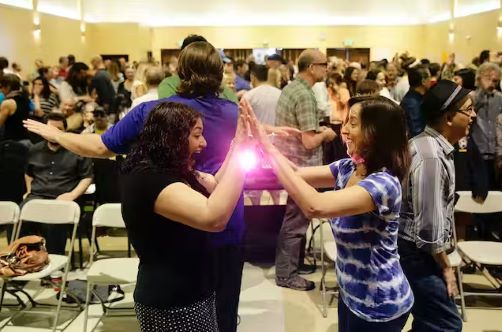
Shared testimonies, collective singing, silent meditation and baptism rituals – these are all activities you might find at a Christian church service on a Sunday morning in the United States. But what would it look like if atheists were gathering to do these rituals instead?
Today, almost 30% of adults in the United States say they have no religious affiliation, and only half attend worship services regularly. But not all forms of church are on the decline – including “secular congregations,” or what many call “atheist churches.”
As a sociologist of religion who has spent the past 10 years studying nonreligious communities, I have found that atheist churches serve many of the same purposes as religious churches. Their growth is evidence that religious decline does not necessarily mean a decline in community, ritual or people’s well-being.
What Is an Atheist Church?
Secular congregations often mimic religious organizations by using the language and structure of a “church,” such as meeting on Sundays or hearing a member’s “testimony,” or by adapting religious language or practices in other ways.
For example, there are a growing number of psychedelic churches, which cater to people looking to experience spirituality and ritual through drug use.
There are also secular organizations that promote the idea that people can live forever, such as the Church of Perpetual Life. Members believe they can achieve immortality on Earth through radical life-extension technologies such as gene editing or cryonic preservation – freezing bodies after death in hopes that they can someday be resuscitated.
These secular congregations often appeal to atheists and other secular people, but their main purpose is not promoting atheism.
However, “atheist church” organizations like the Sunday Assembly and the Oasis explicitly celebrate atheists’ identities and beliefs, even though not everyone who attends identifies as an atheist. Testimonies and activities extol values like rational thinking and materialist philosophies, which promote the idea that only physical matter exists.
There are also long-standing humanist and ethical communities that promote secular worldviews and provide secular ceremonies for major life transitions, like births, funerals and weddings. The American Humanist Association, for example, describes its values as “Good without a God.” And for decades, Unitarian Universalist congregations, which grew out of Christian movements, have drawn on teachings from both religious and nonreligious traditions, without imposing specific creeds of their own.
But there has been a recent rise in secular congregations that explicitly mimic religious organizations and rituals to celebrate atheistic worldviews. Many have just one or two chapters, such as the Seattle Atheist Church and the North Texas Church of Freethought.
However, Sunday Assembly and the Oasis have networks with dozens of chapters, and Sunday Assembly has been dubbed the “first atheist mega-church.” Many chapters of Sunday Assembly see hundreds of attendees at their services.
Testimonies, Singalongs – but Nothing Supernatural
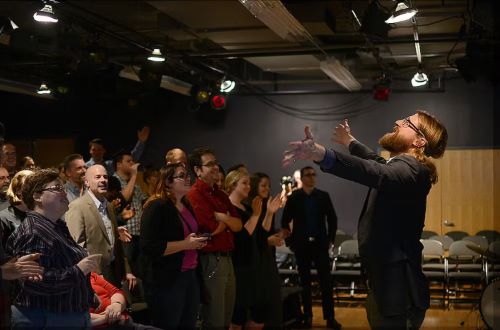
Many features of atheist churches in the U.S. are directly borrowed from religious organizations. At Sunday Assembly, where I spent three years doing research, services include collective singing, reading inspirational texts, silent reflection and collecting donations. They center around a central lecture given by a member of the congregation or a member of the larger local community. I attended one service where an astronomer gave a talk about the New Horizons spacecraft’s mission to Pluto. At another service, a member of a local community garden organization talked about building community through her community garden program.
Atheist church organizers I met told me that they intentionally borrow the structure of a church because they see it as a good model for building effective rituals and communities. More generally, the structure of a “congregation” is popular and familiar to most attendees.
However, there are key differences. Sunday Assembly has no hierarchical structure, and there is no pastor or minister, meaning that decisions are made by the community. Attendees share duties for running the services and finding speakers and readings.
The other key difference is the complete lack of reference to the supernatural. Lectures and rituals I have encountered at atheist church services are centered around affirming atheistic beliefs, celebrating science, cultivating experiences of awe and wonder for nature, and creating communities of support.
Sociologists of religion call these practices “sacralizing the secular” and “secular spirituality”: activities that enable nonreligious people to express their shared beliefs and cultivate a sense of belonging and purpose.

One example is collective singing: borrowing a familiar aspect of religious services that can give members a sense of transcendence. Most Sunday Assembly chapters have church bands that lead singalongs to pop songs like “Livin’ on a Prayer” by Bon Jovi and “Brave” by Sara Bareilles. When the astronomer talked to Sunday Assembly about NASA’s mission to Pluto, the congregation sang “Across the Universe” and “Lucy in the Sky with Diamonds” by the Beatles to reinforce their reverence for the vastness of the universe.
Another borrowed ritual is the sharing of testimony. Many Sunday Assembly services involve a member standing in front of the congregation to share something they learned recently, to express gratitude, or to affirm their atheistic beliefs by sharing why they left religion.
Some atheist communities, although not Sunday Assembly, even engage in “debaptism” ceremonies in which they renounce their former religion. Some atheists I interviewed sent their debaptism certificates to their former churches as a way of solidifying their new nonreligious identity.
Change Ahead?
As rates of religious affiliation continue to decline, many scholars and pundits have argued that there will be a decline in community engagement and other important indicators of well-being, such as health, happiness and people’s sense of meaning and purpose.
However, atheist churches are an example of how nonreligious Americans are finding new ways to meet those needs. A member of Sunday Assembly told me: “I honestly can’t think of a word to describe it. I mean, ‘life-changing’ sounds stupid, but Sunday Assembly just helped so much. I’ve always struggled with depression, and I’m so much happier now that I have this group of friends who share my beliefs and who are trying to do good out in the world with me.”
Atheist churches are still fairly new, but studies have shown that participation in them and other types of atheist organizations can bring social and emotional benefits. In particular, it can help atheists buffer the negative effects of experiencing stigma or discrimination.
Whether the atheist church trend will continue remains to be seen. But such churches’ recent growth is evidence that they can work much like religious organizations to build community, cultivate rituals and bolster well-being in a time of religious change.
Originally published by The Conversation, 01.11.2024, under the terms of a Creative Commons Attribution/No derivatives license.
About the Author