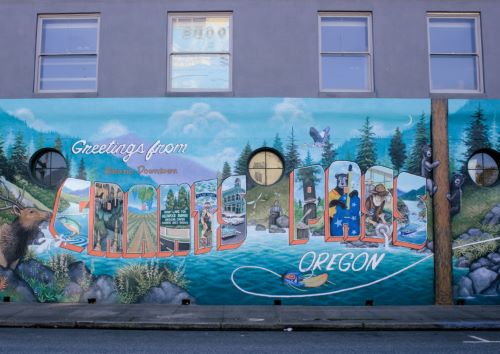
Among rural communities, Grants Pass, Oregon, has notched an unlikely win.

By Claire Carlson
Reporter
Nexus Media News
Introduction
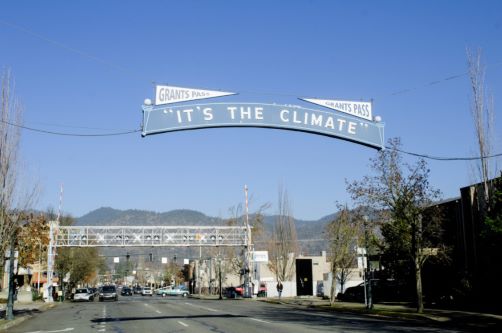
One of the most iconic landmarks in downtown Grants Pass, Oregon, is a 100-year-old sign that arcs over the main street with the phrase “It’s the Climate” scrawled across it.
To an outsider, it’s an odd slogan in this rural region, where comments about the climate – or rather, climate change – can be met with apprehension. But for locals, it’s a nod to an era when the “climate” only referred to Grants Pass’ warm, dry summers and mild winters when snow coats the surrounding mountains but rarely touches down in the city streets.
Now, the slogan takes on a different meaning.
In May 2023, the Grants Pass City Council passed a one-of-a-kind sustainability plan that, if implemented, would transition publicly owned buildings and vehicles to renewable energy, diversifying their power sources in case of natural disaster.
While passing the sustainability plan in this largely Republican county was an enormous feat on its own, actually paying for the energy projects proves to be Grants Pass’s biggest challenge yet.
“There are grants out there, but I don’t think we’re the only community out there looking for grants to help pay for some of these things,” said JC Rowley, finance director for the city of Grants Pass. Some project examples outlined in their sustainability plan include installing electric vehicle charging stations downtown and solar panels at two city-owned landfills, and converting park streetlights to LED.
Rural communities face bigger hurdles when accessing grant funding because they don’t have the staff or budget that cities often do to produce competitive grant applications. This can slow down the implementation of projects like the ones laid out in the Grants Pass sustainability plan.
And time is not something Grants Pass – or any other community – has to spare.
Global climate models show the planet’s average annual temperature increasing by about 6.3° Fahrenheit by 2100 if “business-as-usual” practices continue. These practices mean no substantive climate change mitigation policy, continued population growth, and unabated greenhouse gas emissions throughout the 21st century – practices driven by the most resource-consumptive countries, namely, the United States.
In southwest Oregon, this temperature increase means hotter summers and less snow in the winters, affecting the region’s water resources, according to a U.S. Forest Service analysis. This could mean longer and more severe wildfire seasons.
In Roseburg, Oregon, about 70 miles north of Grants Pass, a 6.3°F increase would mean the city’s yearly average of 36 days of below-freezing temperatures would decrease to few or none, according to the analysis. Grants Pass would suffer a similar fate, drastically changing the climate it’s so famous for.
Grants Pass has a population of 39,000 and is the hub of one of the smallest metropolitan statistical areas in the U.S. The metro contains just one county, Josephine, which has a population of under 90,000, nearly half of whom live outside urbanized areas. Over half of the county’s land is owned by the Bureau of Land Management or National Forest, and it contains a section of the federal Rogue River Scenic Waterway.
“In the event of a natural disaster, we are far more likely to get isolated,” said Allegra Starr, an Americorps employee who was the driving force behind the Grants Pass sustainability plan. “I’ve heard stories of communities that were less isolated than us running out of fuel [during power outages].”
Building resilience in the face of disaster is a main priority of the plan, which recommends 14 projects related to green energy, waste disposal, transportation, and tree plantings in city limits. All of the projects focus on improvements to city-owned buildings, vehicles, and operations.
In partnership with Starr and the Grants Pass public works department, a volunteer task force of community members spent one year researching and writing the sustainability plan. In spring 2023, it was approved by the Grants Pass City Council.
Now, the public works department is in the grants-seeking stage, and they stand to benefit from the influx of climate cash currently coming from the federal government.
Money for Sustainability, If You Can Get It
In 2022, the Biden administration passed the single largest bill on clean energy and climate action in U.S. history: the Inflation Reduction Act, which funnels $145 billion to renewable energy and climate action programs. The Bipartisan Infrastructure Law, passed in 2021, allocates $57.9 billion to clean energy and power projects.
“It’s almost like drinking through a fire hose with the grant opportunities, which is a curse and a blessing,” said Vanessa Ogier, Grants Pass city council member. Ogier joined the council in 2021 with environmental and social issues as her top priority and was one of the sustainability plan’s biggest proponents.
But competing against larger communities for the grants funded through these federal laws is a struggle for smaller communities like Grants Pass.
“I really don’t want to look a gift horse in the mouth, but when a small community only has one grant writer and they have to focus on water systems, fire, dispatch, fleet services, and they’re torn in all these different ways, it can be difficult to wrangle and organize all these opportunities and filter if they’re applicable, if we would even qualify,” Ogier said.
Having a designated grant-writing team, which is common in larger cities, would be a huge help in Grants Pass, Ogier said.
A 2023 study by Headwaters Economics found that lower-capacity communities – ones with fewer staff and limited funding – were unable to compete against higher-capacity, typically urban communities with resources devoted to writing competitive grant applications.
“[There are] rural communities that don’t have community development, that don’t have economic development, that don’t have grant writers, that may only have one or two paid staff,” said Karen Chase, senior manager for community strategy at Energy Trust, an Oregon-based nonprofit that helps people transition their homes and businesses to renewable energy. Chase was a member of the volunteer task force that put together the Grants Pass sustainability plan.
When the Inflation Reduction Act money started rolling in, many of the rural communities Chase works with did not have plans that laid out “shovel-ready” energy and climate resiliency projects, which is a requirement of much of the funding. Grants Pass’ sustainability plan should give them a leg-up when applying for grants that require shovel-ready projects, according to Chase.
“Most of my rural communities pretty much lost out,” she said.
This is despite the approximately $87 billion of Inflation Reduction Act money classified as rural-relevant, rural-stipulated, or rural-exclusive funding, according to an analysis from the Brookings Institute. Rural outreach is part of the Biden administration’s larger goal to put money into rural communities that historically have been left out by state and federal investments.
But this outreach isn’t perfect. Most of the federal grants available to rural communities still have match requirements, which are a set amount of money awardees must contribute to a grant-funded project.
The Brookings Institute analysis, which also looked at rural funding from the Infrastructure Investment and Jobs Act and the CHIPS and Science Act, found that “over half [of the rural-significant grants programs] require or show a preference for matching funds, and less than one-third offer flexibility or a waiver.”
Of the rural-exclusive and rural-stipulated programs, less than one-third of the total grants offer match waivers or flexibility to reduce the match requirement. This makes getting those grants a lot harder for rural communities with smaller budgets.
Help From the Outside
To address limited staffing, in 2021 the Grants Pass public works department applied to be a host site for an Americorps program run out of the University of Oregon.
The program, coined the Resource Assistance for Rural Environments (RARE) program, assigns graduate students to rural Oregon communities for 11 months to work on economic development, sustainability planning, and food systems initiatives. An Americorps member was assigned to Grants Pass to work as a sustainability planner from September 2022 to August 2023.
Without the Americorps member, Grants Pass officials say there’s no way the plan would have been written.
“She came in and learned about the city and the operations and the technical aspects of it and was able to really understand it and talk about that,” said Kyrrha Sevco, business operations supervisor for the public works department. “That’s hard to do.”
Bringing outsiders in can be a tricky undertaking in a rural community, but RARE program director Titus Tomlinson said they collaborate with the host sites to make the transition for their members as smooth as possible.
“When we place a member, we place them with a trusted entity in a rural community,” Tomlinson said. “[The site supervisor] helps them meet and engage with other leaders in the community so that they’ve got some ground to stand on right out of the gate.”
Each participating community must provide a $25,000 cash match that goes toward the approximately $50,000 needed to pay, train, and mentor the Americorps member, according to the RARE website. Communities struggling to meet this cash match are eligible for financial assistance.
Grants Pass paid $18,500 for their portion of the RARE Americorps grant.
Allegra Starr, the Americorps employee, no longer works in Grants Pass since completing her 11-month term. In her stead, a committee of seven has been created to monitor and report to the city council on the progress of the plan’s implementation.
Much of this implementation work will fall on the director of the public works department, Jason Canady, and the business operations supervisor, Kyrrha Sevco.
“There has to be that departmental person who’s really carrying that lift and that load,” said Rowley, the Grants Pass finance director. “It’s the Kyrrhas and Jasons of the world who are leading the charge for their own department like public works.”
Now, Canady and Sevco are laying the groundwork for multiple solar projects. Eventually, they hope to bring to life what local high school student, and member of the original volunteer sustainability task force, Kayle Palmore, dreamed of in an essay titled “A Day in 2045,” which envisions bike lanes, wide sidewalks, solar panels, and electric vehicle charging stations on every street corner.
“A smile spreads across your face as you think of how much you love this beautiful city,” Palmore writes.
Originally published by Nexus Media, 02.14.2024, under the terms of a Creative Commons Attribution-NoDerivs 3.0 Unported license.
About the Author