A book examines how global warming could displace millions of Americans.

By Dr. Ramin Skibba
Astrophysicist and Science Writer
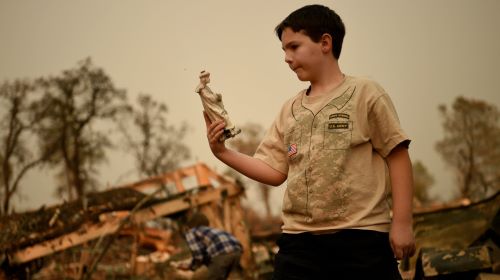
Just months after the Carr and Mendocino Complex fires ripped through nearly 700,000 acres of northern California in 2018, the wind-driven Camp Fire erupted near Chico. The fire scorched through the abnormally dry vegetation, blazing and spreading rapidly, and at one time burned some 10,000 acres in just 90 minutes. It caught the residents of the cozy town of Paradise, nestled in the western Sierra Nevada forests, completely by surprise. The conflagration quickly consumed the entire town, destroying everything and killing 85 people.
Most of the rest of the 26,000 residents fled, and survivors relocated, mostly to California’s Central Valley. Around a quarter have returned to rebuild their homes and communities, despite the fire risks, but many of Paradise’s diaspora cannot or do not want to attempt doing so. Now that they’ve been uprooted, they’re moving on with their lives elsewhere.
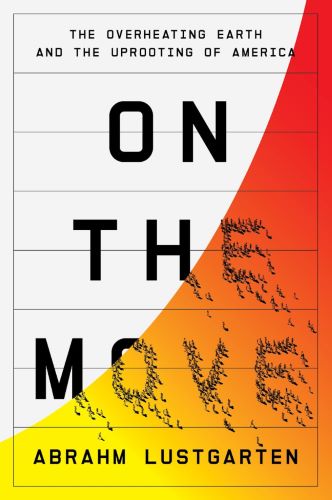
Such a scenario is a sign of what’s to come for a growing swath of Americans in the climate-change era, Abrahm Lustgarten argues in “On the Move: The Overheating Earth and the Uprooting of America.” Building on his investigative reporting for ProPublica and The New York Times, Lustgarten makes the case that the trickle of Americans moving primarily for climate-related reasons will eventually turn into a flood, with some projections showing that within the next 50 years, tens of millions will relocate to more resilient climes, dramatically altering the future of the country.
Plenty of dangerous climate impacts are already baked into our future, even if humanity manages to limit global warming to less than 2 degrees Celsius above pre-industrial levels — and even if global carbon emissions were magically stopped today. More intense wildfires and droughts will continue plaguing much of the western United States, the South will be beset with more frequent heat waves, and most of the Gulf and East Coasts will struggle with crumbling coastlines, hurricanes, and intermittent flooding. And such effects will be worse if warming isn’t limited.
Climate projections depict “a nation about to be transformed,” Lustgarten writes, as many people face a litany of climate-related threats. “The data also presents a vision of hope, because once it is clear where the dangers lie — and which few parts of the country may remain relatively unscathed — it becomes possible to plan a route to escape.”
On a global scale, citing a seminal 2020 study, he reports that nearly unlivable territory that’s too hot or desert-like currently spans just 1 percent of the planet’s surface, but that could grow to nearly 20 percent by 2070, including land that 3.5 billion people today call home. That projection is based on models assuming a high-emissions scenario — also referred to as business as usual.
Places where people have lived for millennia will become increasingly inhospitable, and the climate impacts will be accompanied by economic ones that will be tough even for wealthy Americans to withstand. At the same time, more ideal climates for life and farming in North America will move northward to the Midwest, the Pacific Northwest, and into Canada. Regions known for harsh winters will become more temperate and verdant, and if Lustgarten and the scientists he cites are right, tens of millions of Americans, or more, will pack up and move to them. If climate migration on that scale comes to pass, it will dwarf the Dust Bowl migration of the 1930s.
Lustgarten’s book arrives at a moment when journalists, scientists, and politicians are paying increasing attention to both the climate crisis and migration patterns, and are beginning to see linkages. Researchers have begun noting small numbers of people proactively moving north, to places like Duluth, Minnesota, while writers like Jake Bittle, in his 2023 book “The Great Displacement: Climate Change and the Next American Generation,” are starting to explore the profound economic and social implications of climate migration. Lustgarten, for his part, highlights the role of the insurance industry and subsidies, both as part of the problem and the solution.
But, for a while at least, many people won’t or can’t leave, whether they’re ill or elderly or tied to their jobs. For those who are moving, many go where they can find employment, housing, and to reside close to their families — even if that means moving to flood- or fire-prone zones or to low-lying coastal areas. In particular, populations in the wildland-urban interface that is vulnerable to fires have grown in recent years, especially in the Southwest, like Nevada and Arizona, and in some southern states like Florida. (Lustgarten lives in the San Francisco Bay Area, which contends with fire risks, smoke-affected air quality, sea level rise, atmospheric rivers, and unreliable water sources, on top of earthquake risks.)
Lustgarten’s central argument is that home insurance companies and government subsidies are perversely masking risks in threatened areas, making migration overdue, as many people aren’t aware of the extent of worsening climate impacts that surround their neighborhoods. The effect of such programs is “a gross misrepresentation of the true cost to the public,” he writes, and “the result is that the number of Americans incentivized to live in environmentally unstable places is a lot closer to one in two.”
At the same time, Lustgarten points out that the recent decisions of companies like State Farm and Allstate to halt new homeowners’ insurance policies in California, and Farmers Insurance’s move to limit policy renewals in Florida, may be signs of what’s to come. Either way, the situation presents troubling dilemmas: Does disaster relief provide much-needed help or encourage rebuilding in disaster-prone spots? And can insurance companies nudge climate migration forward without leaving people behind?
One trend Lustgarten could have explored further is the rise in remote and hybrid work environments in the post-pandemic world, and how that might affect demographic patterns. On average, Americans now live more than twice as far from their employers as they did before the pandemic, according to a new study by economists at the payroll company Gusto and several academic researchers. That presents an opportunity, at least to white-collar workers, as many could live in environmentally safer, more resilient places.
“On the Move” reveals our society’s need for climate justice and equitable adaptation and for systemic changes across many industries and aspects of our lives. “Adapting to climate change demands something of America that the country isn’t necessarily good at: decisive action and forethought,” Lustgarten writes. It means shoring up areas that could be made more resilient, government-funded home buyouts and managed retreat policies in places that may have to be abandoned. Some will be tough decisions, to be sure. Yet it also means preparing the places that could grow, he argues, whether they’re regional hubs like Atlanta and Houston or Midwestern cities with a current glut of housing, like Detroit, Cleveland, and Pittsburgh. And it means investing in relocation programs and expanding infrastructure, whose construction could provide a source of jobs.
But, as Lustgarten cautions, the nation has a sordid history when it comes to relocating people, such as the Native American tribes that were violently dispossessed and forced into distant lands that are now more vulnerable to climate change. Climate migration must be handled differently — perhaps including some kind of policy of climate reparations. As one of Lustgarten’s sources puts it “the only way to get ahead of this thing is to make some serious repair for the past.”
“On the Move” focuses on the continental United States, but climate change knows no borders, of course. As Lustgarten notes, “climate migrant” and “climate refugee” aren’t yet official terms in international law, but the concepts are becoming more widely appreciated: Last month, the Inter-American Commission on Human Rights held a hearing in Washington on climate migration for the first time, and the United Nations Refugee Agency acknowledged the climate’s role in displacing people.
In the end, Lustgarten urges readers to rethink our collective future and what we owe each other as our lives become more transient and vulnerable to external forces. “Sometimes the unexpected makes the impossible possible,” he writes. “And still, I live in fear. We all do. There is a sense that change is barreling toward us and we are bracing for impact.”
Originally published by Undark Magazine, 03.29.2024, republished with permission for educational, non-commercial purposes.
About the Author