The secret recordings of two conservative Supreme Court justices reveal dramatic differences in how they see American political life.

By Dr. Kevin J. McMahon
Professor of Political Science
Trinity College
Introduction
Polarization is both essential to a functioning democracy and a threat to it.
Too little disagreement among citizens and leaders is unlikely to produce the fruitful political debate that leads to better policy and law. Too much dissension – especially if groups form opposing camps closed off from one another – may result in violence and destroy democracy.
To borrow a quote from another time and context, polarization is “like the bubble in a carpenter’s level.” If the bubble veers too far to either side, something is askew.
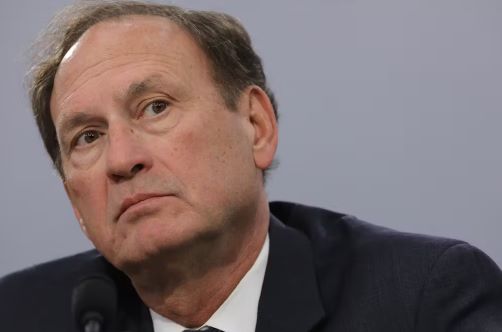
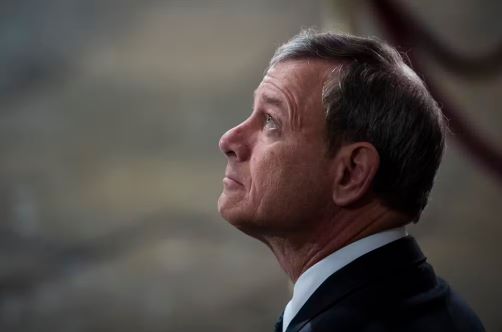
On June 3, 2024, conservative Supreme Court Justices Samuel Alito and John Roberts, in conversations with documentary filmmaker and liberal activist Lauren Windsor, who surreptitiously recorded them, offered starkly different views about where the polarization bubble sits in today’s America.
While Windsor does most of the talking in her conversation with Alito, the justice does agree with her characterization of polarization as a win-lose phenomenon. For Alito, polarization is “very dangerous” because “there are differences on fundamental things that really can’t be compromised.”
While it’s not surprising to hear Alito’s conservative views, his bluntness on polarization is striking. There’s no talk of judges being like umpires, calling balls and strikes, as Chief Justice John Roberts put it in his 2005 Senate confirmation hearing.
Instead, Alito appears to be a justice willing to express his views on the ideological divide in the nation, and in agreeing with Windsor’s words, he’s seemingly ready to use his position to “return our country to a place of godliness.”
Roberts takes a different position on polarization in those recordings. The chief justice offers a more optimistic view of today’s politics by pointing to other periods of great conflict in U.S. history, including the Civil War, the New Deal and the Vietnam War. He asks Windsor for examples of a “non-tumultuous time.” To him, the current state of affairs “is nothing new.”
The divergent views of the two justices may well be reflected in both their respective understanding of the role of the Supreme Court in American life, as well as in consequential decisions in which they played a decisive role.
Fearful or Sanguine
Of course, the conservative Alito is not alone in describing polarization in such unsettling terms. Many on the left agree with him. They fear for the future of American democracy, particularly if Donald Trump wins the presidency again in November 2024.
For Alito, “one side or the other is going to win.” The chance for compromise is unlikely and, he suggests, may be unwanted. Again, many on the left agree.
In Roberts’ more positive statement to the filmmaker, he disagrees with her characterization that “polarization is so extreme it might be irreparable.” For him, “polarization that’s extreme is like the Civil War … [and] during Vietnam [when] people were getting killed.”
Is the Vietnam War era a fair comparison to today?
Certainly, in some areas, there is greater polarization now than during the late 1960s and early 1970s. Consider, for example, party-line voting in Congress.
During the late 1960s and early 1970s, it was not uncommon for members of both parties to unite to pass significant legislation. The Clean Air and Clean Water acts are just two examples. When President Richard Nixon vetoed the latter in 1972, Congress overwhelmingly overrode Nixon’s veto mere hours later. It did so with bipartisan support just weeks before an election that Nixon would win in a landslide.
But I do not believe Roberts was focusing on the ease of enacting new laws. In using the word “killed” in referring to the Vietnam era in the quote above, political violence appears to be front and center in his thoughts.
And here, Roberts is undoubtedly correct.
Assassinations, Police Brutality
The 1960s and 1970s were riddled with political violence. The most obvious manifestations were the political assassinations. Leaders like President John F. Kennedy, Black nationalist Malcolm X, civil rights champion Martin Luther King Jr. and senator and presidential candidate Robert F. Kennedy – to list just a few – were all murdered in the prime of their lives.
John F. Kennedy and Robert F. Kennedy were 46 and 42, respectively. King and Malcolm X were just 39. In 1972, an attempted assassination ended the presidential campaign of George Wallace, the 52-year-old segregationist governor of Alabama.
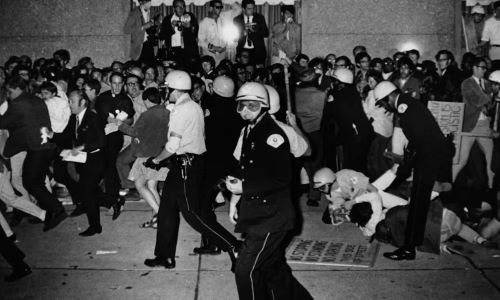
There was political violence in the streets as well. Mass arrests and police brutality defined the scenes from Chicago during the Democratic Convention there in 1968. But that was just a single event.
In her 2022 book “America on Fire,” historian Elizabeth Hinton recasts what have previously been called “urban riots” as “political rebellions.” She details that “between May 1968 and December 1972, some 960 segregated Black communities across the United States witnessed 1,949 separate uprisings. … Over these four years, nearly 40,000 people were arrested, more than 10,000 were injured, and at least 220 people were killed.”
In his 2016 book, “Days of Rage,” journalist Bryan Burrough examines the widespread domestic bombings of the 1970s. While few of them resulted in fatalities, as he writes, “during an eighteen-month period in 1971 and 1972, the FBI reported more than 2,500 bombings on U.S. soil, nearly 5 a day.”
A ‘Rought and Tumble,’ but Enduring, Democracy
While politics in the U.S. is characterized by deep polarization and bitter division now, it is not characterized by widespread and sustained political violence.
One event in particular stands out as a contrary example. The Jan. 6, 2021, attack on the U.S. Capitol was an attack on the nation’s democracy without a comparison. Never before had supporters of the defeated candidate threatened to overturn the election results by violently storming the Capitol to prevent the certification of the election’s victor.
But while the events of Jan. 6, 2021, shook the core of U.S. democracy, members of that mob have not escaped prosecution and punishment.. And, of course, Trump has been indicted for his efforts to overturn the 2020 election.
In a couple of minutes of recorded conversation, Roberts seemingly wanted his listener to understand that America has faced troubled times before. Its democracy has been tested by division and discord and has come through stronger in the end.
Roberts implies that we should expect as much now, as well.
The openness of democracy, as American history has shown time and again, often produces messy politics. Roberts’ view is certainly more confident about the state of America today than that of Alito.
But as a political scientist who incorporates historical analysis in his work, I believe Roberts’ comparison of current U.S. politics to the politics of the 1960s and 1970s is an apt one. Indeed, in a time when so many have raised deep concern about the threat of polarization, it is an important reminder of both the rough-and-tumble nature and the enduring power of American democracy.
Originally published by The Conversation, 06.24.2024, under the terms of a Creative Commons Attribution/No derivatives license.
About the Author