Beliefs and activities vary from group to group.

By Catrina Doxsee
PhD Student in Security Studies
Princeton University
Introduction
Militia groups* recently captured the public’s attention following their presence at racial justice protests in 2020 and participation in the January 6, 2021, Capitol attack. Yet, the modern militia movement has operated in the United States for the past three decades, and the inspiration for these armed groups’ beliefs and methods date back to at least the mid-twentieth century. This piece outlines the history of the U.S. militia movement, as well as these groups’ ideology, organizational structure, and tactics and targets. It concludes with an assessment of the large and escalating threat militias pose in the United States today, which is driven by alleged existential threats from government overreach and exacerbated by an increased blending of conspiracy theories and perceived legitimization from authority figures.
History
The modern U.S. militia movement formed in the early 1990s, presenting a more consistent anti-government ideology than its predecessors. Still, these militia groups drew inspiration from preceding far-right paramilitary groups, such as Posse Comitatus and the Christian Patriots Defense League, as well as adjacent extremist ideologies, such as the sovereign citizen and tax protest movements.
The first of these militias mobilized in response to perceived government overreach, particularly with regard to weapons restrictions. The first inciting incident was the 1992 Ruby Ridge standoff, during which white separatist Randy Weaver and his family engaged in an 11-day siege with law enforcement at a remote cabin in northern Idaho after failing to appear for trial over a weapons charge. This was followed by the 1993 Waco standoff—the law enforcement siege of a Branch Davidian compound near Waco, Texas, after a failed Bureau of Alcohol, Tobacco and Firearms raid. In both instances, civilians were killed or injured, including children. New gun control laws that came on the heels of these standoffs, including the 1993 Brady Bill and the 1994 Federal Assault Weapons Ban, drove a further increase in the number of militia groups and their membership. Strong currents of white supremacy have existed in the militia movement from the beginning, though the extent of racial motivation varies widely between groups and individuals. Waco—which centered more exclusively on anti-government sentiment—gave the nascent movement some cover against allegations of racism after Ruby Ridge primarily mobilized white separatists.
In 1995, the Oklahoma City bombing—the second largest terrorist attack in U.S. history and the deadliest by a domestic perpetrator—raised the militia movement’s profile. Although neither Timothy McVeigh nor Terry Nichols were militia members, McVeigh was inspired by pro-militia and other conspiracy theory literature and had traveled to witness the Waco siege. He conceived the attack on the Alfred P. Murrah Federal Building as a response to the government’s actions at both Waco and Ruby Ridge.
Though militia groups remained active in the United States, the rate of violent incidents decreased by the late 1990s and early 2000s. Contemporaneous data from the Southern Poverty Law Center (SPLC)—corroborated by data trends tracked by the FBI and other watchdog groups—indicate that the number of militia groups operating in the United States spiked to a high of 370 in 1996 following the Oklahoma City attack, but fell to 68 by 1999. The SPLC and others attributed this decline to a variety of factors, including an increase in law enforcement activity and arrests targeting the groups, disillusionment among members, and loss of interest.
After subsisting at a smaller scale on a spate of new conspiracies surrounding Y2K and the 9/11 attacks, the militia movement resurged around the 2008 presidential campaign and the election of President Barack Obama. Part of this revival stemmed from concerns over Democratic policy positions on issue such as gun control and immigration, as well as the strong reaction from white supremacist militia members to the prospect of having such policies established by the nation’s first Black president. Moreover, the emergence of new mainstream political actors such as the Tea Party that voiced similar opinions on these key policy issues offered perceived legitimacy to militias’ ideas.
A third wave in the militia movement began during the 2016 presidential campaign and subsequent Trump presidency. Similarly, this growth was enabled by what militia members perceived as a more permissive, or even legitimizing, political environment. Militias were emboldened by policy changes and rhetoric that they perceived to validate their beliefs, such as hardline immigration control. For example, some militia groups expanded long-standing efforts to patrol the southwestern U.S. border for unauthorized immigrants, intending to assist U.S. Customs and Border Protection (CBP). This also contributed to an evolving relationship with some law enforcement agencies. Though militias traditionally opposed government oversight, some increasingly saw certain law enforcement agencies—such as CBP—as allies.
A series of events in 2020 further mobilized militia extremists. The Covid-19 pandemic and subsequent lockdown and mask requirements sparked a series of protests and public demonstrations, many of which were organized or attended by militia groups. Following the murder of George Floyd, armed militia members also attended racial justice and police reform protests, ostensibly to provide security to local businesses.
Conspiracy theories claiming that the 2020 election of President Joe Biden was illegitimate and was instead won by Donald Trump drove a further increase in militia activity—including participation in the Stop the Steal movement. Members of various militia groups, including major national umbrella groups or ideologically linked networks such as the Oath Keepers, Proud Boys, and the Three Percenters, also participated in the January 6, 2021, attack on the U.S. Capitol.
Throughout the events of 2020 and 2021, the claims and activities of authority figures continued to lend perceived legitimacy to militias’ activity. For example, then-president Donald Trump made claims of a rigged election both before and after the results were tallied, and Illinois General Assembly member Chris Miller displayed a Three Percenters decal on his vehicle on January 6.
Ideology
While the militia movement displays much more ideological continuity between discrete groups than the individual paramilitary groups that inspired them, beliefs and activities vary from group to group. Although most militia groups oppose government and law enforcement power broadly, others view themselves as a potential partner to certain law enforcement agencies, such as CBP. While there is substantial overlap between militia members and white supremacists—particularly in groups driven by anti-immigrant, anti-Muslim, or anti-Semitic beliefs—the two are not equivalent. Some local militias oppose racism—instead villainizing government institutions that perpetuate it—and a small percentage of militia membership includes people of color.
Militias are typically built around preparation for an existential violent threat, in which participants usually envision themselves as heroes—protecting and preserving their families and communities. Although the nature of this alleged threat varies between groups and over time, members are largely unified by their opposition to government authority and support for second amendment rights. In some cases—such as militias’ cooperation with CBP officers or presence at protests during the summer of 2020 to allegedly protect businesses—militia members again cast themselves as defenders of the social order: the last line of defense against perceived threats such as immigrants or left-wing demonstrators. This shifting sense of an existential threat facing communities explains the apparent dissonance between such incidents and militias’ traditional anti-government stance. In recent years, many militias have increasingly positioned themselves in opposition to broader left-wing political movements in addition to—or in place of—their core focus on government actions.
Militias’ rhetoric invokes nostalgic—albeit usually historically inaccurate—imagery of the U.S. revolution and founding, including praise for the minutemen and the myth that only 3 percent of colonists fought for independence. Many believe that the country is locked in a struggle between nationalists (themselves)—individuals dedicated to upholding original Constitutional values—and globalists.
Much of the militia ideology is built around conspiracy theories. For example, most militias’ beliefs revolve around the existence of the New World Order (NWO)—a secretive globalist group that seeks to erode Americans’ rights, typically beginning with the second amendment, in order to create an all-powerful world government. These NWO claims are usually infused with anti-Semitism, tracing back to William Luther Pierce’s The Turner Diaries—a key white supremacist text and one of the earliest articulations that gun control would be the first step toward a NWO takeover. Members of militia groups have remained open to other conspiracy theories over the years, particularly those that allegedly expose widespread threats in which the economic and political elite are either responsible or complicit. For example, posts in internet forums reveal that many militia members were early adherents of the QAnon conspiracy theory.
Despite their heavy focus on firearms and an approaching conflict, the majority of militia members have not planned or committed acts of violence; many are more accurately described as survivalists or armed doomsday preppers than as terrorists. Some groups, such as the Three Percenters, have specifically detailed commitments to not attacking first and not targeting noncombatants to maintain a “moral high ground.” In a blog post first published in November 2008, Mike Vanderboegh—the founder of the Three Percenters—wrote:
We don’t fire first, nor second, nor perhaps even third. This does not mean we can’t defend ourselves. We must. What it does mean is that the rest of [us] don’t react until everyone understands that it is collective self-defense. We must not cede the moral high ground.
Still, the movement’s extremist ideas—namely its distrust of the federal government and its fierce support of second amendment rights—appeal to individuals willing to pursue similar ends by violent means. Given the loose organization of groups, commitments to codes of conduct from leaders also do not imply agreement among all members or offshoots. For example, despite Vanderboegh’s stated commitment to taking defensive action only, the White Rabbit Three Percent Illinois Patriot Freedom Fighters Militia has been linked to two bombings in 2017, at a Minnesota mosque and an Illinois women’s health clinic. Furthermore, militia members’ perception of existential stakes may distort their understanding of self-defense and shape their justification for the use of force.
Organizational Structure
Though described broadly as a “movement,” militias operate independently, with composition, leadership structure, and priorities set by each distinct group. Most militias are organized geographically—centered on a particular city, state, or region. Some national militia organizations also exist, such as the Proud Boys, Oath Keepers, and Three Percenters. These largely serve as umbrella organizations that coordinate smaller chapters or member networks. Most militia groups have a hierarchy of leaders and skill trainers, and most value demonstrable skills and relevant professional backgrounds, including current or prior military or law enforcement affiliation.
Recently, further opportunities for networking and communication across groups and regions have emerged online, both through mainstream social media platforms and through custom platforms designed for militia and paramilitary enthusiasts. For instance, many local and regional militia groups have used Facebook pages or groups to organize in recent years. As Facebook increases its scrutiny of militia-associated pages, independent militia websites have grown in popularity, including one with national reach through which militia members and prospective members can access resources, participate in forum discussions, and find or create local militia groups. Since the most prominent of these sites allows public access to most content and has been openly cited by law enforcement and counterextremism researchers, other private forums have emerged that users advertise via word of mouth and that require a higher level of screening to gain access.
Tactics and Targets
Many militia attacks and plots have targeted government and law enforcement targets, owing to their opposition to government authority. For example, in 2020, law enforcement disrupted plots to abduct and likely execute the governors of Michigan and Virginia in response to state shutdown orders, which militia groups viewed as government overreach.
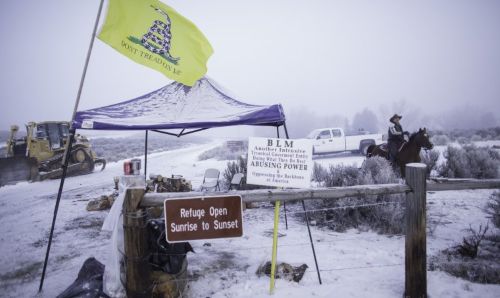
Despite instances in which militia extremists have directly used firearms or explosives to conduct attacks, such as the White Rabbit Three Percent Illinois Patriot Freedom Fighters Militia bombings, militia-linked events often involve standoffs between heavily armed extremists and law enforcement, intended to coerce a desired outcome through the threat of violence. While Ruby Ridge and Waco are the most famous examples, these tactics have also been used more recently. For example, in 2014, Cliven Bundy rallied hundreds of militia members to Bunkerville, Nevada, in an armed standoff with the Bureau of Land Management (BLM) over land rights. In 2016, Bundy’s son, Ammon Bundy, led the occupation of the Malheur National Wildlife Refuge in Burns, Oregon, to protest the imprisonment of two local ranchers and the allegedly unjust control of the BLM.
In some cases, militia members have also used armed demonstrations or threats to disrupt policymaking sessions. In April 2020, a group of demonstrators—some heavily armed and members of militia groups—stormed the Michigan State Capitol in opposition to Michigan governor Gretchen Whitmer’s stay-at-home order. Nor is this the first time in recent years that militia groups have impeded state legislative proceedings: in June 2019, a militia threat led to the emergency closure of the Oregon statehouse after Republican lawmakers staged a walkout in opposition to proposed climate change legislation.
Threat Assessment
Previous CSIS analysis found that far-right terrorists—including militia extremists and white supremacists—pose the greatest domestic terror threat in the United States, with activity increasing in recent years. Similarly, in a March 2021 threat assessment, the Office of the Director of National Intelligence identified militia violent extremists alongside racially or ethnically motivated violent extremists as the most lethal domestic extremist threat. This assessment also noted that “contentious sociopolitical factors” would likely continue to escalate the threat posed by violent militias throughout 2021.
As demonstrated by the militia extremists who participated in the January 6 attack at the Capitol, these groups justify violent action by the alleged existential threat from socialists and globalists believed to be associated with the Democratic Party. Over the past year, such activity has been supported most strongly by militia members who overlap with other extremist movements, such as QAnon and Stop the Steal. Studies have indicated that people who believe in one conspiracy theory are more likely to also believe in others. If extremism in the United States linked to these and other related ideologies—including white supremacy, the boogaloo movement, violent misogyny, and other components of the “Patriot” movement—continues to grow, it is possible that some militia members will radicalize further and subsequently become more inclined to act.
It is likely that militia extremists will continue to mobilize in response to what they perceive as the existential threats posed by the Biden administration. Gun control changes—such as those announced by the administration in 2021—would be the most obvious flashpoint for extremist action, but other issues including concerns over personal freedom related to Covid-19 or immigration policy changes could also result in violence. Following the results of the 2020 presidential election, some longtime militia extremists compared the coming years to the threat of the Obama administration, with the key difference being that this time, they are better prepared and have a wide array of disappointed Trump supporters from which to recruit.
One of the outstanding questions as militia activity continues to grow is whether these extremists will develop and maintain the capability to coordinate in a larger or more centralized manner, including through online platforms. Yet, as cases such as the Wolverine Watchmen plot to abduct Michigan governor Gretchen Whitmer demonstrate, a large group is not needed to coordinate a dangerous plan—and in fact, it may be easier to organize a smaller set of participants to execute a plot. Following the events of January 6, many militia members participating in online forums recommended to others that they join local groups rather than large national ones to avoid scrutiny by law enforcement.
Furthermore, the growth in militia activity coincides with other warning signs. For example, gun sales in the United States have spiked to an all-time high, corresponding to purchases in states with strong lockdown policies (and, by extension, a strong push to reopen). Terrorist activity in the United States is on the rise—having reached its highest level in decades in 2020—and firearms are the most common weapon used in fatal U.S. terrorist attacks, regardless of ideology.
These factors combine to paint a troubling picture of what the country might see from militia groups in the coming months or years. Overall, militia extremists pose a large and escalating terrorism threat in the United States, driven by what they perceive as existential threats justifying violence and a broadening milieu of conspiracy theories—all reinforced by recent signals from authority figures, whom militias view as legitimizing or directing their cause. A movement that was often dismissed as a low-level nuisance three decades ago now maintains a significantly elevated profile and is actively expanding its influence. Until recently, the federal government did not dedicate substantial time or resources toward combating this domestic threat, thus permitting it to grow largely unabated. It will take time, concentrated interagency effort, and bottom-up intelligence to reverse this trend, particularly as the movement becomes intertwined with other extremist beliefs.
Originally published by the Center for Strategic & Inrternational Studies (CSIS), 08.12.2021, republished with permission for educational, non-commercial purposes.
About the Author