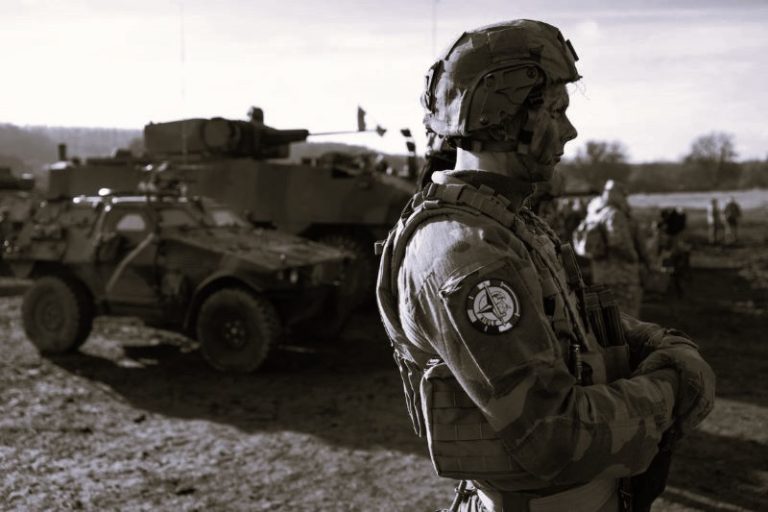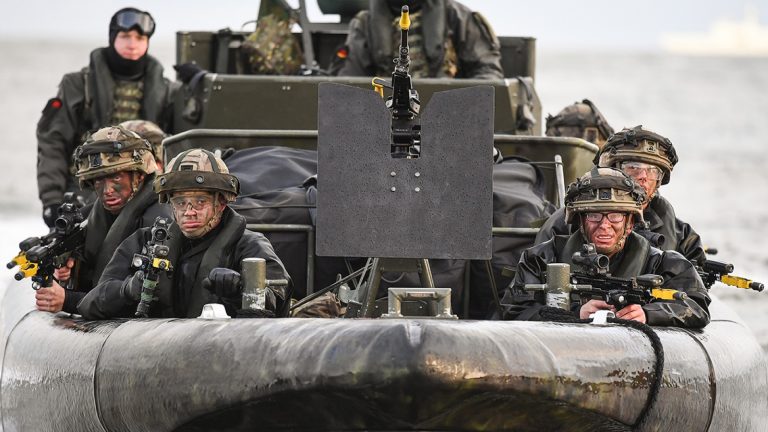
The alliance is bolstering its military deterrent in Europe amid Russia’s invasion of Ukraine.

By Jonathan Masters
Deputy Managing Editor
Council on Foreign Relations
Introduction
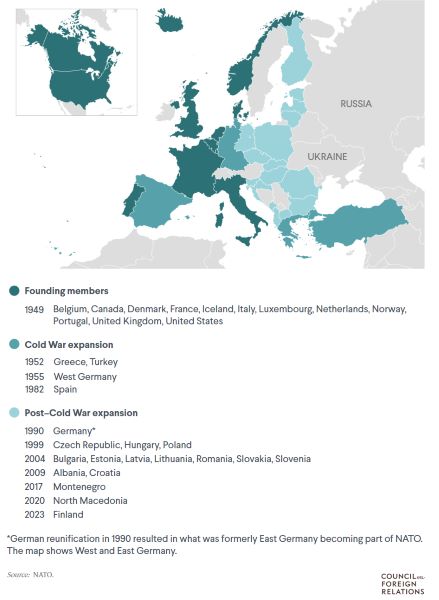
Founded in 1949 as a bulwark against Soviet aggression, the North Atlantic Treaty Organization (NATO) remains the pillar of U.S.-Europe military cooperation. An expanding bloc of NATO allies has taken on a broad range of missions since the close of the Cold War, many well beyond the Euro-Atlantic region, in countries such as Afghanistan and Libya.
Russia’s unprovoked invasion of Ukraine, a nonmember, in early 2022 has shaken Europe’s security architecture and prompted a major reevaluation of NATO members’ foreign policies and defense commitments. The threat from Russia has generated the greatest tensions with the alliance in the post-Cold War era. It is driving up defense spending and has pushed some longtime NATO partners, namely Finland and Sweden, to seek full membership. Finland acceded to the alliance in April 2023.
A Post-Cold War Pivot
After the demise of the Soviet Union in 1991, Western leaders intensely debated the direction of the transatlantic alliance. Some in the Bill Clinton administration initially opposed expanding NATO, wary it would upset relations with President Boris Yeltsin’s fragile government in Russia and complicate other U.S. foreign policy objectives, such as nuclear arms control. Others favored expansion as a way to extend NATO’s security umbrella to the east and consolidate democratic gains in the former Soviet bloc.
European members were also split on the issue. The United Kingdom feared NATO’s expansion would dilute the alliance, while France believed it would give NATO (and the United States) too much influence. Paris hoped to integrate former Soviet states via European institutions.
As a first step, Clinton chose to develop a new NATO initiative called the Partnership for Peace (PfP), which would be open to all former Warsaw Pact members, as well as non-European countries. Seeing this nonmembership framework as a means to allay some of Russia’s concerns about alliance expansion, NATO launched PfP at its annual summit in 1994. More than two dozen countries, including Georgia, Russia, and Ukraine, joined in the following months.
However, Clinton soon began speaking publicly [PDF] about expanding NATO’s membership, saying in the Czech Republic just days after the launch of PfP that “the question is no longer whether NATO will take on new members but when and how.” Yeltsin warned Western leaders at a conference later that year that “Europe, even before it has managed to shrug off the legacy of the Cold War, is risking encumbering itself with a cold peace.”
Beyond Collective Defense
Many U.S. officials felt that a post–Cold War vision for NATO needed to look beyond its core defense commitments—Article V of the North Atlantic Treaty states that “an armed attack against one or more [member states] in Europe or North America shall be considered an attack against them all”—and focus on confronting challenges outside its membership. “The common denominator of all the new security problems in Europe is that they all lie beyond NATO’s current borders,” said influential U.S. Senator Richard Lugar in a 1993 speech.
The breakup of Yugoslavia in the early 1990s and the onset of ethnic conflict tested the alliance on this point almost immediately. What began as a mission to impose a UN-sanctioned no-fly zone over Bosnia and Herzegovina evolved into a bombing campaign on Bosnian Serb forces that many military analysts say was essential to ending the conflict. In April 1994, during Operation Deny Flight, NATO conducted its first combat operations in its forty-year history, shooting down four Bosnian Serb aircraft.
NATO’s Structure
Headquartered in Brussels, NATO is a consensus-based alliance in which decisions must be unanimous. However, individual states or subgroups of allies can initiate action outside NATO’s auspices. For instance, the United States, France, and the United Kingdom began policing a UN-sanctioned no-fly zone in Libya in early 2011 and, within days, transferred command of the operation to NATO once Turkey’s concerns had been allayed. Member states are not required to participate in every NATO operation; Germany and Poland declined to contribute directly to the campaign in Libya.
NATO’s military structure comprises two strategic commands: the Supreme Headquarters Allied Powers Europe, located near Mons, Belgium, and the Allied Command Transformation, located in Norfolk, Virginia. The supreme allied commander Europe oversees all NATO military operations and is always a U.S. flag or general officer; U.S. Army General Christopher G. Cavoli currently holds this position. Although the alliance has an integrated command, most forces remain under their respective national authorities until NATO operations commence.
NATO’s secretary-general, Norwegian politician Jens Stoltenberg, is serving a second four-year term as the bloc’s chief administrator and international envoy. However, NATO leaders extended his service for one additional year (until September 2023) amid the war in Ukraine. The alliance’s principal political body is the North Atlantic Council, which is composed of high-level delegates from each member state.
Sharing the Burden
Member states’ primary financial contribution is the cost of deploying their respective armed forces for NATO-led operations. These expenses are not part of the formal NATO budget, which funds alliance infrastructure, including civilian and military headquarters, and stands at about $3 billion in 2022. NATO members were estimated to have collectively spent more than $1 trillion on defense [PDF] in 2022. The United States accounted for roughly 70 percent of this, up from about half during the Cold War.
NATO members have committed to spending 2 percent of their annual gross domestic product (GDP) on defense by 2024, and just nine of the thirty members [PDF] were expected to have met this threshold in 2022: the United States, Croatia, Estonia, Greece, Latvia, Lithuania, Poland, Slovakia, and the United Kingdom.
While U.S. officials have regularly criticized European members for failing to meet their budget commitments to NATO, the administration of President Donald Trump took a more assertive approach, suggesting it would reexamine U.S. treaty obligations if the status quo persisted. The number of members meeting their spending pledges increased slightly during Trump’s tenure, although some subsequently slipped below the 2 percent threshold.
Russia’s full-scale military assault on Ukraine in 2022, the largest land war in Europe since World War II, shocked many European defense planners and has led many alliance members, most notably Germany, to significantly increase military spending. In the weeks after Russia’s invasion, German Chancellor Olaf Scholz pledged to boost weapons investments by one hundred billion euros and exceed NATO’s 2 percent defense budget threshold by 2024.
Afghanistan
NATO invoked its collective defense provision, Article V, for the first time following the September 11, 2001, attacks on the United States, which were perpetrated by the Afghanistan-based al-Qaeda terrorist network. Shortly after U.S.-led forces toppled the Taliban regime in Kabul, the UN Security Council authorized an International Security Assistance Force (ISAF) to support the new Afghan government. NATO formally assumed command of ISAF in 2003, marking its first operational commitment beyond Europe. Analysts say that the mission in Afghanistan marked a turning point for the alliance by signaling that NATO was adapting to the post–Cold War security environment.
NATO commanded over 130,000 troops from more than fifty alliance and partner countries at the height of its commitment in Afghanistan. After thirteen years of war, ISAF completed its mission in 2014. In 2015, NATO began a noncombat support mission to provide training, funding, and other assistance to the Afghan government.
The United States and NATO allies withdrew their remaining forces—about 10,000 troops—from Afghanistan in 2021, bringing the alliance’s twenty-year military operation to a close. Although a slight majority of Americans supported the decision, some Western officials and security analysts criticized the Joe Biden administration’s handling of the withdrawal and its refusal to keep any residual force in the country. The Taliban, an Islamist fundamentalist movement, regained control of the country following NATO’s exit.
Tensions with Russia
Moscow has viewed NATO’s post–Cold War expansion into Central and Eastern Europe with great concern. Many current and former Russian leaders believe the alliance’s inroads into the former Soviet sphere are a betrayal of alleged U.S. guarantees to not expand eastward after Germany’s reunification in 1990, although U.S. officials involved in these discussions dispute this account of history.
Most Western leaders knew the risks of enlargement. “If there is a long-term danger in keeping NATO as it is, there is immediate danger in changing it too rapidly. Swift expansion of NATO eastward could make a neo-imperialist Russia a self-fulfilling prophecy,” wrote Secretary of State Warren Christopher in the Washington Post in January 1994.
Over the years, NATO and Russia took significant steps toward reconciliation, particularly with the signing of the 1997 Founding Act, which established an official forum for bilateral discussions; however, a persistent lack of trust has plagued relations.
NATO’s Bucharest summit in the spring of 2008 deepened suspicions. While the alliance delayed membership action plans for Georgia and Ukraine, it vowed to support their membership down the road, despite Russia’s repeated warnings of political and military consequences. Russia’s invasion of Georgia that summer was a clear signal of Moscow’s intentions to protect what it sees as its sphere of influence, experts say.
Russia’s annexation of Crimea in 2014 and its continued destabilization of eastern Ukraine further spoiled relations with NATO. Weeks after the intervention, NATO suspended all civilian and military cooperation with Moscow.
President Trump came into power in 2017 aiming to ease tensions with Russian President Vladimir Putin. However some members of his administration, as well as many in the U.S. Congress and military, resisted this effort given what they saw as Russia’s ongoing transgressions, most notably its attempts to meddle in foreign elections and develop new nuclear weapons. Late in his presidency, Trump planned to restructure the U.S. military posture in Europe, which would have seen a reduction of its overall footprint there, but this did not materialize.
Russia-NATO tensions came to a head in late 2021 and early 2022 when Putin ordered an extraordinary military buildup on the border with Ukraine and threatened a wider invasion unless the alliance pledged to permanently stop expanding its membership, seek Russian consent for certain NATO military deployments, and remove U.S. nuclear weapons from Europe, among other guarantees. Alliance leaders dismissed these requests while seeking other diplomatic avenues, and Russia launched its invasion in February.
A Renewed Alliance
Years of Russian aggression in Ukraine have pushed the alliance to reinforce defenses on NATO’s eastern flank. Since its 2014 summit in Wales, NATO has ramped up military exercises and opened new command centers in Bulgaria, Estonia, Hungary, Latvia, Lithuania, Poland, Romania, and Slovakia. The modestly staffed outposts are intended to support a new rapid reaction force of about twenty thousand, including five thousand ground troops. NATO military planners say that a multinational force of about forty thousand could be marshaled in a major crisis.
In 2017, NATO began rotating four multinational battle groups—about 4,500 troops total—through the Baltic states and Poland. The alliance has also bolstered defenses in the Black Sea region, creating a new multinational force of several thousand in Romania. In addition, NATO has increased air patrols over its eastern borders and routinely scrambles jets to intercept Russian warplanes violating allied airspace. Meanwhile, the U.S. Army added another rotational armored brigade to the two it had in the region.
NATO members have increasingly collaborated with Ukraine, although as a nonmember, Ukraine remains outside of NATO’s defense perimeter. In 2018, the United States started providing Ukraine with advanced defensive weapons, including Javelin anti-tank missiles, to help counter Russia-backed insurgents in the Donbas region.
In the years leading up to Russia’s invasion, Ukraine held annual military exercises with the alliance and became one of just six enhanced opportunity partners, a special status given to the bloc’s closest nonmember allies. Moreover, Kyiv affirmed its goal to eventually gain full NATO membership.
Since the invasion, many NATO member countries—including the United States—have provided Ukraine with an unprecedented amount of military support, including sophisticated weaponry such as tanks, heavy artillery, armed drones, and antiaircraft systems. This lethal aid is not committed under alliance auspices, and NATO leaders have been keen to avoid taking actions, such as implementing a no-fly zone, that could draw it into direct conflict with Russia or otherwise escalate the hostilities. Still, Russia has warned that in providing this assistance, NATO allies are risking the outbreak of a nuclear war.
Russia’s provocations also prompted another major NATO expansion. Finland and Sweden, two countries with a history of avoiding formal military alignment, applied to join the alliance in 2022. Finland acceded in April 2023, expanding NATO’s Nordic footprint and doubling the length of its border with Russia. Sweden’s bid has been delayed by political disputes with Turkey and Hungary, the final holdouts to its membership.
Recommended Resources
This CFR Backgrounder explains how NATO’s expansion after the Cold War fueled resentment in Russia and contributed to tensions over Ukraine.
In Opening NATO’s Door, Ronald D. Asmus bears witness to the politics behind alliance enlargement after the fall of the Soviet Union.
Originally published by the Council on Foreign Relations, 04.04.2023, under the terms a Creative Commons Attribution-NonCommercial-NoDerivatives 4.0 International license.
About the Author