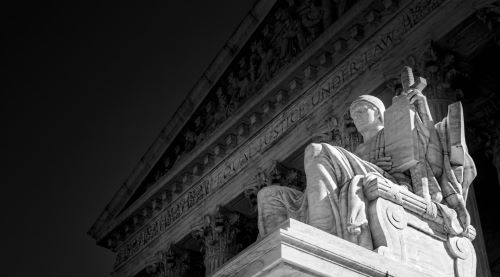
Supreme Court justices are the only judges in the country without a binding ethics code.

By Douglas Keith, J.D.
Counsel, Democracy
Brennan Center for Justice

By Alicia Bannon, J.D.
Director, Judiciary Program, Democracy
Brennan Center for Justice

By Amanda Powers
Research and Program Associate, Democracy”
Brennan Center for Justice
The facts are simple yet jaw-dropping: Between the November 2020 election and the January 6 insurrection, Ginni Thomas texted White House Chief of Staff Mark Meadows 29 times, urging him to stop “the greatest Heist of our History.” One year later, Justice Clarence Thomas, Ginni’s husband, voted to block the release of White House records regarding the insurrection — records that likely include communications by his wife.
The immediate response should be clear: at a minimum, Justice Thomas should publicly explain what he knew about his wife’s communications with the White House, when he knew it, and why he participated in cases related to the insurrection and the results of the 2020 election. He should also pledge to step aside from any such cases going forward.
But a promise to recuse is not enough. The Supreme Court is facing a crisis of public confidence, and the justices have shown again and again that they cannot be trusted to police themselves. It’s long past time for a Supreme Court code of conduct — one that anticipates the potential for lawlessness by the justices themselves.
Indeed, the law already requires recusal in Justice Thomas’s case, stating that justices must step aside from “any proceeding in which [their] impartiality might reasonably be questioned.” The statute also requires justices to step aside if they know their spouse or family member has an “interest that could be substantially affected by the outcome of the proceeding.” Thomas himself clearly knows this law, having recused six times from cases involving Wachovia while his son worked for the bank.
So why didn’t this law prevent Justice Thomas from hearing a case that could reveal his wife’s private communications with the White House? Particularly since ethics experts say the law requires Thomas to ask about his wife’s activities, not intentionally avoid knowledge so he can claim ignorance? As Chief Justice John Roberts has explained, the Supreme Court lets justices decide for themselves whether they are conflicted. “I have complete confidence in the capability of my colleagues to determine when recusal is warranted, ” said Roberts in his 2011 report on the state of the federal judiciary.
It is clear today that the chief justice’s trust is misplaced. First, the law does not ask whether justices consider themselves conflicted, but whether an outsider might reasonably think they are. Would anyone begrudge a member of the public questioning Justice Thomas’s allegiances in this case?
Second, a series of controversies beyond this one make clear that there is a long and troubling record of justices engaging in conduct that has eroded the public’s trust. This includes partisan speeches, lavish gifts, and recusal failures by members of the Supreme Court, including a recent New York Times story detailing Justice Thomas’s participation in events hosted by conservative activists. As the advocacy group Fix the Court has documented, in recent years every one of the sitting justices has faced scrutiny for purported ethical lapses.
A code of conduct isn’t a cure-all, but having one could allow for more detailed guidance on when justices’ recusal is required. This could include better defining when a spouse has an “interest” in a case and clarifying that potential conflicts should be viewed not from the justice’s perspective but from the public’s. A code could also set up other guardrails to help restore public confidence in the Court, including addressing when and how justices can participate in events with prominent politicians or other political figures — a common practice, and one that research suggests the public views as inappropriate. The justices are the only nine judges in the United States who do not currently have to follow an ethics code.
A number of bills, sponsored by both Democrats and Republicans, have sought to require a code of conduct for the Supreme Court. Critically, however, the Court doesn’t have to wait for Congress to act. The justices can — and should — adopt a code of conduct on their own to provide guidance, transparency, and accountability regarding ethical boundaries.
The Court must also require justices to explain their recusal decisions in writing, allowing the public to assess for themselves a justice’s explanation of why they are sitting on a case in which they have a seemingly obvious conflict of interest.
Public trust in the Supreme Court is at an all-time low. Only 16 percent of adults say that the justices do a good or excellent job of keeping their own political views out of their decisions, according to a January survey by the Pew Research Center. Yet this trust — and the public’s expectation that the Supreme Court’s decisions be followed — are the Court’s primary sources of authority.
Justice Thomas’s failure to recuse reflects less a gap in the law than a lack of tools for holding justices to it. A code of conduct and public explanations won’t solve the Court’s legitimacy crisis, but they would set expectations for the justices’ behavior. Clear standards — and the accompanying added public scrutiny — would provide an incentive for judges to live up to them. It is urgent that either the Court or Congress put those tools in place.
Originally published by the Brennan Center for Justice, 03.30.2022, under the terms of a Creative Commons Attribution-No Derivs-NonCommercial license.
About the Author