An international treaty aims to bring the shipping industry to net-zero emissions by around 2050.

By Elise Hansen
Freelance Reporter
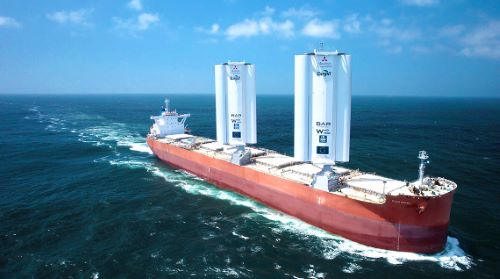
In August, a cargo ship known as the Pyxis Ocean set sail — literally. The ship, about 750 feet long, had been outfitted with a pair of “sails” made of steel and fiber-reinforced plastic to harness wind power on the long voyage from Shanghai to Paranaguá, Brazil.
The Pyxis Ocean still uses its traditional engine but, along with careful routing decisions, its new sails will help to cut the amount of fuel burned on international voyages, says Simon Schofield, chief technology officer at BAR Technologies, the UK-based company that designed the sails.
“We are harnessing the same elements as we did hundreds of years ago, we’re just doing it in a more efficient way,” Schofield says.
Schofield, a veteran engineer of elite yacht-racing competitions, helped to found BAR Technologies in 2016, in the hopes that insights from shipping’s sexier cousin could be among the tools that help marine industries modernize to address climate change.
Shipping is a serious source of greenhouse gas emissions. Together, fishing and international and domestic shipping created over 1 billion tons of greenhouse gas emissions in 2018, which is close to 3 percent of all human-driven emissions, according to the International Maritime Organization, the UN agency that oversees the safety and security of the shipping industry.
Yet the voyages are the lifeblood of global trade: The UN Conference on Trade and Development estimated that in 2021, ships transported about 11 billion tons of goods, representing over 80 percent of world trade. The Pyxis Ocean, as one example, was chartered for its sail-assisted voyage by the US agricultural giant Cargill; upon arriving in Brazil, the cargo ship picked up about 63,000 metric tons of soybean meal to transport to Poland.
If the industry doesn’t change, emission numbers from shipping are likely to increase, says Benjamin Halpern, a marine ecologist at the University of California, Santa Barbara. “All of the economic forecasts for global trade say that trade will continue to be more and more global,” he says. “There’s just more people buying more goods every year.”
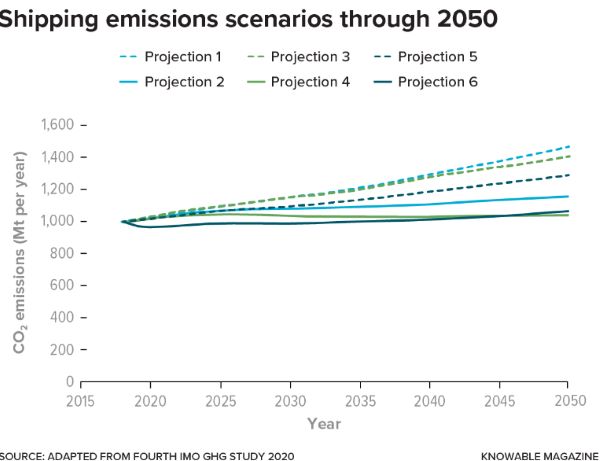
The International Maritime Organization, or IMO, has projected that shipping’s greenhouse gas emissions in 2050 could reach up to 130 percent of their 2008 levels. Shipping could also start to affect new regions of the globe as the Arctic warms and sea ice retreats, potentially opening up new shipping lanes, says Casey O’Hara, a conservation data scientist at the University of California, Santa Barbara.
“The status quo is not business as usual; it is going to be on an upward trend and potentially have impacts in some of the more untouched places in the world,” he says.
While shipping is only a small part of the whole picture affecting the world’s oceans, reducing just some of the pressures on marine life can help ecosystems be more resilient to other stressors, such as noise pollution, fishing and coastal development, adds O’Hara, who with Halpern authored a 2022 overview of the compounding pressures on marine systems in the Annual Review of Environment and Resources.
With all this at stake, the IMO’s 175 member states recently voted unanimously to adopt a more ambitious set of climate goals. These new goals, agreed upon in July 2023, would see countries strive for net-zero greenhouse gas emissions from international shipping by “close to” 2050. Countries committed to trying to cut international shipping’s annual emissions by at least 20 percent, compared to their 2008 levels, by 2030, and by at least 70 percent by 2040. Remaining emissions could be “balanced out” with carbon removal or carbon sequestration projects, to complete the goal of net zero.
That’s “light-years” ahead of the IMO’s previous, 2018 strategy, which aimed for only a 50 percent reduction in carbon emissions by 2050, says Delaine McCullough, shipping emissions policy manager at the environmental advocacy group Ocean Conservancy. But, she adds, even this latest strategy could require larger emission cuts sooner, to guard against even temporarily overshooting key global warming benchmarks.
How can shipping reach the IMO’s new targets? In the short run, a handful of technical and operational changes could make a big difference in cutting emissions, McCullough says. In June 2023, the research organization CE Delft, which focuses on sustainable energy and transportation, published a study suggesting that a combination of measures could, under certain conditions, cut emissions by 28 percent to 47 percent. These would include slowing ships down so they would burn less fuel, adding wind power, and mixing in a small percentage of alternative fuels.
But achieving the industry’s loftiest goals will probably require a much bigger overhaul.

One of the main changes will likely be widespread adoption of greener fuels, says Pernille Dahlgaard, chief officer of government, business and analytics at the Mærsk Mc-Kinney Møller Center for Zero Carbon Shipping, a research organization that works with the marine and energy industries. Many ships currently run on heavy fuel oil, a fossil fuel that is relatively inexpensive and widely available for refueling stops at ports.
The two main alternative contenders so far are green methanol and e-ammonia, but neither fuel is ready for mass adoption yet, says Dahlgaard. Green methanol is difficult to procure in the quantities needed, and e-ammonia presents safety risks, she adds. Both options are more expensive than traditional fuel.
The uncertainty around the fuel — or fuels — of the future is extra challenging in the shipping industry, because ships typically have a roughly 25-year lifespan, says Dahlgaard. “The vessels that come on water now, they will still be sailing in 2050,” she says. “So when you’re ordering a vessel today, you need to think about … your strategy for actually living up to that net zero in 2050.”
On top of that, alternative fuels need to be available when compatible ships arrive. That requires technological investment in ships to synchronize with fuel development, as well as investments in ground transportation, infrastructure and port operations, says Jesse Fahnestock, decarbonization project director of the Global Maritime Forum, an international nonprofit.
Fahnestock advocates for the creation of “green shipping corridors”: shipping lanes that support vessels that use alternative fuels. The corridors would require collaboration among a wide array of players, including ports, governments, fuel providers and ship owners. In that sense, the effort is much like a testing ground for a future global transformation of the industry.
“Decarbonizing everything at once is a huge challenge,” Fahnestock says. Green corridors could provide a way to “shrink that challenge down to size but still pursue it at a meaningful commercial, industrial scale,” he says.
But whether it’s snazzy technologies or alternative fuels or green corridors, shipping decarbonization won’t happen by the initiative of the private sector alone, most experts argue. It’s a “trillion-dollar investment,” as Dahlgaard puts it. National governments will likely need to craft new regulations as well as economic policies such as an emissions trading scheme or a carbon tax, says McCullough.
“If we can get two really solid, technical and market measures together, those can be really powerful in driving the industry,” she says.
The challenges are daunting, but for Fahnestock, the latest IMO strategy will at least help to chart the course.
“There’s a long-term strategy now,” he says. “Now we know that the journey to zero is going to go all the way to zero.”
Originally published by Knowable Magazine, 11.20.2023, under the terms of a Creative Commons Attribution-NoDerivatives 4.0 International license.
About the Author