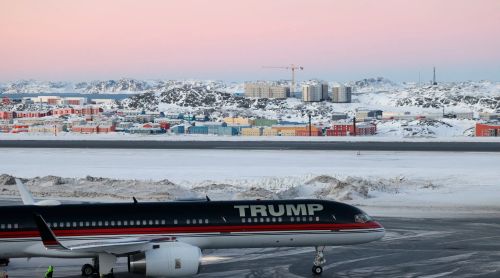
The question is not whether Greenland will ever change hands. It is whether the alliances that structure global security can withstand repeated tests.

By Matthew A. McIntosh
Public Historian
Brewminate
Introduction: A Proposal That Defies Conventional Logic
When Donald Trump revived his interest in acquiring Greenland, the proposal was widely dismissed as eccentric, unserious, or merely rhetorical. Yet the idea has resurfaced often enough, and with sufficient intensity, to merit closer examination. In international politics, proposals that appear incoherent on their face sometimes serve purposes that are not immediately obvious. History suggests that when a major power fixates on an objective that defies economic or diplomatic logic, the fixation itself may be the signal worth studying.
Measured against conventional benchmarks, Greenland makes little sense as a territorial acquisition. Its population is small, its governance complex, and its economic value limited when weighed against the diplomatic cost of alienating Denmark, a longstanding ally and NATO member. The United States already enjoys extensive military access on the island, including long-established basing rights, without assuming sovereignty or provoking an international crisis. From a purely strategic or resource-based perspective, there is little that outright acquisition would meaningfully add.
This is where the proposal becomes analytically interesting rather than absurd. Any attempt to coerce, purchase, or otherwise force the issue of Greenland’s status would immediately generate a crisis within NATO itself. Denmark’s sovereignty would be challenged, alliance cohesion would be tested, and the credibility of collective defense would be placed under strain. The danger would not lie in the success of such a move, but in the fracture it could expose. Alliances rarely collapse because they are defeated from the outside. They unravel when internal contradictions are pushed too far.
The central question, then, is not whether the United States needs Greenland, but who benefits from the disruption such a confrontation would create. If the proposal cannot be explained by resources, geography, or conventional strategy, it must be examined as a political act with secondary effects. History teaches that the most consequential moves are often those that seem irrational until their beneficiaries are identified.
Greenland’s Real Strategic Meaning: NATO, Not Resources
Greenland’s strategic importance is often described in terms of geography, minerals, or Arctic positioning, but these explanations only go so far. While the island sits astride emerging Arctic shipping routes and contains untapped natural resources, none of these factors require ownership to exploit. The United States already maintains a long-standing military presence in Greenland through agreements with Denmark, most notably at Pituffik Space Base, granting access to surveillance, missile warning systems, and Arctic reach without the political cost of sovereignty.
What makes Greenland uniquely sensitive is not what it offers materially, but what it represents institutionally. Greenland is an autonomous territory within the Kingdom of Denmark, and Denmark is a full NATO member. Any serious attempt to seize, coerce, or destabilize Greenland’s status would therefore not be a bilateral dispute but an intra-alliance crisis. It would force NATO members to confront an unprecedented scenario: one member exerting pressure on another over territory.
Such a crisis would test NATO at its weakest point, not its strongest. Article 5, the alliance’s collective defense clause, has always relied as much on political will as on military capacity. A confrontation involving Greenland would not resemble a conventional external threat. Instead, it would expose ambiguity, hesitation, and internal disagreement over how alliance obligations apply when conflict originates from within. The danger lies less in military escalation than in paralysis.
The historical record shows that alliances rarely fail through outright defeat. They fail when credibility erodes, when members doubt whether commitments will be honored, and when unity fractures under political strain. A Greenland crisis would raise uncomfortable questions that NATO has largely avoided: how collective defense functions when legal obligations collide with political realities, and whether alliance solidarity can survive internal coercion.
Seen in this light, Greenland’s real strategic meaning has little to do with extraction or expansion. Its value lies in its potential to become a pressure point, a place where alliance norms, legal frameworks, and political resolve are forced into the open. The island matters not because of what it contains, but because of what it could reveal about the durability of NATO itself.
Russia’s Long-Standing Objective: Weakening NATO from Within
From its inception, NATO has been perceived by Moscow not merely as a military alliance, but as a structural threat to Russian influence in Europe. During the Cold War, Soviet opposition to NATO was explicit and ideological. After the Soviet Union’s collapse, that hostility did not disappear. It evolved. The expansion of NATO eastward in the 1990s and 2000s reinforced Russian fears of encirclement and solidified the alliance as a central obstacle to Moscow’s regional ambitions.
In the post-Soviet era, Russia increasingly recognized that dismantling NATO through direct military confrontation was neither feasible nor necessary. Instead, the more effective strategy was erosion rather than assault. Weakening trust among member states, amplifying internal divisions, and casting doubt on the alliance’s reliability offered a slower but far more sustainable path. An alliance that cannot act decisively, or whose members question its purpose, begins to unravel on its own.
Russian strategic doctrine has consistently emphasized political warfare, influence operations, and asymmetric pressure over conventional force. This approach targets the cohesion of adversarial systems rather than their armies. Elections, public opinion, elite fragmentation, and alliance politics all become arenas of contestation. NATO, as a collective entity dependent on consensus and shared commitment, is especially vulnerable to this mode of pressure.
Crucially, Russia does not need NATO to formally dissolve to claim success. It only needs the alliance to hesitate and fracture under stress or to fail in moments that matter. Each unresolved crisis, each public disagreement among members, and each instance of internal coercion weakens the perception that NATO functions as a unified deterrent. Credibility, once lost, is difficult to restore.
Viewed through this lens, scenarios that introduce ambiguity into alliance obligations carry disproportionate strategic value. A crisis involving Greenland would not require Russian intervention to be effective. The mere spectacle of NATO struggling to respond to internal conflict would serve long-standing Russian objectives. Weakening NATO from within has always been less about conquest than about patience, pressure, and the quiet exploitation of structural fault lines.
Trump and NATO: A Public Record of Hostility
Trump’s antagonism toward NATO is not speculative or inferred. It is a matter of public record, repeated consistently across speeches, interviews, and policy statements over multiple years. He has characterized the alliance as obsolete, framed it primarily as a financial burden on the United States, and openly questioned the value of collective defense. These positions were not isolated remarks but a sustained rhetorical posture that set him apart from every other postwar American president.
Trump’s critique of NATO rested on a transactional view of alliance politics, reducing collective security to a balance sheet of contributions and reimbursements. In doing so, he rejected the foundational premise that alliances function as deterrents precisely because commitments are upheld even when they are inconvenient or costly. This framing undermined the alliance’s normative core by suggesting that defense obligations were conditional rather than binding.
The consequences of such rhetoric extended beyond words. Trump repeatedly threatened to withdraw from NATO, reportedly explored mechanisms for doing so, and signaled skepticism toward Article 5 itself. These actions injected uncertainty into the alliance at a time when cohesion was already under strain. Allies were forced to question whether the United States would honor commitments that had underpinned European security for decades.
What matters analytically is not whether Trump’s criticisms of NATO spending had merit in narrow terms, but how those criticisms functioned strategically. By publicly challenging the alliance’s legitimacy, Trump has weakened the perception of unity that NATO relies upon to deter adversaries. Regardless of intent, this posture created precisely the kind of ambiguity and doubt that alliances are designed to avoid. The 2024 National Defense Authorization Act (Sec. 1250A) prevents the president for unilaterally leaving NATO, but his attempts to subvert the alliance’s strength are ongoing.
Election Interference: What Is Established in the Public Record
Any serious analysis of U.S.–Russia relations must begin with what is firmly established rather than what is alleged. Multiple investigations by the U.S. intelligence community and bipartisan congressional committees concluded that Russia undertook coordinated efforts to interfere in the 2016 U.S. presidential election. These efforts included cyber operations, information campaigns, and the strategic use of social media to influence public opinion and exacerbate existing political divisions. These findings have been reaffirmed in subsequent assessments addressing later election cycles.
It is equally important to state what those investigations did and did not conclude. The Special Counsel investigation did not establish a criminal conspiracy between the Trump campaign and Russian operatives. That absence of prosecutable conspiracy has often been conflated with the broader question of interference itself, which intelligence agencies and Congress treated as settled fact. The distinction between interference and conspiracy is critical, yet it has frequently been blurred in public discourse.
Trump’s response to these findings is part of the public record. He consistently rejected the conclusions of U.S. intelligence agencies, dismissed the interference as a hoax, and publicly sided with denials issued by Russian officials. This pattern placed him in direct opposition to assessments produced by his own government’s national security apparatus, a posture without clear precedent in modern American presidential history.
The implications of this rejection extend beyond partisan politics. When a president publicly discredits intelligence findings about foreign interference, it complicates the ability of institutions to respond effectively to future threats. It also signals to allies and adversaries alike that consensus within the U.S. government on matters of national security may be fragile or conditional.
From an analytical perspective, these facts do not require speculation about motive. They establish a documented tension between institutional assessments and presidential rhetoric. That tension forms an essential backdrop for understanding subsequent actions, statements, and proposals that intersect with alliance politics, foreign influence, and strategic credibility.
Insider Perspective
At this point, interpretation becomes unavoidable, but it must also be handled with restraint. To better understand how Trump’s Greenland rhetoric might be viewed within diplomatic and strategic circles, this analysis draws on the perspective of a former political officer who served with the U.S. Embassy and Consulate in the Kingdom of Denmark. The source requested anonymity due to the sensitivity of the subject and the potential professional repercussions of speaking publicly. Their role did not involve intelligence operations or policy formation at the highest levels, but it did place them in close proximity to alliance politics and regional strategic discussions.
From this vantage point, the Greenland proposal appears less puzzling than it does in purely economic or territorial terms. The former political officer described the idea as strategically incoherent if interpreted as a serious acquisition plan, but potentially meaningful if understood as a political stressor. In this reading, the value of the proposal lies not in its feasibility, but in its capacity to generate uncertainty, provoke alliance friction, and force difficult questions about NATO’s internal limits.
The source emphasized that such interpretations are common within diplomatic analysis, where stated objectives are often less important than secondary effects. Proposals that seem unrealistic on their face can still function as signals or tests, revealing how institutions respond under pressure. Greenland becomes a symbolic trigger rather than a concrete goal, a way to expose fault lines without requiring escalation or follow-through. If the goal is to bring NATO to an end, then these actions provide a plausible pathway.
Importantly, the source did not claim direct knowledge of Trump’s intent, nor did they assert coordination with any foreign power. Instead, they framed their view as an assessment of strategic plausibility. When evaluating actions that undermine alliance cohesion, diplomats are trained to ask not whether an outcome was intended, but whether it was foreseeable and who stands to benefit if it occurs. This distinction separates analysis from accusation.
The former political officer also noted that alliance stress need not culminate in open conflict to achieve strategic impact. Even unresolved disputes can weaken deterrence by signaling hesitation or division. In this sense, a prolonged controversy over Greenland, regardless of outcome, would represent a net strain on NATO’s credibility, particularly if it forced members to publicly disagree over sovereignty, obligation, or response.
My source underscored that such interpretations should not be mistaken for proof. They reflect how experienced practitioners think through risk, incentive, and consequence, especially in environments shaped by information warfare and political disruption. The purpose of incorporating this perspective is not to settle questions of intent, but to illuminate how the proposal fits into broader patterns of alliance vulnerability that history has shown to be strategically consequential.
Who Benefits? A Historical Question, Not an Accusation
History offers a simple but powerful analytical tool when intent is uncertain: follow the consequences rather than the declarations. When a political action appears illogical by conventional standards, historians and strategists alike ask a different question. Not who intended what, but who stands to gain if the action succeeds, fails, or merely destabilizes the existing order. This approach avoids speculation while remaining attentive to outcomes that matter.
Applied to Greenland, the consequences are clear regardless of intent. Any serious dispute would strain relations between NATO members, introduce uncertainty into collective defense obligations, and force public disagreement over alliance norms. Even a failed attempt would have value as a demonstration of fracture. Alliances derive strength from predictability and unity; anything that weakens either erodes deterrence over time.
From this vantage point, the beneficiaries are not difficult to identify. Russia has long sought to diminish NATO’s cohesion and credibility, not necessarily by defeating it militarily, but by encouraging doubt, division, and hesitation among its members. Trump’s rhetoric has long fed narratives that at the very least have a Russian scent. A NATO crisis triggered internally would advance those objectives without requiring Russian action or escalation. The benefit would be structural, not tactical.
This line of reasoning does not require assuming coordination, loyalty, or hidden control. It rests instead on historical patterns in which great powers exploit the internal contradictions of their rivals. During the Cold War and after, destabilization strategies often relied on indirect pressure and opportunism rather than command-and-control relationships. Outcomes mattered more than motives, and disruption itself became a form of leverage.
Framing the question in terms of benefit rather than blame allows for a more disciplined analysis. It shifts attention away from personal intent and toward systemic vulnerability. History rarely turns on secret allegiances alone. It turns on whether institutions are resilient enough to withstand stress, ambiguity, and internal challenge. In that sense, the Greenland question is less about any single actor and more about the durability of the alliances that shape the modern world.
Conclusion: Why This Question Cannot Be Ignored
The Greenland proposal can be dismissed as rhetorical excess, personal idiosyncrasy, or political theater. But history warns against treating strategically disruptive ideas as harmless simply because they appear impractical. When proposals repeatedly surface that carry the potential to fracture alliances, undermine institutional norms, or introduce ambiguity into collective defense, they deserve scrutiny not for their likelihood of success, but for the strain they impose simply by being voiced.
This analysis does not rest on proving intent, allegiance, or coordination. It rests on patterns that have defined geopolitical conflict for generations. Alliances weaken when their members doubt one another, when commitments appear conditional, and when internal pressures eclipse shared purpose. The most damaging outcomes often emerge not from decisive action, but from prolonged uncertainty and unresolved tension.
Ignoring such dynamics because they are uncomfortable or politically charged carries its own risk. History is filled with moments when institutions failed not because they were defeated outright, but because they underestimated the corrosive effects of internal challenge. Strategic disruption thrives in environments where incoherence is tolerated and consequences are deferred.
The question, then, is not whether Greenland will ever change hands. It is whether the alliances that structure global security can withstand repeated tests, even those launched by the founding and strongest ally (the United States), of cohesion and credibility. History suggests that when such tests are ignored, their cumulative effect becomes visible only after resilience has already been eroded. That is why this question cannot be dismissed, and why it must be examined with clarity, restraint, and historical perspective.
Originally published by Brewminate, 01.08.2026, under the terms of a Creative Commons Attribution-NonCommercial-NoDerivatives 4.0 International license.
About the Author