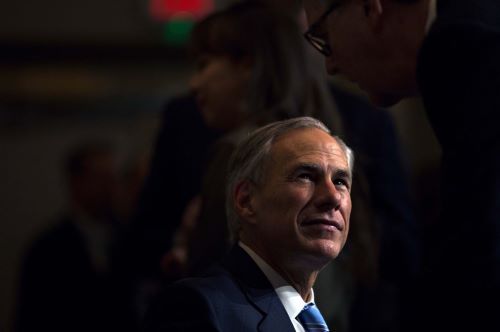
Greg Abbott has consolidated power like none before him.

By Perla Trevizo
Reporter
ProPublica-Texas Tribune Investigative Initiative

By Marilyn W. Thompson
Reporter
ProPublica
Introduction
Days after being elected Texas governor in 2014, Greg Abbott called a staff meeting to discuss his vision for leading the state.
“Our number-one priority as public servants is to follow the law,” Abbott, who served as Texas attorney general before he was elected, told staffers, according to his autobiography. Adhering to the law was “a way to ignore the pressure of politics, polls, money and lobbying.”
The Republican governor-elect said he rejected the path of Democratic President Barack Obama, whom he had sued 34 times as attorney general. Abbott claimed that Obama had usurped Congress’ power by using executive orders, including one to protect from deportation young people born in other countries and brought to the United States as children.
Now, nearly eight years into his governorship, Abbott’s actions belie his words. He has consolidated power like no Texas governor in recent history, at times circumventing the GOP-controlled state Legislature and overriding local officials.
The governor used the pandemic to block judges from ordering the release of some prisoners who couldn’t post cash bail and unilaterally defunded the legislative branch because lawmakers had failed to approve some of his top priorities. He also used his disaster authority to push Texas further than any other state on immigration and was the first to send thousands of immigrants by bus to Democratic strongholds.
Abbott’s executive measures have solidified his conservative base and dramatically raised his national profile. He is leading Democrat Beto O’Rourke in polls ahead of the Nov. 8 election and is mentioned as a potential 2024 GOP presidential contender. But his moves have also brought fierce criticism from some civil liberties groups, legal experts and even members of his own party, who have said his actions overstep the clearly defined limits of his office.
“Abbott would make the argument that Obama had a power grab, that he was trying to create an imperial presidency by consolidating power. That’s exactly what Abbott is doing at the state level,” said Jon Taylor, chair of the political science and geography department at the University of Texas at San Antonio.
At least 34 lawsuits have been filed in the past two years challenging Abbott’s executive actions, which became bolder since the start of the pandemic. Abbott used his expanded power at first to require safety measures against COVID-19, similar to what other governors did. But after pushback from his conservative base, he later forbade local governments and businesses from imposing mask and vaccine mandates. He also forced through Republican priorities, including an order that indirectly took aim at abortions by postponing surgeries and procedures that were not medically necessary.
Lower courts have occasionally ruled against Abbott, but Texas’ all-Republican highest court has sided with the governor, dismissing many of the cases on procedural grounds. Other challenges to Abbott’s use of executive power are still pending. In no case have the governor’s actions been permanently halted.
Abbott’s office did not respond to multiple requests for an interview or to questions from ProPublica and The Texas Tribune. In responding to the lawsuits, his legal team has defended his actions as allowed under the Texas Disaster Act of 1975, which gives the governor expansive powers.
Several of Abbott’s allies also declined to comment or didn’t return phone calls. Carlos Cascos, a former secretary of state under Abbott, said that in the end, it is up to the courts to decide whether the governor’s actions are unconstitutional.
“Until there’s some final judgment, the governor can do it,” Cascos, also a Republican, said. “If people want to change the rules or laws, that’s fine, but you change them by going through a process.”
Legal experts concede that Abbott has been successful so far, but they insist his moves exceed his constitutional authority.
“I’m not sure any other governor in recent Texas history has so blatantly violated the law with full awareness by the Supreme Court, and he’s been successful at every turn when he had no power to exercise it. It’s amazing,” said Ron Beal, a former Baylor University law professor who has written widely on administrative law and filed legal briefs challenging Abbott’s power. Although Texas Supreme Court justices are elected, Abbott has appointed five of the nine members of the state’s highest court when there have been vacancies.
Some Republicans also fault the governor’s actions. Nowhere was that more pronounced than when Abbott vetoed the Legislature’s budget last year after Democrats fled the state Capitol to thwart passage of one of the strictest voting bills in the country. The governor contended that “funding should not be provided for those who quit their job early.”
The move, which spurred a lawsuit from Democratic lawmakers, would have halted pay for about 2,100 state employees who were caught in the crosshairs.
Former state lawmakers, including two previous House speakers — Joe Straus, a Republican, and Pete Laney, a Democrat — as well as former Republican Lt. Gov. Bill Ratliff, weighed in on the dispute, filing a brief with the state’s Supreme Court calling the governor’s action unconstitutional and “an attempt to intimidate members of the Legislature and circumvent democracy.”
In response to the lawsuit, state Attorney General Ken Paxton argued that Abbott used his constitutional authority to veto the Legislature’s budget and that the courts didn’t have a role to play in disputes between political branches.
The Supreme Court agreed, saying it was not a matter for the judicial branch to decide. In the end, lawmakers passed a bill that restored the funding that Abbott had vetoed. Staffers didn’t lose a paycheck.
“It was a terrible thing to do, to threaten those people who do all that work, and threaten not to pay them while the governor and the members of Legislature were still going to get paid. How cynical is that?” said Kel Seliger, an outgoing Republican state senator from Amarillo who has split with his party’s leadership on various issues as it has shifted further right.
Weak Governor?

Research groups consistently rank Texas as a “weak governor” state because its constitution limits what the governor can do without legislative authorization. Executive officers such as the lieutenant governor and the attorney general are also independently elected, not appointed by the governor, further diluting the power of the office.
“The way the constitution is designed, unless it’s specified in the constitution, you don’t have that power. Period. And that’s why I think you can look at a whole variety of his actions as violating the constitution. He just doesn’t have it. He asserts it, and he gets away with it,” said James Harrington, a former constitutional law professor at the University of Texas at Austin who founded the Texas Civil Rights Project. Harrington initially filed a brief defending Abbott’s early use of pandemic-related executive orders limiting crowd sizes and the types of businesses allowed to remain open, but he said the governor’s later orders fell outside of the bounds of the law.
The weak-governor structure was created by the framers in 1876 who believed that Edmund Jackson Davis, a former Union general who led Texas following the Civil War, abused his powers as governor. A Republican who supported the rights of freed people, Davis disbanded the Texas Rangers and created a state police force that he used, at times, to enforce martial law to protect the civil rights of African Americans. He also expanded the size of government, appointing more than 9,000 state, county and local officials, which left a very small number of elected positions.
Currently, the governor’s office accrues power largely through vetoes and appointments. While the Legislature can override a veto, governors often issue them after the legislative session ends. The governor is the only one who can call lawmakers back.
During a typical four-year term, a governor makes about 1,500 appointments to the courts and hundreds of agencies and boards covering everything from economic development to criminal justice. The longer governors serve, the more loyalty they can build through appointments.
Abbott’s predecessor, Republican former Gov. Rick Perry, set the stage for building power through appointments. Over 14 years, Perry, a former state representative who became Texas’ longest-serving governor, positioned former employees, donors and supporters in every state agency.
Perry could not be reached for comment through a representative.
In contrast to his predecessor, Abbott, a jurist with no legislative experience, found other avenues to interpret and stretch the law. Abbott has benefited from appointments and vetoes, but he has also taken advantage of emergency orders and disaster declarations like no other governor in recent state history.
Disaster declarations are generally used for natural calamities such as hurricanes and droughts and are useful legally for governors who could face legislative gridlock or state agency inaction if going through normal channels. Abbott’s use of such tools has grown even as his party holds a majority in the state Legislature.
In his eight years as governor, Abbott has issued at least 42 executive orders. Perry signed 80 orders during his 14-year tenure, though they rarely brought controversy. He once required human papillomavirus vaccines for girls but backtracked after pushback from the Legislature.
“Rick Perry experimented with and developed a number of tools that former governors had,” said Cal Jillson, professor of political science at Southern Methodist University. “That he sharpened appointments would be one of those, executive orders would be another of those, the use of the bully pulpit would be a third. And Abbott went to school on that.”
Aiding Abbott in his push to strengthen executive power have been what is essentially a Republican-controlled state with no term limits for officeholders, a Legislature that meets every two years and innate fundraising skills that have helped him draw about $282 million (adjusted for inflation) in campaign contributions in the decade since he first ran for governor. He has used some of that haul to oppose candidates for office, including those in his own party, who have crossed him.
“It’s surprising that even the legislative leadership in the Republican Party has acquiesced to the degree they have because the powers that Abbott has accrued have to come from somewhere else, and it’s coming from them,” said Glenn Smith, an Austin-based Democratic strategist.
Last year, state lawmakers filed 13 bills aiming to curb the governor’s powers under the state’s disaster act, including Republican proposals that would require the Legislature’s permission to extend executive orders, which the governor now does every 30 days.
For instance, in 2019 Abbott issued an executive order to extend the state’s plumbing board after it was on track to shut down because of legislative inaction. He was able to do so by using his power under a disaster declaration that he first issued when Hurricane Harvey pummeled the state in 2017. He continued to renew the disaster declaration for nearly four years.
Abbott similarly continues to renew his 2020 COVID-19 disaster declaration even as he downplays the severity of the pandemic.
During the last legislative session, the only measure that passed — and was signed by Abbott — is a bill that removed the governor’s authority to restrict the sale, dispensing or transportation of firearms during a declared disaster.
“He governs like a judge, and that’s where the autocratic side comes out,” said state Rep. Lyle Larson, a Republican lawmaker whom Abbott tried to oust in 2018 after he pushed a measure that would make the governor wait a year before appointing to boards anyone who donated more than $2,500 to his campaign. The San Antonio lawmaker, who defeated Abbott’s preferred candidate at the time, has decided not to seek reelection.
Methodically Creating a Powerhouse

Abbott’s tenacity at building the power of the office can be traced back to his recovery after an oak tree fell on him while he was jogging at age 26, paralyzing him from the waist down, said Austin-based Republican consultant and lobbyist Bill Miller.
“He’s had setbacks in life that he’s overcome with tremendous success, and you don’t achieve that unless you’re persevering and a tough individual, and he’s both in the extreme,” Miller said.
At 32, Abbott was elected as a Harris County district judge, then was plucked from the bench by former Gov. George W. Bush, who elevated him to fill a vacancy on the Texas Supreme Court, a recommendation of Bush’s political adviser Karl Rove. Abbott ran for state attorney general and served 12 years before his election as governor in 2014.
He began testing the limits of his executive power quickly after his election.
In June 2015, six months into his first term, Abbott analyzed the state budget and vetoed more than $200 million in legislative directives that provided specific instructions to agencies on how certain funds should be used.
The move eliminated funding for various projects, including water conservation education grants and a planned museum in Corpus Christi. Abbott called some of the projects “unnecessary state debt and spending.”
The head of the Legislative Budget Board at the time argued that the governor had overstepped his authority because while he could veto line-item appropriations, he could not override the Legislature’s instructions to state agencies.
“We were just kind of flabbergasted. In all of your 150-plus years of precedent in state government, this had never been seen before,” said a longtime capitol attorney who asked to not be identified for fear of retribution. “It was kind of shocking to me that he was an attorney, was the attorney general, was on the (Texas) Supreme Court and, in my opinion, has such little value for the Texas Constitution and disrespect for the separation of powers. Such disrespect for a coequal branch of government.”
Over the years, Abbott continued to insert himself in decision-making that had previously not been in the purview of the governor’s office. His actions drew little public scrutiny because they involved procedural matters.
For instance, state agencies must typically seek public comment before publishing final regulations in areas such as the environment and education. But Abbott wanted to review proposed regulations before their public release. In 2018, his office directed agencies to first run them past the governor.
Citing a 1981 executive order by Ronald Reagan, Abbott’s chief of staff wrote that presidential review of proposed regulations helped to “coordinate policy among agencies, eliminate redundancies and inefficiencies, and provide a dispassionate ‘second opinion’ on the costs and benefits of proposed agency actions.”
But insisting on a review of agency proposals could give his office influence over matters that should not be left to the executive branch, critics said. For example, Abbott’s office could suggest softening regulations for emissions, which could be favorable to the oil and gas industry. While agency leaders do not have to comply, the boards and commissions overseeing them are often appointed by the governor.
Byron Cook, a Republican former state lawmaker from Corsicana, criticized Abbott’s request at the time and continues to believe that the governor overstepped his authority. “I think it’s a dangerous precedent, and I don’t think it’s in the best interest of the people in the state because it circumvents the legislative process,” Cook said in a recent interview.
At the time, Abbott’s office defended his line-item veto and his request to review agency rules as measures that were within his constitutional authority.
It’s unclear how much influence Abbott has wielded over that process in the past six years because the governor’s office is fighting the release of records to ProPublica and the Tribune that would show its interactions with state agencies.
While some lawmakers like Cook openly resisted Abbott’s push to grow the powers of the executive branch, Perry and Abbott have faced limited pushback because few have wanted to cross them, several former and current lawmakers told ProPublica and the Tribune.
“Somebody’s got to push back, but pushing back very often brings retribution, and so people are very careful,” said Seliger, who filed a bill in one of last year’s special legislative sessions aimed at removing the governor’s line-item veto power.
The measure was mostly symbolic because only Abbott has the power to decide what topics will be addressed in a special session — and Seliger’s bill was not among them.
Pushing an Agenda

As the pandemic hit Texas, Abbott reacted like most other governors struggling with an unprecedented public health crisis. He declared a public emergency on March 13, 2020, and issued a string of executive orders to deal with pandemic safety.
Abbott initially faced at least 10 lawsuits from business owners and conservative activists insisting his restrictions on businesses and crowd control violated the constitution. Charles “Rocky” Rhodes, a professor of state and federal constitutional law at South Texas College of Law Houston, said many of Abbott’s early actions were allowed under the disaster act’s sweeping provisions.
Legal challenges mounted as Abbott, in response to criticism from conservative groups and lawmakers, shifted course and asserted his disaster authority to control local government responses to the crisis and to impose his policy priorities. Rhodes pointed to an order forbidding employers from imposing vaccine mandates on employees. He said Abbott pushed “beyond the scope of his authority” and against federal vaccine mandates.
A string of legal actions filed by local governments and school districts in state and federal courts alleged that Abbott has tried to usurp the power of local entities, including the courts, by issuing orders that prohibited them from taking their own measures to deal with rising infection rates. Abbott’s legal team has defended the orders as within the scope of his expansive powers under the disaster act.
Two Texas parents who signed on as intervenors in a lawsuit against Abbott brought by La Joya and other independent school districts — Shanetra Miles-Fowler, a mother of three in Manor, and Elias Ponvert, a father of four in Pflugerville — told ProPublica and the Tribune that they saw Abbott’s order as political.
A lower-court order delayed implementation of Abbott’s prohibition against local governments imposing mask and vaccination mandates. The timing allowed parents to get through “the most dangerous months of the COVID pandemic,” said attorney Mike Siegel, who represented parents in the La Joya lawsuit. “Our fight likely saved the lives of students and staff who were facing a terrible choice of missing school or risking infection.” The masking cases are still pending at the Texas Supreme Court.
Abbott also used his disaster emergency powers to block judges from releasing prisoners who had not posted pretrial bail, prompting a lawsuit from 16 county judges and legal groups who argued that he had exceeded his constitutional powers. Abbott’s order also restricted the release of some charged with misdemeanors on time served with good behavior. His order said the disaster act gave him broad authority to control entrance and exit into facilities and the “occupancy of premises.”
In a court filing, the National Association of Criminal Defense Lawyers argued that Abbott’s executive order “violates the separation of powers, interferes with judicial independence, violates equal protection and due process of law, and constitutes cruel and unusual punishment.”
Abbott had been trying unsuccessfully since 2017 to make it harder for those accused of violent crimes, or any prior offenses involving threats of violence, to get out of jail without posting cash bonds. When COVID-19 struck, some counties began releasing prisoners to try to reduce jail populations. In Harris County, where Abbott had once served as a judge, the jail was overflowing, and a federal judge in Houston had ordered the county to begin releasing about 250 prisoners per day.
Elizabeth Rossi, an attorney with the Civil Rights Corps, a nonprofit group that has represented plaintiffs in a lawsuit against Harris County challenging its felony bail practices, said Abbott’s “heartless and cruel” order impacted tens of thousands of prisoners held in Texas jails. “The human effects were really visceral,” she said.
One inmate, Preston Chaney, 64, died of COVID-19 while awaiting trial in the Harris County jail for three months, unable to post a small bond on charges that he stole lawn equipment and frozen meat.
Maurice Wilson, a 38-year-old with diabetes who served time in Harris County on drug possession charges, said he was terrified by the spread of COVID-19 as he sat in jail on a $10,000 bond. He was one of the many prohibited from release under Abbott’s order because of a prior misdemeanor assault conviction.
The Texas Supreme Court ultimately ruled that the Harris County judges and other plaintiffs lacked standing because they had not suffered injury and overturned a temporary restraining order that had halted enforcement of Abbott’s order. Abbott finally got a bail-reform package through the Legislature and signed it into law in September 2021. It formalized some aspects of his executive order.
What Abbott has tried to do is “make himself the chief prosecutor, the chief lawmaker and, with bail, the chief judge,” said Jessica Brand, a lawyer who represented a law enforcement group in the case. “We do not live in a kingdom, however, and such behavior is totally inconsistent with the framework of government this state has adopted.”
Power Concentration

Abbott’s power consolidation came to a head last year as his administration embarked on the state’s most ambitious and costly border initiative to date.
On May 31, 2021, about four months into President Joe Biden’s term, Abbott became the first governor in recent history to issue a border disaster declaration, which he said was needed because the federal government’s inaction was causing a “dramatic increase” in the number of people crossing into the state. The disaster declaration gave the governor more flexibility to shift funds, increase penalties for some state trespassing charges against immigrants and suspend rules, including those governing state contracts.
Abbott had already succeeded in securing more than $1 billion for border security during the Legislative session for the deployment of Department of Public Safety troopers and National Guard members under Operation Lone Star.
The governor launched the initiative in March of that year, contending it was necessary to stem the smuggling of drugs and people into the country through Texas. Under the disaster declaration that Abbott used to bolster his authority over the operation, immigrants charged with criminal trespassing for crossing the border through private property could be punished by up to a year in jail. He could also use state funds to build barriers.
In August, Abbott used his power to reconvene lawmakers for a special session where they again increased funding for border security by an additional $2 billion. Over the next few months, the governor continued to deploy National Guard members to the border with no end date for their mission.
As costs ballooned, Abbott chose not to bring lawmakers back for another special session. Instead, with help from a handful of Republican lawmakers and some state agency leaders, Abbott dipped at least twice into other agencies’ coffers to shift another nearly $1 billion to support an operation that has been plagued with problems since it began.
An investigation by ProPublica, the Tribune and The Marshall Project found that the state’s reported success included arrests unrelated to the border or immigration and counted drug seizures from across Texas, including those made by troopers who were not directly assigned to Operation Lone Star. Reporting by the Tribune and Army Times also exposed poor working conditions, pay delays and suicides among National Guard members deployed as part of the operation. And the Department of Justice is investigating potential civil rights violations related to Abbott’s directive to prosecute immigrants for trespassing. A spokesperson for the DOJ said she didn’t have any information to provide on the investigation.
Abbott’s office has previously said the arrests and prosecutions “are fully constitutional.”
Still, Abbott continues to expand the scope of the operation with no end in sight.
In April, the governor used the powers he had tested and amassed to announce his latest step under the umbrella of Operation Lone Star: Texas would transport migrants arriving at the border to Washington, D.C., later expanding the initiative to New York and Chicago. Once again, he used the powers of the disaster declaration and tasked the state’s emergency agency with carrying out the measure.
Since then, more than 12,500 people have been bused at a cost of about $14 million, according to state records. Florida Gov. Ron DeSantis and Arizona Gov. Doug Ducey, also Republicans, followed Abbott’s lead with their own initiatives. A Texas county sheriff is conducting a criminal investigation into the treatment of immigrants, and the D.C. attorney general is examining immigrant busing into Washington by Texas and Arizona. All of the governors have defended their actions as legal.
“I can’t remember that the governor has ever used state powers for this type of militarized border enforcement,” said Barbara Hines, founder and former director of the University of Texas Law School Immigration Clinic.
“What he’s doing under the guise of emergencies, disasters, invasions, whatever misnomer Abbott wants to give it to enforce federal immigration law,” she added, “I think that’s illegal.”
Originally published by ProPublica, 10.25.2022, under a Creative Commons Attribution-NonCommercial-NoDerivs 3.0 United States license.
About the Author