

Adams had become widely revered in his last years.
The morning of February 21, 1848, was bright and clear. Representative John Quincy Adams left his house on F Street for the Capitol, for the last time. Age had made him gnome-like: bald, frail, and a little hunched over in the sparkling winter air, but still with a piercing gaze. Adams knew he was nearing the end of his career. But, he likely did not suspect that his last hours in the Capitol would become a national media event, driven by brand-new technologies and nostalgia for the past that Adams represented.
Adams had become widely revered in his last years. Fellow Representatives knew they were sitting alongside a man who had made history. Born under British rule, the son of a President, and a President himself, Adams capped his career with 18 years in Congress. Bestowed with the title “Father of the House,” he was given all due deference in choosing his desk as well as the responsibility of swearing in the Speaker at the start of Congress.
On this particular day, Adams made his way to his desk and signed autographs for a pair of starstruck young Representatives. During one of the first votes of the day, the old man’s voice was surprisingly strong as he barked “No!” on a vote related to the Mexican War. But then Adams rose, staggered, and tried to speak, “but uttered only an inarticulate sound,” one newspaper reported, “his face covered with a deathlike pallor, water streamed from his eyes and nose.”
“Look to Mr. Adams!” cried observers, and Representative David Fisher of Ohio leapt to catch the old man as he fell. From the galleries, reporters saw Representatives George Fries of Ohio and Henry Nes of Pennsylvania, both physicians, run to Adams’s side, yelling “Stand back! Give him air! Remove him!” Fellow Bay Stater Joseph Grinnell threw icy water on his face, to no avail. Adams had suffered a massive stroke, or as it was termed then, a fit of apoplexy.

From that moment, his every word and movement was recorded by news correspondents, using Samuel Morse’s new “magnetic telegraph” to file stories as quickly as they could get to the Capitol telegraph office.
Speaker Robert Winthrop quickly adjourned the House. Some stalwart Members hauled over one of the Chamber’s heavy sofas, and placed Adams on it. First, they carried the sofa into the Capitol Rotunda. Then someone suggested they move Adams to the open door, “where a fresh wind was blowing.” It was, of course, a February wind, “chilly and loaded with vapor.” Speaker Winthrop took matters in hand and directed the litter bearers to bring the sofa and its burden into his office, just off the Chamber.
Reporters, alert to the possibility of history passing before their eyes, followed close behind, and recorded Adams’s words during a brief moment of consciousness. Nineteenth-century Americans had lofty ideas about death, and what they considered a good death included memorable last words. Newspapers would repeat Adams’s final sentence—“This is the last of earth, but I am composed”—many times over the next days, evidence of the statesman’s appropriately noble passing.
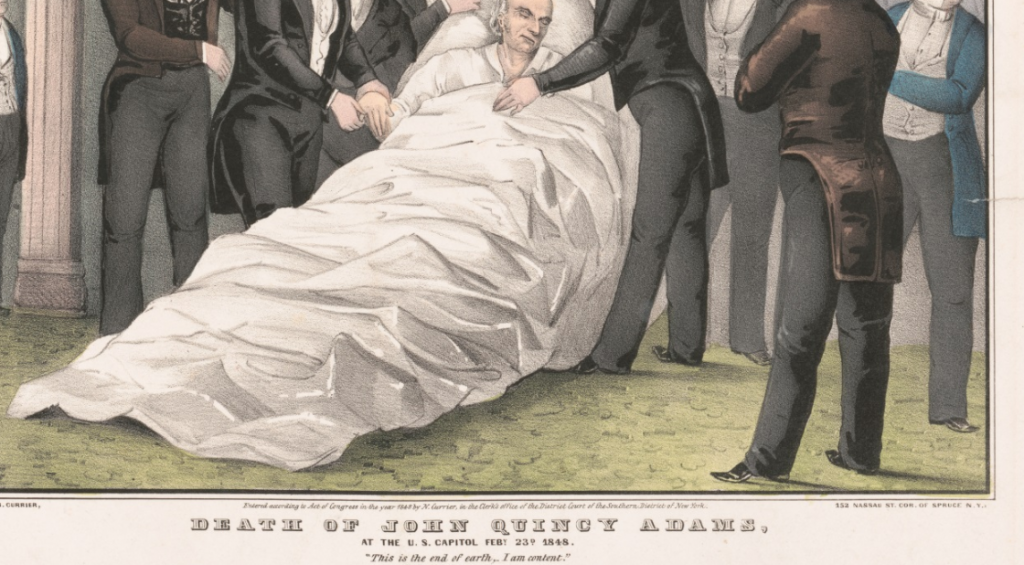
Readers were keen on the practical side of death, too. Newspapers provided all the gory details. The tortures of 19th-century medicine were visited on Adams and duly reported. Physicians tried mustard poultices and friction and used bloodletting, referred to as “cupping,” on Adams’s temples and the back of his neck. It became clear nothing would work, and papers reported that it was only a matter of time.
Just as reporters waited for definitive news, the city also held its breath, waiting. While in the Speaker’s room, Adams’s breath was “but the death-rattle.” The tough old New Englander kept up his disturbing breathing for another two days. Shortly after 7 p.m. on February 23, Adams died, with no fewer than 17 people in the small room. The next morning, the coffin was not ready, but “the remains were laid out in the room of the House Committee on Post Office and Post Roads,” the New York Evening Post reported, “where a continual throng of visitors is circulating.”

Everyone seemed to have an opinion on how the dead Congressman looked. “His countenance looks very calm, and his features are not in the least swollen,” went the standard reports. Some reporters looked a little more closely: “There are two spots of discoloration on the broad forehead, marking where the cups had been placed.” Some thought his body had begun to decompose already. Others were confident that it had not, and dueling accounts came out.
On the following day, February 25, Adams’s body was moved into the House Chamber for what amounted to a state funeral. The glass-windowed casket was elaborate, “trimmed at the bottom with rich silver lace, and around the top with heavy silver fringe. The head and breast of the deceased are plainly to be seen.” Adams was also outfitted with splendid flowers, cut that morning in the President’s greenhouse. The Hall of the House was also fitted for such a somber occasion. “The windows of the room (in the Capitol) are handsomely festooned with an immense and magnificent American ensign – the walls are hung in flowing [crepe].”
Following the service, all Washington turned out, from the Speaker to the Columbia Typographical Society, to escort the body to a temporary vault in Congressional Cemetery. Adams’s remains were on the move again in a few days. The recent expansion of rail travel made it possible for a massive funeral train to stop in five cities. Finally, 500 miles later, Adams was laid to rest in the family vault in Quincy, Massachusetts.
Adams’s death marked an early confluence of national, real-time mourning and morbid curiosity, made possible by electricity and steam. Telegraphs and locomotives enabled Americans to track John Quincy Adams’s demise, take part in reporters’ cliffhangers, and then participate personally by paying their respects, admiring the casket’s silk, and deciding for themselves whether that bruise was from bloodletting.
Originally published by the Office of the Historian, United States House of Representatives, 02.26.2019, to the public domain.
About the Author