
By Dr. Kevin A. Young
Associate Professor of History
University of Massachusetts Amherst
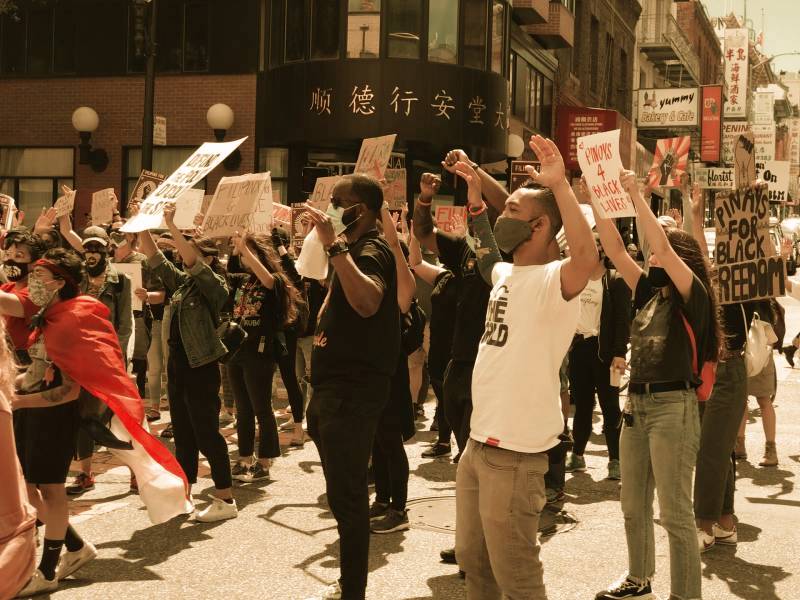
All disruptive social movements are met with stern warnings from people who think they know better. The current movement to “Defund the Police” is no exception.
Thus an editor of the Detroit Free Press professes sympathy for the protesters’ aims but says their “awful slogan” is “alienating” to the public, including to “White people who feel more reassured than threatened” by the police. Other pundits insist that “activists who are demanding radical change” are paving the way for Trump’s reelection: “Defund the Police” is “music to Trump’s ears” because it baits the Democrats into endorsing this presumably unpopular demand.
These critics share an assumption about how change happens: Movements must win over the majority of the public; once they do so, that sentiment soon finds its way into policy changes.
This argument has several problems. One is that government so frequently disobeys the will of the majority. Statistical analyses that compare public preferences and policy find that the opinions of non-wealthy people “have little or no independent influence on policy.” Having the support of the majority is no guarantee of change, to say the least.
Also problematic is the assumption that radical demands or actions scare away the public. The empirical evidence is mixed, but the 54% support for the recent burning of the Minneapolis police precinct should make us skeptical of conventional wisdom.
But the biggest problem with the We-Must-Persuade-the-Majority argument is that most progressive victories in U.S. history did not enjoy majority support when they were won. In case after case, a radical minority disrupted the functioning of businesses and state institutions, which sought to restore stability by granting concessions and ordering politicians to do the same.
Their Own Emancipation Proclamations
Before the Civil War, Abraham Lincoln had criticized slavery but opposed immediate abolition. In 1837 he wrote that “slavery is founded on injustice and bad policy, but that the promulgation of abolition doctrines tends to increase rather than abate its evils.” Even 16 months into the war, Lincoln still stressed that “my paramount object in this struggle is to save the Union,” and that “if I could save the Union without freeing any slave, I would do it.” By all indications, most Northern Whites shared Lincoln’s position.
In contrast, the formerly enslaved Frederick Douglass criticized “those who profess to favor freedom and yet deprecate agitation,” saying that they “want crops without plowing up the ground,” and “the ocean without the awful roar of its many waters.” Douglass celebrated John Brown’s 1859 raid on the Harpers Ferry arsenal, which forced slavery into the center of debate: “Until this blow was struck, the prospect for freedom was dim, shadowy, and uncertain.”
Enslaved workers themselves played a decisive role. By fleeing the plantations, burning property, fighting for the Union, and numerous other acts of resistance, they weakened the Confederacy and impelled Union leaders to embrace the pragmatic logic of emancipation as a way of undermining their enemies. This “general strike” of enslaved people was a key theme in W.E.B. Du Bois’ classic 1935 book Black Reconstruction in America, and that thesis has been confirmed and expanded by more recent historians. In Vincent Harding’s words, it was “courageous Black men and women and children” who “created and signed their own emancipation proclamations, and seized the time.”
Thus it was a militant minority—enslaved Black people in the South, aided by abolitionists such as Douglass and Brown in the North—who transformed the war to “save the Union” into an antislavery revolution.
The Moderates Get Alienated
The Black freedom struggles a century later were likewise the work of a minority. Most of the public either favored segregation outright or criticized segregation and the disruptive tactics of civil rights activists. Even many established Black leaders criticized the disruptive approach, favoring a purely legal strategy instead.
In a 1961 Gallup poll, 61% of respondents disapproved of the Freedom Riders who rode integrated buses into the South. A similar percentage condemned the sit-ins at lunch counters. Three years later, 74% said, in an echo of Lincoln, that “mass demonstrations by Negroes are more likely to hurt the Negro’s cause for racial equality.”
Such attitudes inspired Martin Luther King Jr.’s 1963 “Letter from a Birmingham Jail,” which brilliantly skewered “the white moderate, who is more devoted to ‘order’ than to justice.” King later dismissed warnings about alienating “white middle-class support” by saying, “I don’t think that a person who is truly committed is ever alienated completely by tactics.” Ultimately, “I don’t think in a social revolution you can always retain support of the moderates.”
Like the enslaved people who sabotaged the Confederate war effort, Black activists of the 1960s faced opposition or ambivalence from the majority. They succeeded because they imposed massive and sustained economic costs on the Southern elite, through boycotts, sit-ins, and other means. Thus it was the White business owners in places such as Birmingham who capitulated first, and who directed the rest of the White power structure—police, mayors, legislators, and so on—to allow desegregation.
The Wise Men Get Shaken
Another major progressive victory of that era, the U.S. withdrawal from Vietnam, came about for similar reasons. Public opinion and Congress were peripheral to the war’s end. Far more important was the unabating Vietnamese resistance, most notably the January 1968 Tet Offensive against the U.S. occupation and client regime in South Vietnam.
Tet catalyzed two decisive shifts. One was among U.S. business leaders, who concluded that the war was a drag on their profits. Lyndon Johnson’s March 1968 decision to de-escalate the war came five days after he met with his “Wise Men,” a group of top business leaders and former government officials. Insider accounts report that Johnson was “deeply shaken” by the meeting and left with “no doubt that a large majority” of the Wise Men “felt the present policy was at a dead end.”
Tet also accelerated the rebellion among U.S. soldiers. The people needed to fight the war increasingly disobeyed, deserted, declined to enlist or reenlist, and even killed the commanding officers who sent them on death missions. By 1971 military leaders warned of “a personnel crisis that borders on disaster,” and actually demanded that Nixon speed up the withdrawal. My co-authors and I tell this story in more detail in a new book, Levers of Power: How the 1% Rules and What the 99% Can Do About It.
Public opinion often shifts toward the radicals after the fact. In 1966, 59% thought the Vietnam War was “morally justified.” A decade later, 70% said the war was “fundamentally wrong and immoral.” In the years in between, radicals such as MLK had condemned U.S. intervention in Vietnam as “one of the most unjust wars that has ever been fought in the history of the world.” As usual, the radicals endured a barrage of vitriol from respected commentators, and King and many others paid for their radicalism with their lives.
The lesson of these past victories is that successful change depends not on majority opinion, but on the ability of the key participants in a system to disrupt that system: enslaved Black people in the Confederacy, Black consumers in Birmingham, the Vietnamese people and U.S. soldiers in Vietnam (or workers in a workplace, tenants in a building, and so on).
This is a major advantage of non-electoral forms of activism. Electoral campaigns require a majority of voters. Non-electoral strategies do not.
It’s not that the opinions of the majority are irrelevant. Certainly it’s good to have more people sympathizing with you. Most of the radicals in the above movements realized that. They understood the importance of organizing, building relationships, and doing educational work among the public. They thought carefully about tactics.
But they also recognized, as King did, that “you can’t always retain support of the moderates.”
Originally published by Yes! Magazine, 07.08.2020, under a Creative Commons Attribution-NonCommercial-NoDerivatives 4.0 International license.
About the Author