To understand Russia’s war in Ukraine, look to the blend of religious and militaristic nationalism under Putin.

By Dr. Lena Surzhko Harned
Assistant Teaching Professor of Political Science
Penn State
Introduction
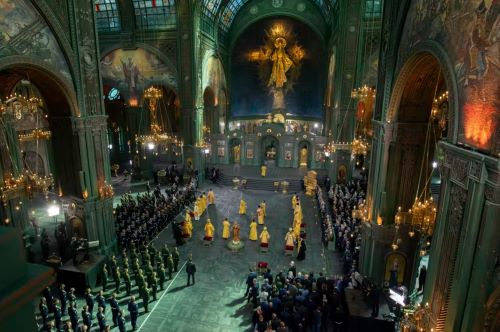
A curious new church was dedicated on the outskirts of Moscow in June 2020: The Main Church of the Russian Armed Forces. The massive, khaki-colored cathedral in a military theme park celebrates Russian might. It was originally planned to open on the 75th anniversary of the Soviet Union’s victory over Nazi Germany, in May 2020, but was delayed due to the pandemic.
Conceived by the Russian defense minister after the country’s illegal annexation of Crimea in 2014, the cathedral embodies the powerful ideology espoused by President Vladimir Putin, with strong support from the Russian Orthodox Church.
The Kremlin’s vision of Russia connects the state, military and the Russian Orthodox Church. As a scholar of nationalism, I see this militant religious nationalism as one of the key elements in Putin’s motivation for the invasion of Ukraine, my native country. It also goes a long way in explaining Moscow’s behavior toward the collective “West” and the post-Cold War world order.
Angels and Guns
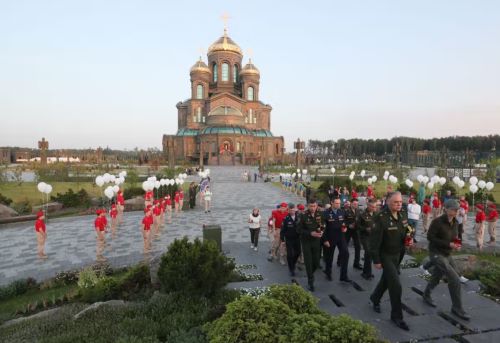
The Church of the Armed Forces’ bell tower is 75 meters tall, symbolizing the 75th anniversary of the end of World War II. Its dome’s diameter is 19.45 meters, marking the year of the victory: 1945. A smaller dome is 14.18 meters, representing the 1,418 days the war lasted. Trophy weapons are melted into the floor so that each step is a blow to the defeated Nazis.
Frescoes celebrate Russia’s military might though history, from medieval battles to modern-day wars in Georgia and Syria. Archangels lead heavenly and earthly armies, Christ wields a sword, and the Holy Mother, depicted as the Motherland, lends support.
‘Cradles’ of Christianity
The original plans for the frescoes included a celebration of the Crimean occupation, with jubilant people holding a banner that read “Crimea is Ours” and “Forever with Russia.” In the final version, the controversial “Crimea is Ours” was replaced by the more benign “We are together.”
When Russia annexed the Crimean Peninsula from Ukraine in 2014, the Russian Orthodox Church celebrated, calling Crimea the “cradle” of Russian Christianity. This mythology draws on the medieval story of Prince Vladimir, who converted to Christianity in the 10th century and was baptized in Crimea. The prince then imposed the faith on his subjects in Kyiv, and it spread from there.
The Russian Orthodox Church, also called the Moscow Patriarchate, has long claimed this event as its foundational story. The Russian Empire, which linked itself to the church, adopted this foundational story as well.
‘Russian World’
Putin and the head of the Russian church, Patriarch Kirill, have resurrected these ideas about empire for the 21st century in the form of the so-called “Russian World” – giving new meaning to a phrase that dates to medieval times.
In 2007, Putin created a Russian World Foundation, which was charged with promotion of Russian language and culture worldwide, such as a cultural project preserving interpretations of history approved by the Kremlin.
For church and state, the idea of “Russian World” encompasses a mission of making Russia a spiritual, cultural and political center of civilization to counter the liberal, secular ideology of the West. This vision has been used to justify policies at home and abroad.
The Great Patriotic War
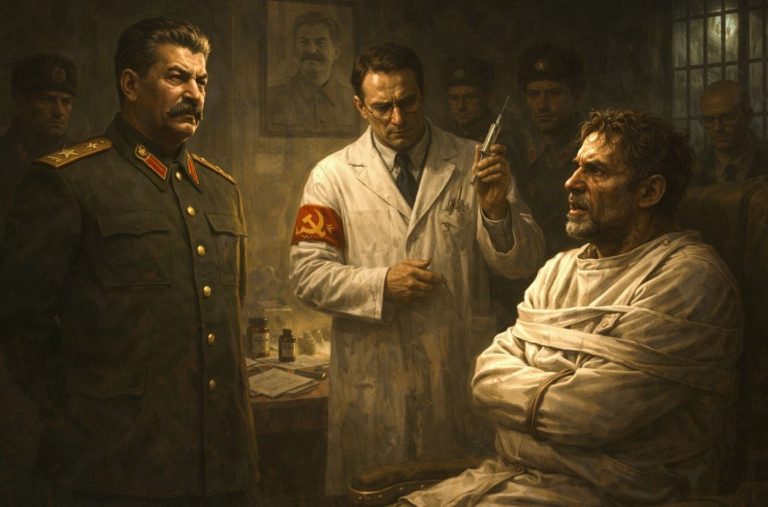
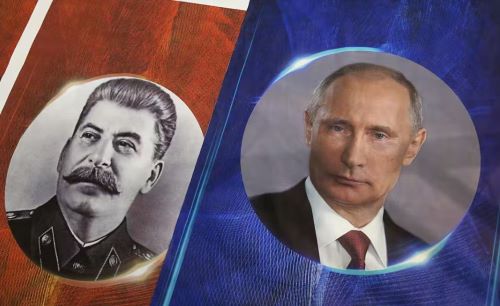
Another planned mosaic depicted the celebrations of Soviet forces’ defeat of Nazi Germany – the Great Patriotic War, as World War II is called in Russia. The image included soldiers holding a portrait of Josef Stalin, the dictator who led the USSR during the war, among a crowd of decorated veterans. This mosaic was reportedly removed before the church’s opening.
The Great Patriotic War has a special, even sacred, place in Russians’ views of history. The Soviet Union sustained immense losses – 26 million lives is a conservative estimate. Apart from the sheer devastation, many Russians ultimately see the war as a holy one, in which Soviets defended their motherland and the whole world from the evil of Nazism.
Under Putin, glorification of the war and Stalin’s role in the victory have reached epic proportions. Nazism, for very good reasons, is seen as a manifestation of the ultimate evil.
The rhetoric of this militant religious nationalism has been on display as Russia threatened to and ultimately did invade Ukraine. During a speech on Feb. 24, 2022, Putin bizarrely called for the “de-nazification” of Ukraine. He also spoke of fraternal relationships between Russian and Ukrainian people and denied the existence of the Ukrainian state. In his view, Ukraine’s sovereignty is an example of extreme, chauvinistic nationalism.
Putin’s claim that Ukraine’s government is run by Nazis is absurd. However, the manipulation of this image makes sense in the framework of this ideology. Painting the government in Kyiv as evil helps to paint the war in Ukraine in black and white.
Messianic Mission
Tangible geopolitical issues may be driving Putin’s war in Ukraine, but his actions also seem motivated by a desire to secure his own legacy. In his vision of “Great Russia,” restored to its former size and influence, Putin is a defender who must vanquish its enemies.
The Russian president himself appeared in earlier versions of the cathedral’s frescoes, along with Minister of Defense Sergei Shoigu and Russian Foreign Minister Sergei Lavrov. However, the mosaic was removed after controversy, with Putin himself reportedly giving orders to take it down, saying it was too early to celebrate the country’s current leadership.
Стены главного храма вооруженных сил России, строительство которого заканчивается в подмосковном парке «Патриот», украсят мозаикой с изображениями Владимира Путина, Сергея Шойгу и Иосифа Сталина. Фото: МБХ медиаhttps://t.co/O5AlRk3Pbl pic.twitter.com/TUxHW8LxXO
— ЧТД (@Chtede) April 23, 2020
Patriarch Kirill, who has called Putin’s rule a “miracle of God,” said the new cathedral “holds the hope that future generations will pick up the spiritual baton from past generations and save the Fatherland from internal and external enemies.”
This volatile religious nationalism manifests itself in the militarism unfolding in Ukraine.
On Feb. 24, 2022, the day the invasion began, Patriarch Kirill called for a swift resolution and protection of civilians in Ukraine, while reminding Orthodox Christians of the fraternal connection between the two nations. But he has not condemned the war itself and has referred to “evil forces” trying to destroy the unity of Russia and the Russian Orthodox Church.
Originally published by The Conversation, 03.02.2022, under the terms of a Creative Commons Attribution/No derivatives license.
About the Author