Conservative-run states are using various tools to restrict access to gender-affirming care.

By Aliyya Swaby
Reporter
ProPublica
One Saturday morning in September 2022, Terrence Steyer, the dean of the College of Medicine at the Medical University of South Carolina, placed an urgent call to a student. Just a year prior, the medical student, Thomas Agostini, had won first place at a university-sponsored event for his graduate research on transgender pediatric patients. He also had been featured in a video on MUSC’s website highlighting resources that support the LGBTQ+ community.
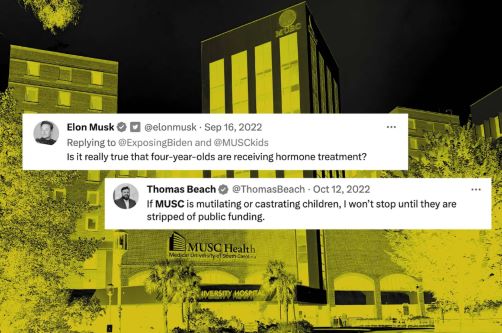
Now, Agostini and his once-lauded study had set off a political firestorm. Conservative activists seized on one line in particular in the study’s summary — a parenthetical noting the youngest transgender patient to visit MUSC’s pediatric endocrinology clinic was 4 years old — and inaccurately claimed that children that young were prescribed hormones as part of a gender transition. Elon Musk amplified the false claim, tweeting, “Is it really true that four-year-olds are receiving hormone treatment?” That led federal and state lawmakers to frantically ask top MUSC leaders whether the public hospital was in fact helping young children medically transition. The hospital was not; its pediatric transgender patients did not receive hormone therapy before puberty, nor does it offer surgical options to minors.
The dean’s call went to voicemail. A person familiar with the call shared the voice message with ProPublica.
After reassuring Agostini that he had done nothing wrong and wasn’t in trouble, Steyer pressed him for more detail about his research. “I’m really getting some pressure from the state Legislature and the leadership at MUSC,” he said in the message. He asked Agostini to give him “in particular the number of people at each age that was seen and the youngest child who received gender-affirming therapy for transgender issues.” Agostini declined to comment for this story. Steyer did not respond to a request for comment, but an MUSC spokesperson told ProPublica that Steyer wanted to “ensure we had all the facts as the situation was unfolding.”
It had been three months since South Carolina’s Legislature had banned the state’s flagship medical university from using public money to provide any treatment “furthering the gender transition” of children under 16. Before and after the directive went into effect, hospital leaders told lawmakers and reporters that they didn’t use state money to care for transgender patients. And the chief of children’s and women’s care said that the ban would not affect the services the hospital offered, according to an email he sent to colleagues, which was among hundreds of MUSC emails that ProPublica obtained through a public records request.
Then came the blowback from Musk’s tweet. (Musk did not respond to an email seeking comment.)
In the months after the tweet, as conservative lawmakers and activists sought more information on the hospital’s transgender patients, MUSC employees expressed concern that hospital leaders went too far to appease lawmakers, according to emails. The emails show hospital leaders eventually buckling under the pressure and excluding doctors and other key employees from the decision-making process.
By the beginning of December, the hospital’s leaders came to an agreement that MUSC would cut off access to hormones for gender transition for minors of all ages — including 16- and 17-year-olds, which went beyond what the Legislature sought. At the time, MUSC leaders told reporters that they were no longer legally allowed to offer the care, an about-face from their initial pronouncement that the Legislature’s action would not impact regular functions. They also gave no public explanation of how providing the care to older teens could be considered illegal.
In response to ProPublica’s questions, MUSC spokesperson Carter Coyle called cutting off care for older teens an “operational decision made by hospital leadership,” but failed to elaborate. She said MUSC and its providers “took immediate steps” to comply with the state’s ban once it went into effect.
The hundreds of emails released to ProPublica do not indicate exactly why or when MUSC leaders made these decisions. But from last September through this spring, the emails show leaders painstakingly attempting to avoid the appearance of support for transgender people or LGBTQ+ causes on social media, concerned about garnering further political backlash.
In banning state funding, South Carolina lawmakers wielded one of many tools conservative-run states are using to restrict access to gender-affirming care. Over the last several years, Republican elected officials in many states have elevated anti-transgender issues in their political platforms, used misinformation about transgender people when introducing bills to restrict gender-affirming care and spent public money waging extended court battles to limit access to care for trans children and adults.
More than 20 states have passed bills that restrict care for transgender young people. Several of those laws are facing court challenges, including one in Tennessee, where opponents have petitioned the U.S. Supreme Court to take up the case. South Carolina conservatives tried and failed to get a ban passed this year and are expected to try again when the Legislature reconvenes in January. These attempts contradict the recommendations of major medical associations, which support access to gender-affirming care for transgender young people.
Even before states pass outright bans, hospitals and clinics, especially those reliant on state contributions, often bow to political pressure. In Mississippi, for example, the University of Mississippi Medical Center decided to stop providing puberty blockers and hormone therapy to trans youth months before state lawmakers banned care. Mississippi Today obtained emails showing UMMC cut off care after receiving pressure from lawmakers who were angry that the facility was providing any gender-affirming care to youth. UMMC declined to comment either to Mississippi Today or for this story.
In South Carolina, after it became clear last December that MUSC was halting transition-related care for all minors, conservative lawmakers celebrated their victory. “I went after the Medical Center of South Carolina with 19 other of my door-kicking, rock-ribbed, and South Carolina’s most Conservative legislator friends,” Republican state Rep. Thomas Beach wrote in a Facebook post. “It feels good to be a gangster.”
Some transgender youth and their families found out the care was no longer available well after the decision was made. Max, a 17-year-old transgender patient at MUSC, didn’t know until this spring that he’d be cut off from testosterone therapy after more than a year on it, time in which he’d become more confident in his body and gender. “I can’t watch myself go back in time like that,” he recalled thinking. “I was like, ‘I don’t think I’m gonna survive this.’”
In the days after Musk’s tweet, hospital staff and executives were scrambling to minimize the damage and to telegraph to the Legislature that they were not violating the ban.
“It’s been a whirlwind few days, with LOTS of cooks in the kitchen,” MUSC communications director Heather Woolwine wrote on the morning of Sept. 20 to the hospital’s director of LGBTQ+ health services. Woolwine asked him to review “the messaging that has been approved at the leadership level, after much back and forth.”
In her email, Woolwine reported that staff was checking all of the hospital’s online pages for “about 35 key terms to see if there is any other content out there that might place us in anyone’s crosshairs.” (Those terms included “affirming providers,” “questioning” and “queer.”) She acknowledged that the hospital didn’t want to “swing too far in the other direction” in responding to the threat of political retaliation. “We MUST keep respect of our patient, family and employee audiences at the forefront of any decision-making,” she wrote.
But that commitment was already faltering. By the time she sent the email, MUSC had determined that it would no longer provide hormones or puberty blockers to transgender children under 16.
The recipient of Woolwine’s email, MUSC’s first top-level employee focused exclusively on LGBTQ+ health, quickly wrote back. Chase Glenn explained that the hospital’s principal provider of gender-affirming care for transgender youth had told him about the lack of “any direct communication to her patients under 16 and their parents about the current legal reality.” One of her patients had come in the day before, he noted, only to learn that the care was no longer available.
“The patient’s mother was extremely angry and of course that’s out of concern for their child,” Glenn wrote, adding that the doctor herself “is hoping for some proactive, thoughtful, patient-centered communication that would at least make impacted patients/parents aware of the situation.”
Woolwine asked Glenn to help tackle that problem and suggested getting hospital leaders together for a discussion. But the emails over the following several months suggest that plan fell by the wayside. Woolwine didn’t respond to ProPublica’s questions. Glenn declined requests for comment.
Within days, U.S. Rep. Nancy Mace, a South Carolina Republican, posted a video on social media attacking political opponent Annie Andrews, a pediatrician at MUSC who was not connected to the endocrinology clinic. The video scrolled white block letters over a photo of Andrews: “Sex change surgery, puberty blockers, gender changing hormones for children?! That’s not protection. That’s child abuse.” Andrews took unpaid leave from her job and worked with MUSC to coordinate extra security for herself and her kids.
About a week later, MUSC leaders discouraged pediatric residents who wanted to send a letter to all hospital leaders defending Andrews against Mace’s political attacks. “They left me out on a limb,” said Andrews, who has since resigned from the hospital. “What disappointed me so deeply was their refusal to support these vulnerable youth in our community by making a statement that gender-affirming care is not child abuse.”
MUSC told ProPublica it reminded residents that state guidelines prevent public institutions from using state resources to advocate for political candidates. “If MUSC had issued a public statement it could have been interpreted as an endorsement of a candidate running for office,” Coyle said in an email.
In October, conservative politicians and activists started filing public records requests with MUSC to get the data behind Agostini’s abstract. Activists called the pediatric endocrinology clinic pretending to be parents of trans children, attempting to catch providers violating the clinic’s own stated policies regarding gender-affirming care. At least one lawmaker took to social media to threaten MUSC’s $188.9 million in state funds — 3.5% of its budget. “If MUSC is mutilating or castrating children, I won’t stop until they are stripped of public funding,” Beach, a member of the far-right Freedom Caucus, tweeted. Beach did not respond to a request for comment.
In an Oct. 5 email, MUSC leaders shared a news article about Oklahoma’s governor threatening massive budget cuts to the children’s hospital affiliated with the public hospital if it continued to offer gender-affirming care. “Could be the road we end up on,” wrote Mark Scheurer, chief of children’s and women’s care.
MUSC leaders also repeatedly pulled back on messaging related to LGBTQ+ issues, overriding the decisions of their LGBTQ+ health director. Glenn, a transgender man and longtime LGBTQ+ activist, had joined MUSC in 2021 to help the institution become a vanguard of LGBTQ+ health care in the state. By spring of 2022, Glenn had successfully organized the hospital’s first LGBTQ+ Health Equity Summit, bringing providers and students together virtually to learn about challenges in serving queer patients.
But as tension built that fall, Glenn found he had less and less power to do his job.
In November, Woolwine sent Glenn an email discouraging him from promoting a meeting that MUSC students had with the Department of Health and Human Services’ assistant secretary for health, Rachel Levine, the first openly trans person confirmed by the U.S. Senate. Several months prior, the hospital had proudly touted Levine’s appearance at the health equity summit Glenn had organized. Now, officials worried that promoting her involvement would make the hospital a target.
Glenn agreed to stand down. “I’ll note though that the fact that Admiral Levine is transgender is not the emphasis of the post,” he wrote back.
That same month, Woolwine advised a drastic edit to a social media post Glenn had helped draft to commemorate the annual Transgender Day of Remembrance, honoring “the memory of the lives lost due to acts of anti-transgender violence.” Woolwine stressed that lawmakers in the Freedom Caucus would soon be receiving information they had requested from the hospital about the state of gender-affirming care. “I have no doubt that in the week or two that follows, there’s going to be some sort of external messaging from them on transgender issues and their ‘findings,’ probably in social and in news media,” she wrote. “That post for the remembrance day, as written, may then have us looking like we are ‘firing back,’ since lives lost messaging may be interpreted as a shot across the bow.”
The resulting post barely mentioned transgender people at all.
On Dec. 1, an email from Patrick Cawley, the CEO of MUSC Health, landed in the inboxes of three of the hospital’s top leaders: “We need to update the website,” he wrote, referring to the page that described services for pediatric transgender patients. Cawley followed up with another email the next day, giving his preferred edits in red text. To the preexisting sentence that read, “We do not offer surgical treatments,” he added “or gender affirming hormonal interventions.” David Zaas, then the CEO of the Charleston division of MUSC Health, and Scheurer quickly agreed to the change.
Though MUSC Health’s CEO had been ready to make the change public on the website, the decision to cut off the care had not been communicated to Glenn. He asked MUSC leaders about the edit in an email the next day: “Can you confirm for me if this is accurate?” Cawley, Zaas and Scheurer did not respond to ProPublica’s requests for comment.
For some families, the news that their child’s care would be cut off came not from their MUSC provider but from media coverage, including a December Post and Courier article. As the information reached the public in mid-December, Glenn emailed MUSC leaders yet again to push them to communicate with patients. “After the news pieces began airing, I started receiving texts and emails and panicked Facebook messages from concerned parents who wanted to know exactly what this was going to mean for them and their children,” Glenn wrote. “Frankly, I’m frustrated that this communication is indirectly falling on me and embarrassed that we have left many of these patients scared about how they’re going to be able to continue this treatment.”
In response to ProPublica’s questions, MUSC spokesperson Montez Seabrook wrote that the hospital chose to have its providers reach out directly to affected patients during regularly scheduled visits instead of sending out a broader message to trans youth and their families: “This was to ensure that patients and families had an opportunity to discuss any concerns directly with their providers.” He also said, “This personalized approach took a little time to complete.”
In early January, Glenn resigned. “I strongly object to a number of actions recently taken by MUSC leadership that have directly impacted LBGTQ+ individuals’ access to health care services, health care providers’ access to educational resources specific to LGBTQ+ care and my ability to fulfill my responsibilities,” he wrote in a letter explaining his decision.
He criticized leaders for removing pages of LGBTQ+ resources from MUSC’s website and “unilaterally” postponing the next LGBTQ+ Health Equity Summit just three months before it was going to be held. He also cited leadership’s decision to voluntarily stop providing hormone therapy for 16- and 17-year-olds as one of the reasons for his resignation.
“These decisions and others have created a hostile environment where it will no longer be possible for me, in good conscience, to represent MUSC as a leader in LGBTQ+ care in our state and within the LGBTQ+ community– my own community,” he wrote. “I wish the MUSC all the best in the future and hope that there will come a time when they will meaningfully renew their commitment to being a leader in LGBTQ+ health care.”
When asked about its response to the letter, MUSC told ProPublica it could not comment on a personnel matter.
As the news of Glenn’s resignation spread through the hospital, at least one top employee shared his frustration.
“This is, in my opinion, both terribly sad and entirely predictable,” MUSC pediatrician and Chief Quality Officer Dr. David Bundy emailed other members of the Charleston division’s leadership team. Bundy’s son Eli, who is transgender and attends college out of state, has frequently addressed the Legislature to oppose anti-transgender bills. “MUSC needs to take a long look in the mirror and ask ourselves what our values are.” Bundy declined to comment.
This March, months after MUSC cut off hormone therapy for young transgender people, pediatric endocrinologist Dr. Deborah Bowlby asked Scheurer and the pediatrics chair for guidance on how to communicate the decision to patients. Bowlby was the main doctor who had been treating transgender youth who experienced gender dysphoria, and she repeated concerns she had shared with Glenn the previous fall.
“I have been told that the current policy is that the pediatric endocrinology clinic is not to be providing endocrine care regarding gender transition for pediatric patients. I want to abide by MUSC policies and am not comfortable seeing these patients,” she wrote. “Are you going to arrange to have these patients taken off my schedule and advise them that we are not providing endocrine care regarding gender transition for pediatric patients?”
Scheurer advised Bowlby to refer patients who wanted gender-affirming care to the adolescent medicine providers, who would help coordinate further care. Bowlby was not the only one who was confused. That week, an employee in the psychiatry department emailed colleagues to ask how they were notifying parents and families that they could no longer provide gender-affirming hormone therapy for minors.
At the time MUSC doctors were pleading with leaders for guidance, 17-year-old Max was unaware that MUSC had cut off his care. (Because Max is a minor, ProPublica is protecting his identity by using just his first name and not identifying his parents.) Max, who’d been treated by Bowlby since 2021, had little reason to think anything was amiss when he’d gone in for a follow-up visit in February 2023. His medical notes from that visit reference his preexisting testosterone prescription, as well as his history of gender dysphoria and suicidal ideation. Bowlby did not inform Max or his parents that MUSC had decided to end his hormone therapy.
In late March, Max’s father reached out to Bowlby for a testosterone prescription refill. She didn’t respond. Confused and a little concerned, Max’s dad called the endocrinology clinic’s office and was told by an administrative staff member that his son could no longer get hormone therapy at MUSC.
For Max and his parents, the journey to find the right doctor and medical care was hard-fought. Even when Max was in elementary school, the idea of going through a cisgender girl’s puberty — getting a period and wearing a bra — felt terrifying. At the beginning of high school, Max’s parents took him to a therapist to help with his mental health struggles. The therapist recommended Prozac to address his anxiety and depression. It didn’t work. Max’s anxiety spiked and his gender dysphoria worsened. He began experiencing thoughts of suicide.
In May 2021, he tried to kill himself and was committed to inpatient psychiatric care at MUSC. Once he was released, Max and his parents decided he should see an MUSC pediatric endocrinologist so he could finally start hormone replacement therapy. He immediately trusted Bowlby, who seemed much more knowledgeable about transgender health than some of his previous doctors. Over the course of several months, she guided the family through the process of assessing whether Max was a good candidate for testosterone, patiently explaining the steps she would take to understand his dysphoria.
For Max, getting on testosterone in early 2022 sparked a second puberty at age 16. His voice cracked, he felt hungrier, his skin broke out in acne. “But I felt happier,” Max told ProPublica. “I just mentally felt more relieved, like I’m excited to continue transitioning and things are feeling right.”
Max said he believed that Bowlby would advocate for him. He remembers her referencing the bans on gender-affirming care that were starting to pass in conservative states and reassuring him that she would never stop providing treatment.
When Bowlby abruptly stopped responding to their messages after Max had been on testosterone for more than a year, Max’s dad wrote a second message to Bowlby in the patient portal: “You know how amazingly supportive and grateful we are for your advocacy over the years in these matters, while trans kids (and parents) are under attack. I just wish the office had told us that your office was no longer prescribing testosterone. Now we are a bit behind the 8 ball trying to remedy this.” Bowlby never responded, according to Max’s dad. She declined to be interviewed for this story.
MUSC staff recommended Max’s parents connect with Dr. Elizabeth Wallis, the adolescent medicine provider who had volunteered to help coordinate care. “I’ve been trying to reach everyone and make sure they have a plan for care but it’s been very slow going,” Wallis wrote to Max’s dad in response to his email. She apologized for the “colossal mess” and promised to help them find a solution. But Max’s dad said that didn’t work out either. (Wallis did not respond to ProPublica’s requests for comment.)
After about a month, Max’s dad found a Facebook group for parents of trans young people in South Carolina, who suggested the family try Planned Parenthood. Max got a renewed prescription soon after.
Now back on testosterone, Max looks forward to turning 18 early next year, which will help ensure he can access gender-affirming care. South Carolina considered a bill earlier this year that would ban medical transitions for anyone younger than 21, but it didn’t go anywhere.
Max and his father still have questions: Why did MUSC cut off Max’s hormone therapy when the state Legislature didn’t even mention 16- and 17-year-olds in its ban? Couldn’t MUSC have prevented the chaos by communicating better with its patients? Why did Bowlby disappear instead of warning them?
“Knowing what happened would be nice,” Max’s dad said. “We figured it out — but we had to figure it out.”
Coyle, the university spokesperson, told ProPublica that MUSC did communicate the change to its doctors. “Physicians are notified of regulatory changes regarding medicine in various ways, including department leadership discussions, discussions with colleagues, information from specialty societies, and mainstream media,” Coyle wrote.
But as recently as May, some MUSC providers were unsure about the policy.
On the afternoon of May 23, after a conversation with her department chairperson, an OB-GYN sent an email to a physician’s assistant in family medicine, an adult endocrinologist and Bowlby. The subject line was “Question about transcare for teens.” She had only just learned that MUSC doctors were “restricted from prescribing transgender affirming care for people under 18yo,” she wrote. “Is this the case? How are y’all navigating that?”
“I have referred to Deb in the past,” the physician’s assistant responded, referring to Bowlby, “but MUSC has made some changes.”
Originally published by ProPublica, 12.06.2023, under a Creative Commons Attribution-NonCommercial-NoDerivs 3.0 United States license.
About the Author