
“They know how to play power games.”

By Eli Hager
Reporter
ProPublica
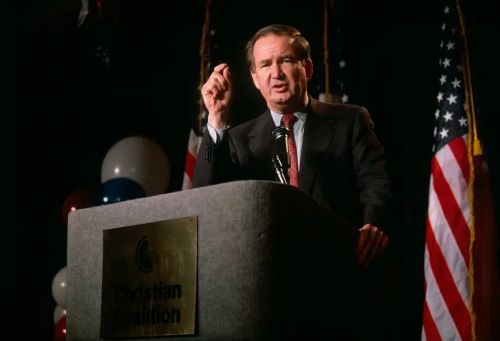
In 1996, a familiar Republican candidate ran for president calling himself an “America-first” populist, riling up his supporters by claiming that immigrants were “invading” our country.
“I’ll build that security fence, and we’ll close it, and we’ll say, ‘Listen, José, you’re not coming in this time!’” shouted the candidate, Pat Buchanan, to raucous applause at an Iowa rally early that year.
Anti-immigrant sentiment was simmering across the nation, and it was about to translate into federal policy. Leading congressional Republicans, channeling Buchanan’s ideas, were drafting the most restrictionist immigration legislation in nearly a century. The bill included not just a crackdown on undocumented migrants but also provisions that would cut legal immigration almost in half. It looked likely to pass.
But then the business community, so reliant on immigrant workers, showed up.
A motley crew of corporate types, including lobbyists for ascendant Silicon Valley and Seattle tech companies like Microsoft, Intel and Hewlett-Packard, swarmed the nation’s capital, navigating House and Senate hallways as well as the legislative process. Alongside the National Association of Manufacturers and other business groups, they spent months in crowded conference rooms finding common ground with Hispanic and civil rights organizations. They circulated policy briefs to persuadable lawmakers. They counted votes.
They poured resources into the effort, commissioning studies and getting op-eds published defending immigrants.
That spring, their coalition defeated the proposed bill and its attack on legal immigration, forcing Republicans to pursue a scaled-back, though still very tough, illegal immigration enforcement measure.
And Buchanan, after several early victories in the primaries, dropped his bid for the presidency.
This was, for decades, the classic role of the business community in immigration politics. They rarely won total victories, and their motivation, typically, wasn’t much more complicated than economic self-interest.
From the U.S. Chamber of Commerce (the largest lobbying organization in the nation, representing business interests) to the “Growers” (agricultural businesses employing migrant farmworkers) to hotel, restaurant and construction industry associations, they spent time and money on Capitol Hill largely to fend off threats to their existing supply of immigrant labor. They also advocated for guest worker programs and a range of types of visas and work permits for new foreign-born workers.
But they were always there, on the Hill and in the public conversation. They built coalitions, leveraging their considerable influence over Republicans and finding the compromises with Democrats that were available to make.
And in the process, they fundamentally moderated the nation’s immigration debate.
These business groups — alongside immigration and labor advocacy groups on the left, including the National Council of La Raza (now called UnidosUS) and the United Farm Workers — helped achieve multiple overhauls of the U.S. immigration system this way. They were deeply involved in the negotiations that led to President Ronald Reagan’s sweeping legalization of the status of undocumented immigrants in 1986. Then, they successfully fought for the creation of several new and expanded visa categories, as well as the Temporary Protected Status program, in 1990.
Even when they failed to get subsequent immigration reform bills passed, their continued active presence in the debate provided a crucial counterweight to the nativist wing of the Republican Party — which was always close to power, long before Donald Trump came on the political scene.
As Virginia Lamp, who during that period was an immigration and labor-relations lobbyist for the Chamber of Commerce, once put it to a panel of immigration experts, the business community had to challenge the “faulty assumption” that immigration negatively affects the economy (and that the border is “out of control”). These ideas, she said, are “based on a type of selfish nationalism.”
Virginia Lamp is now Ginni Thomas, the hyperconservative wife of Supreme Court Justice Clarence Thomas. She is better known these days as an “America First” election denier.

Indeed, things have changed.
According to ProPublica interviews with more than 20 longtime business lobbyists across a range of industries, as well as congressional staffers and federal officials, the U.S. business community has increasingly retreated from immigration politics over the past decade and especially this year. They have largely relinquished their previous role as a lobbying force and moderating presence on this issue, despite their need for immigrant workers arguably being greater than ever. And they’ve been noticeably absent even as the current Republican presidential candidate promises to deploy the military to mass-deport 15 million to 20 million immigrants, and even as he continues to hack away at the political popularity of immigration itself — the effects of which might be felt for decades to come.
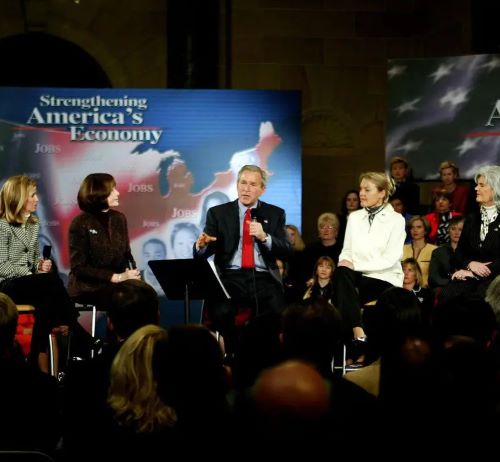
Some erstwhile pro-immigration business leaders in Silicon Valley in particular have not only declined to speak out against Trump’s rhetoric and policy plans, they have gone all in on him. Elon Musk, an immigrant, has immersed himself in nativism. Mark Zuckerberg says that he’s done with politics, despite once making immigration reform a priority.
Many business leaders have backed away from this policy area out of a calculation that they can still get corporate tax cuts and slashed labor and environmental regulations from Trump’s version of the Republican Party, several prominent business lobbyists told me.
In a hyperpolarized political climate in which getting something practical done on immigration would be difficult — and costly, in terms of both political capital and lobbying dollars — they’ve had to mostly set it aside for now, many said.
Randy Johnson, a previous senior vice president at the Chamber of Commerce, spent decades in Washington, D.C., lobbying for comprehensive immigration reform among other employment issues. In recent interviews and emails with ProPublica, though, he said that “immigration, while an important issue for the business community, has never been a tier-one issue.” He said that it’s typically easier to raise a “war chest” of lobbying dollars from chamber members when the subject is Occupational Safety and Health Administration regulations, worker unionization or tax reform (including reducing taxes on inherited wealth). Those are all bigger immediate concerns for CEOs, Johnson said, because “the impact on the bottom line is more direct and obvious,” whereas “the benefits of immigration reform tend to be more uncertain and diffuse.”
“Business has kind of abdicated the field at the grassroots level,” said C. Stewart Verdery Jr., founder of Monument Advocacy, a lobbying and consulting firm that counts Microsoft, Amazon, J.P. Morgan, Netflix, Starbucks and PepsiCo as clients, among others. Verdery was previously assistant secretary for policy at the Department of Homeland Security, in a role overseeing both Immigration and Customs Enforcement and Customs and Border Protection. “When I’ve seen business get really engaged, when they really want something — whether it’s tax reform, permitting reform, trade deals — there’s a lot that they can do.”
Verdery said that businesses and business associations could, for example, spend $100 million on ambitious media campaigns to counteract the anti-immigrant rhetoric that Fox News churns out every night. They could run ads, fund rallies, get involved in local political races.
But they have not done these things lately, at least not on any large scale. Meanwhile, right-wing groups continue to spend hundreds of millions of dollars on increasingly extreme anti-immigrant advertising.
Even when the most consequential bipartisan immigration legislation in years came before Congress earlier this year, business groups and lobbyists didn’t flock to congressional offices and hearing rooms the way that they had in 1986 and 1990 and 1996 (and 2001, and 2005, 2006 and 2007, and 2013). They weren’t there in force to supply their industry expertise and fight for the best possible bill, as was once their MO — nor did they push back aggressively when Trump started attacking the bill for political reasons.
“They know how to play power games,” said Rick Swartz, an immigration lobbyist who since the 1980s has helped forge coalitions of business groups, liberal advocates and policymakers in Washington. He founded the National Immigration Forum, an umbrella organization of immigration advocacy groups. “There have been real battles happening, that are consequential, that business has a lot at stake in,” Swartz said. “Where are they?”
Many ostensibly pro-immigration business interests, like the Koch network, have been pouring money into the campaigns of business-friendly conservative candidates even if they attack immigrants, Swartz said. “Money is fungible,” he said, so supporting such candidates “fuels nativism even if derivatively and hidden by the occasional op-ed or roundtable study.”
“This, to me,” he concluded, “is declining to rise to the moment.”
Viewed through a purely economic lens, the business sector would have every reason to keep fighting for more immigrants. The U.S.-born working population is in relative decline, due to both our postpandemic labor shortage and the aging and retirement of tens of millions of baby boomers. Around 8 million jobs nationally are sitting unfilled right now — untapped capacity that companies could unleash more of with more workers from abroad, who are younger on average.
Of course, many manufacturing jobs have actually been shipped overseas, many service jobs automated. Some bad-actor businesses, too, rely on migrant workers continuing to be undocumented; it makes those workers easier to exploit.
Still, without immigrants, businesses around the country that rely on in-person work would struggle to find enough people to hire. In construction, homes would go unbuilt, causing housing prices, already painfully high, to soar. Nursing homes and the home health care sector, dangerously understaffed as they are, would face a crisis-level labor shortage. Ditto with child care and the dairy industry. And Big Tech would lose some of its best and brightest.
Moreover, our current immigration system is chaotic, choked with visa and asylum backlogs. Every day, migrant workers face tremendous uncertainty about whether they can even legally go to work.
Business generally prizes stability and predictability among its employees. Reform would seem to be a priority.
But the elephant in the room is Trump. Under his thrall, the anti-immigrant wing of the GOP has mushroomed, its rhetoric increasingly frightening to Chamber of Commerce types, many told me in interviews. They’ve become wary of even seeming like traditional Republicans anymore, some said, let alone advocating publicly on this issue.
“Businesses are inherently risk-averse,” said Jennie Murray, president and CEO of the National Immigration Forum. In an earlier role, she ran the forum’s Corporate Roundtable for the New American Workforce, an immigrant worker-integration program co-founded by Walmart and Chobani.
Murray pointed to recent episodes in which Trump and other Republicans have directly attacked private companies as reasons why the business community doesn’t want to do as much public-facing advocacy on this issue right now. (Trump has gone after Twitter, the NFL, Amazon, Apple and General Motors, among others; for Florida Gov. Ron DeSantis, it’s Disney.)
Murray said that some businesses and business groups are still working with the federal government in a more behind-the-scenes way, on issues like processing visa backlogs, advancing immigrant worker training and developing services for refugee employees.
Bob Worsley, a real estate and energy business owner who was also an Arizona state senator and is now co-chair of the board of the American Business Immigration Coalition, said that the recent relative inactivity of the business community on immigration can partly be attributed to a type of “cancel culture.” In an atmosphere in which your political party (he’s a Republican) and even your church expect you to be in favor of things like deporting migrants, Worsley said, business owners have developed a “fear of coming out” about their support of immigration. Doing so, he said, can actively be bad for business.
Several business owners highlighted last year’s right-wing boycott of Bud Light as a worst-case scenario — losing customers en masse for taking even a mild stand on a hot-button political topic.
“It’s become almost an impossible juxtaposition,” Worsley said. Many of his fellow businesspeople support Trump, “and yet their business relies on these workers, or they would not be in business.”
Denyse Sabagh, a past president of the American Immigration Lawyers Association and a longtime immigration advocate representing businesses and others, said that she hears from businesspeople “every day” who want help obtaining visas or legal status for their current or future employees. She said she often recommends that they contact their representatives in Congress, “because the more that [lawmakers] hear from business, the more likely it’s going to be effective.” But her clients haven’t been taking her up on that, she said.
“It’s surprising to me that they’re not more involved,” Sabagh said. “They’re all clamoring for workers.”
Even if individual businesses are afraid of speaking up, it would ostensibly be the job of the business associations and coalitions to publicize and advocate for what their members’ long-term labor needs are. But they too have been shying away from doing so of late.
The executive director of the Critical Labor Coalition, which includes the American Hotel and Lodging Association, the National Restaurant Association, Chipotle and other business groups and businesses, has even said that it’s best to avoid saying the word “immigration” on Capitol Hill altogether and, instead, to use “workforce solutions.”
This all creates a feedback loop, business lobbyists and congressional staffers said. Business looks at the state of things on the Hill and in presidential politics and sees more land mines than viable immigration reforms to rally around. As a result, Republicans no longer get as much input from business on this topic — which they have historically been responsive to. Then, the political conversation focuses ever more narrowly on the border, crime and asylum backlogs, none of which are as interesting to business as legal immigration and visas.
That’s too bad, said J. Michael Treviño, a Texas businessman, civil rights advocate and proponent of immigration reform; he has spent much of his career in the oil and gas industry. Treviño said that when the business community isn’t at the table, policymakers “lose the facts” about how immigrants generate economic growth and benefit society.
Business leaders and advocates providing those facts, he said, is “the only way that you can actually refute the misinformation, of which there is so much.”
This didn’t all start with Trump, of course.
In the mid-2000s, congressional staffers along with business and other pro-immigration groups were busy hashing out the details of a bipartisan comprehensive immigration reform compromise shepherded by Sens. Ted Kennedy and John McCain.
But something had been happening politically in the years since 9/11, a nation-changing event that ushered in a newly intense fear of foreigners stoked by increasingly powerful media personalities at Fox News and on talk radio. Businesspeople and their allies in Congress didn’t fully grasp this phenomenon until lawmakers faced an onslaught of grassroots right-wing opposition to the legislation, in 2006 and 2007 and heading into the 2008 election. Even McCain turned against it, amid his race for president that year. (He still lost.)
Many of those dynamics have persisted, leading several business leaders and lobbyists supportive of immigration reform to tell me that it’s not them who have changed. It’s the very nature of Congress, which was thrust into growing levels of dysfunction from 2008 onward, a period that also included xenophobia surrounding the first Black president; President Barack Obama’s own rightward turns on immigration; the rise of social media and the misinformation it spreads about this issue in particular; and increased partisan gerrymandering and polarization generally.
Yet all of that notwithstanding, much bipartisan federal legislation has still been passed in recent years. And the food, drug, gun and oil industries still push for less-popular policies by throwing their considerable money and muscle at lobbying.
Charles Kamasaki, a longtime immigration reform expert and advocate who wrote the definitive book on 1986’s successful reform effort and the other legislative battles that followed, put it this way: “Business still gets what they think of as a fair hearing on Capitol Hill, but only on issues that are ‘existential’ to them.” These days, he said, that mainly means tax cuts and deregulation.
Immigration is “being trumped, pun intended, by other considerations,” Kamasaki said.
When businesses do still engage on immigration, he added, it’s usually to try to shape a specific piece of policy affecting their specific industry’s often narrow interests. It’s not as coalitional and big-picture anymore, which diminishes the old strength in numbers. They’re much less likely than they once were to stand up for comprehensive immigration reform on the grounds that immigration, writ large, is good.
Some corporate-backed lobbying groups, such as fwd.us and the American Business Immigration Coalition, have stayed involved in immigration politics in a forward-looking, idealistic way, although they aren’t as powerful of a presence on Capitol Hill. Businesses will still speak up, meanwhile, against efforts to make them responsible for checking the immigration status of their workers, including through E-Verify. They’ll also get behind relatively popular causes like a pathway to citizenship for “Dreamers.” And Chamber of Commerce officials have highlighted recent reforms to the EB-5 visa program for immigrant investors as well as incremental increases to the cap on H-2B visas (for temporary or seasonal workers in the hotel, landscaping and other industries) as advocacy successes.
Some in the agricultural sector, perhaps more reliant on undocumented migrant workers than any other, have even recently begun to sound the alarm on Trump’s mass-deportation proposals.
Swartz, the pro-immigration lobbyist, acknowledged that there are exceptions to the idea that the business community has disengaged from the politics of immigration entirely. “But it’s the big picture, about power and the exercise of power,” he said. He added that businesses have a special responsibility to do much more than they’re currently doing because in a possible Trump mass-deportation situation, “the easiest undocumented people to target will be in the workplace.”
All the while, without the reliable participation of business, center-left immigration advocacy groups have been feeling as though they “don’t have a partner in this anymore,” said Lanae Erickson, a senior vice president at Third Way, a center-left public policy think tank.
And the left, still fighting for a path to citizenship for undocumented people, family immigration policies and protections for refugees, is out in the cold.
Craig Regelbrugge, a business lobbyist who in the late ’90s and aughts represented agriculture interests including in his role as chair of the Agriculture Coalition for Immigration Reform, remembers the “sense of purpose” of being fully absorbed in immigration politics back then. That included negotiating with his ostensible opponent, the leadership of the United Farm Workers, to jointly pressure policymakers to make effective immigration policy.
“I just don’t think there’s as much of that happening anymore,” Regelbrugge said. He pointed to how the organized anti-immigrant movement of the Trump era wears its ideology as a badge of honor, fundraises and spends off of that, and shows up for the fight. Business, Regelbrugge said, could stand to relearn those arts.
Originally published by ProPublica, 10.25.2024, under a Creative Commons Attribution-NonCommercial-NoDerivs 3.0 United States license.
About the Author