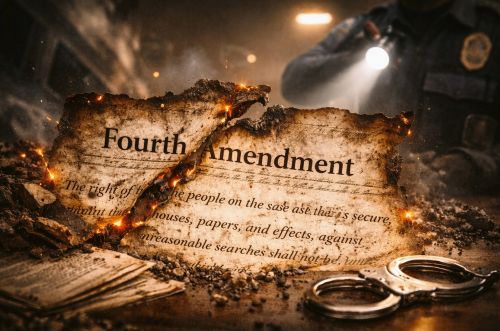
The Fourth Amendment was designed as a structural restraint on power, not a negotiable privilege contingent on circumstance, status, or suspicion.

By Matthew A. McIntosh
Public Historian
Brewminate
Introduction
The Fourth Amendment was written to place a firm boundary between the individual and the state. Its language is deliberately plain. Searches and seizures must be reasonable. Warrants must be specific. Power must be justified before it is exercised. These were not procedural niceties, but hard-won lessons drawn from a history of arbitrary intrusion and unchecked authority.
Yet constitutional erosion rarely announces itself openly. The Fourth Amendment is not repealed. It is reinterpreted. Its protections are narrowed through exceptions, softened by doctrine, and applied unevenly across populations. What remains on paper survives in theory, while in practice privacy becomes conditional, consent becomes ambiguous, and intrusion becomes routine.
In the current political and legal climate, these pressures have intensified. Immigration enforcement has become a proving ground for warrantless searches. Courts have expanded justifications for entry without judicial authorization. Executive power has selectively invoked Fourth Amendment protections while endorsing broad surveillance and enforcement authority for others. Each development is often defended as narrow or situational. Taken together, they reveal a systemic retreat.
This brings together reporting, legal analysis, and commentary to trace how Fourth Amendment protections are being weakened in practice. The danger lies not in any single decision or policy, but in the pattern they form. When exceptions become doctrine and privacy becomes negotiable, constitutional rights do not vanish. They hollow out.
Ground-Level Tactics: How Fourth Amendment Violations Actually Happen
Overview
Fourth Amendment erosion does not begin in court opinions or constitutional theory. It begins in ordinary encounters, at apartment doors, during traffic stops, and in moments when individuals are pressured to comply without fully understanding their rights. These ground-level tactics rely less on brute force than on confusion, deception, and asymmetry of power. What follows shows how constitutional protections are often bypassed long before a judge ever weighs in.
“This Deceptive ICE Tactic Violates the Fourth Amendment”
Immigration and Customs Enforcement agents have increasingly relied on deception, presenting administrative documents as judicial warrants to gain entry into homes, even though such documents do not authorize warrantless searches under the Fourth Amendment. – ACLU
This report documents how constitutional protections are undermined not through overt defiance of the law, but through misrepresentation. By exploiting the public’s limited familiarity with warrant requirements, ICE agents obtain consent that is neither informed nor legally valid. The tactic converts the Fourth Amendment’s protection against unreasonable searches into a technicality easily circumvented by authority figures operating in bad faith.
“ICE Wants to Go After Dissenters as Well as Immigrants”
Proposed expansions of immigration enforcement authority would allow ICE to surveil and investigate not only undocumented immigrants, but also activists, journalists, and political organizers engaged in lawful dissent. – Brennan Center for Justice
This analysis shows how Fourth Amendment vulnerability spreads outward from marginalized populations. Immigration enforcement becomes a testing ground for expanded surveillance and search powers that can later be applied more broadly. Once warrantless intrusion is normalized against one group, the constitutional firewall separating state power from private life weakens for everyone.
Legal Rationales: How Warrantless Intrusion Gets Justified
Overview
Once intrusive practices are established on the ground, their survival depends on legal framing. Courts are rarely asked whether warrantless entry should be the norm. Instead, they are presented with narrow questions about reasonableness, exigency, or technical compliance. Over time, these exceptions accumulate, reshaping Fourth Amendment protections without ever formally discarding them.
“Court Finds Police Properly Entered Man’s Home Despite Absence of a Warrant”
The Supreme Court ruled that police officers acted lawfully when they entered a man’s home without a warrant, citing circumstances that the Court deemed sufficient to override the Fourth Amendment’s warrant requirement. – SCOTUSblog
This decision illustrates how the Fourth Amendment is narrowed through case-specific reasoning rather than sweeping declarations. By expanding the scope of warrant exceptions, the Court affirms a logic in which intrusion is permissible whenever officers can articulate urgency after the fact. The home, once described as the Amendment’s core protected space, becomes conditionally private rather than presumptively secure.
Supreme Court, Immigration Raids, and the Constitution under Trump
Recent Supreme Court rulings involving immigration enforcement have raised concerns that constitutional protections against unreasonable searches and seizures are being weakened in the context of federal raids. – Mississippi News Now
This reporting highlights how immigration enforcement continues to function as a constitutional stress test. Practices that would provoke alarm in other contexts are treated as administratively necessary when applied to immigrants. The result is a two-tiered Fourth Amendment, where legal justification depends less on constitutional principle than on the population being searched.
Judicial Normalization: When Exceptions Become Doctrine
Overview
At a certain point, Fourth Amendment erosion no longer depends on dramatic raids or controversial rulings. It becomes embedded in professional legal reasoning. What were once described as narrow exceptions harden into accepted doctrine, taught, cited, and applied as settled law. This is the quietest and most durable stage of constitutional retreat.
The Fourth Amendment’s Expanding Exceptions and the Courts
Modern Fourth Amendment jurisprudence reflects a steady expansion of exceptions to the warrant requirement, with courts increasingly prioritizing reasonableness and law enforcement needs over categorical protections. – DC Bar Association
This legal analysis shows how Fourth Amendment dilution becomes normalized through technical language and professional consensus. Rather than framing expanded search authority as a departure from constitutional principle, courts and commentators treat it as doctrinal evolution. The Amendment’s original presumption, that searches without warrants are inherently suspect, is gradually replaced by a framework in which intrusion is acceptable unless clearly unreasonable. The shift is subtle, but its consequences are profound: privacy becomes contingent, not guaranteed.
Executive Exploitation: Weaponizing Fourth Amendment Claims
Overview
Once Fourth Amendment protections have been softened through exception and normalization, they become vulnerable to selective invocation. In this phase, constitutional language is no longer used to restrain power, but to defend it when convenient and dismiss it when inconvenient. The Amendment becomes rhetorical cover rather than a limiting principle.
“Trump’s Fourth Amendment Claims and the Strategy Behind the Mar-a-Lago Search Challenge”
Former President Donald Trump’s legal challenge to the Mar-a-Lago search relies on expansive interpretations of Fourth Amendment protections, even as his administration previously supported broad search and surveillance authorities. – Lawfare
This analysis exposes a central contradiction in contemporary Fourth Amendment politics. Trump invokes constitutional protections when they shield him personally, while simultaneously endorsing enforcement regimes that weaken those same protections for others. The Amendment is treated not as a universal constraint on power, but as a situational defense. Such selective constitutionalism erodes the principle of equal protection under the law and transforms the Fourth Amendment into a political instrument rather than a civic safeguard.
“Trump Attacks the Fourth Amendment”
Donald Trump has repeatedly supported policies and rhetoric that weaken Fourth Amendment protections, particularly in the contexts of policing, immigration enforcement, and national security. – Common Dreams
This commentary situates Trump’s Fourth Amendment posture within a broader pattern of governance that prioritizes enforcement over restraint. While publicly decrying searches he deems unfair, Trump advances a vision of state power in which broad discretion and diminished oversight are normalized. The result is a constitutional double standard: privacy is defended for those in power and diluted for those subject to it.
Systemic Warning: The Fourth Amendment in Retreat
Overview
By the time Fourth Amendment erosion becomes visible as a national concern, it is often already entrenched. What began as isolated tactics, narrow rulings, and technical exceptions has hardened into a governing logic. Searches once presumed unreasonable are now routinely justified. Privacy once treated as a constitutional baseline is increasingly conditional. This final section steps back to confront that cumulative reality.
Our Fourth Amendment Rights Are Endangered Like Never Before
Across policing, immigration enforcement, and national security, Fourth Amendment protections against unreasonable searches and seizures are being weakened through policy changes, court decisions, and executive actions that expand state power at the expense of individual privacy. – OtherWords
This piece draws together the threads visible throughout the preceding sections and names the danger directly. The Fourth Amendment is not collapsing through dramatic repeal or constitutional amendment. It is retreating through accumulation: more exceptions, broader discretion, fewer meaningful checks. Each justification appears limited. Together, they produce a legal environment in which privacy survives only by tolerance rather than by right.
Conclusion
The Fourth Amendment was designed as a structural restraint on power, not a negotiable privilege contingent on circumstance, status, or suspicion. Its protections were meant to operate most forcefully when enforcement pressure is greatest, not least. Yet the pattern traced here shows the inverse: the more expansive state power becomes, the more elastic constitutional limits are made to accommodate it.
As with other constitutional rights, the danger lies less in overt rejection than in gradual accommodation. When warrantless intrusion becomes routine, when exceptions eclipse the rule, and when constitutional language is invoked selectively, the Amendment remains visible but weakened. The question is no longer whether the Fourth Amendment exists in law, but whether it continues to function as a meaningful barrier between the state and the private lives of the people.
Originally published by Brewminate, 01.16.2026, under the terms of a Creative Commons Attribution-NonCommercial-NoDerivatives 4.0 International license.
About the Author