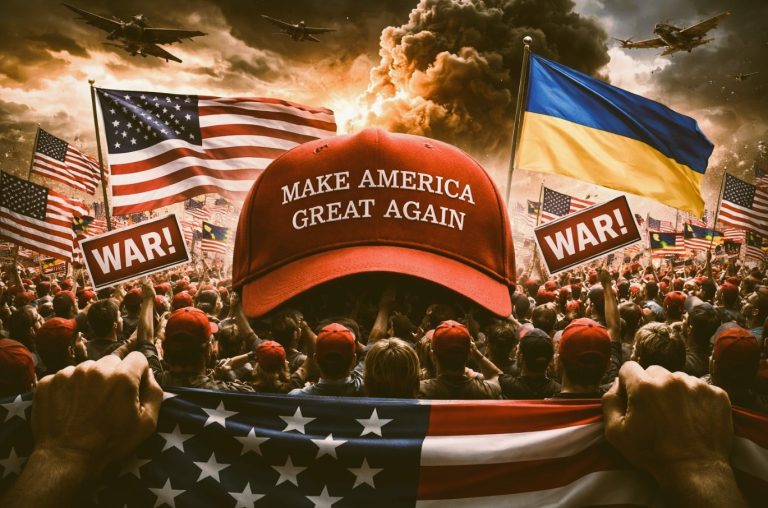
Populism is often characterized by this.

By Nikita Savin
PhD Candidate in Political Science
University of California, Los Angeles

By Dr. Daniel Treisman
Professor of Political Science
University of California, Los Angeles
Introduction
Donald Trump’s political career has been marked by a unique and often controversial rhetorical style. Since 2015, his rhetoric has evolved significantly, attracting attention for its direct, often violent tone.
Analyzing his speeches offers a revealing look at how his language has shaped both his political persona and the broader landscape of American politics.
We are political scientists who analyzed Trump’s campaign and presidential speeches from 2015 through 2024. We found that one of the most striking trends in Trump’s rhetoric is the sharp rise in his use of violent vocabulary. The share of words associated with violence rose from almost 0.6% in 2016 to 1.6% in 2024 in Trump’s speeches. As a comparison, the proportion of violent words in 40 randomly chosen weekly radio addresses by Barack Obama was 0.79%.
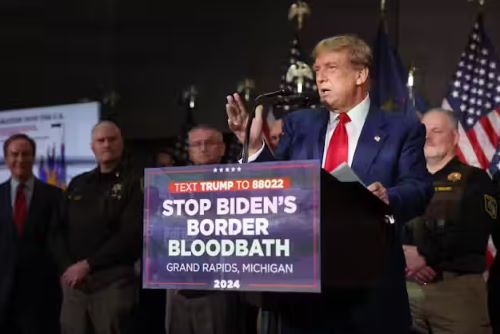
From Trump’s first campaign in 2015 through the next nine years, his speeches have increasingly included words and phrases related to crime and military conflict. In March 2024, for example, Trump said that “it’s going to be a bloodbath for the country” if he wasn’t reelected in November.
By 2024, Trump’s use of violent language had surpassed that of nearly all other democratic politicians we considered, approximating that of authoritarian figures such as Kim Jong Un and Fidel Castro.
This surge in violent rhetoric is not linked to significant external events such as wars. Trump has focused his messaging on violent crime, particularly in American cities, even as crime rates were declining. His repeated references to “murderers, rapists and thugs” paint a picture of a nation under siege, heightening anxiety among his supporters.
At the same time, he casts himself as a strong leader capable of confronting these perceived threats.
Economic, Public Service Language Declines
While Trump’s rhetoric has become more violent, it has simultaneously moved away from traditional political discourse on economic performance and public services. Early in his political career, Trump quite frequently mentioned economic issues, tapping into concerns about jobs, trade and prosperity. Over time, however, his focus on economics has significantly declined.
This trend is not unique to Trump. Both Democratic and Republican candidates have been using less economic vocabulary in their speeches since at least 2012.
Trump’s retreat from economic discussions, however, is particularly pronounced. He has always focused less than other presidential candidates on the provision of public services such as health care, housing and transportation. His speeches contained fewer words such as “medicine,” “education,” “child care,” etc.
Instead, his rhetoric has increasingly centered on identity politics and cultural issues, reflecting broader changes in U.S. political discourse.
Shift Away from Inclusive Language
Populism is often characterized by a focus on “the people” versus “the elites,” with politicians presenting themselves as champions of the common citizen against corrupt insiders. Early in his political career, Trump did use such inclusive language invoking “the people” quite often.
Since then, however, his rhetoric has shifted toward what we call “exclusionary populism,” with frequent attacks on political elites, immigrants and media figures. The Sept. 10, 2024, debate between Trump and Kamala Harris was rife with such examples, the most famous of which concerned immigrants eating dogs.
This shift from inclusive to exclusionary rhetoric reflects a broader strategy of defining politics as a battle between “us” and “them,” with Trump casting himself as the defender of ordinary Americans against external threats.
Trump’s rhetorical style has undergone significant changes since he launched his first presidential campaign. During his initial run in 2015-2016, his language became more inclusive, with a rise in the use of “we” and “the people” and fewer references to elites and social groups he views negatively (“them”).
Once in office, however, his speeches exhibited a more combative style. His use of violent language surged, and references to “them” became more frequent.
This evolution suggests that Trump’s rhetoric is adaptable, changing in response to political contexts and the audience he aims to engage. His increasing use of inflammatory language and swear words after taking office contrasts with the more measured tone he adopted during his 2016 campaign.
Aggressive Attacks on Elites
Trump’s rhetoric can be understood more fully by comparing it with the rhetoric of other U.S. presidential candidates since 1952, as well as world leaders, both democratic and authoritarian.
The only other recent presidential candidates with levels of violent language comparable to Trump’s in 2024 were Republican George W. Bush and Democrat John Kerry in 2004. But while Bush and Kerry were discussing the ongoing Iraq war, which was then causing hundreds of U.S. casualties a year, Trump’s violent claims were not connected to actual events or statistics.
In terms of populism, Trump stands out from other leaders for his aggressive attacks on elites. Since the beginning of his political career in 2016, Trump has talked about his intention to “drain the swamp,” referring to the corruption of political elites. While populist candidates often criticize political insiders, the frequency of Trump’s denunciations surpasses that of most recent U.S. presidential candidates.
Trump’s 2024 speeches, for instance, feature far more references to corrupt elites than those of his predecessors, revealing a deeper attachment to exclusionary populist rhetoric.
While politicians’ rhetoric does not always predict their actions, Trump’s increasing attachment to violent language and populist themes may offer insight into his future approach, whether as president or in defeat. As political scientists, we believe the rise of such rhetoric merits close monitoring because of its potential implications for the broader political landscape.
Originally published by The Conversation, 10.26.2024, under the terms of a Creative Commons Attribution/No derivatives license.
About the Author