Addressing these challenges requires a clearer understanding of how digital platforms shape information, perception, and engagement.

By Matthew A. McIntosh
Public Historian
Brewminate
Introduction
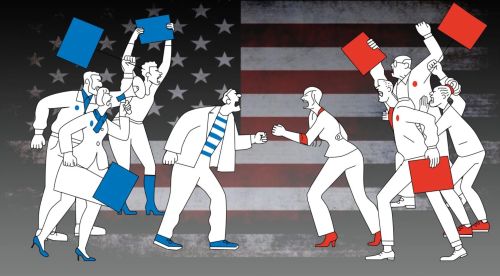
Political conversations on social media appear louder and more polarized than in everyday life, but research shows that this impression is shaped by a small group of unusually active users. Studies indicate that most Americans rarely discuss political issues online, leaving a vocal minority to dominate what the public sees and shares.
National reporting has found that a narrow slice of social media users is responsible for much of the political content circulating on major platforms. This hyperactive minority amplifies conflict and gives the appearance of widespread division, even though their views do not reflect the posting habits of most Americans. Research from Brigham Young University supports this pattern, showing that conversations around political issues are often driven by people positioned at the ideological margins rather than the broad center of public opinion.
Most U.S. social media users rarely or never post about political or social issues, underscoring the divide between what appears online and what most people actually discuss. The majority of users engage with personal or entertainment content rather than public affairs. These findings highlight how platform dynamics obscure the fact that political posting is a minority activity.
Researchers say this uneven distribution of political speech contributes to widespread misperceptions about the strength of opposing viewpoints. Users frequently mistake the volume of political posts for evidence of majority sentiment. As a result, online environments often present a distorted picture of national opinion, which can shape how individuals interpret public debates and assess the attitudes of people outside their social circles.
A Vocal Minority Shapes the Public Narrative
Studies show that a small group of highly active users drives a disproportionate share of political conversation on major platforms. This minority posts at a rate far higher than typical users, creating an environment where strongly worded or extreme content appears more common than it actually is. Researchers note that this imbalance has made political discussion online seem louder and more contentious than offline interactions.
Those at the ideological edges contribute disproportionately to political threads. Their findings show that engagement patterns on social platforms are not representative of the general population, since users with the strongest or most polarizing views tend to post more frequently. As a result, conversations appear more extreme when compared to surveys of broader public sentiment.
These dynamics influence how political stories spread. Posts from this highly active minority often receive elevated visibility through platform engagement systems. While this group is small, their frequent posting gives them a large footprint in public feeds, shaping how issues are framed and discussed. This can affect which topics trend and which narratives gain traction, even when most users are not participating.
Researchers caution that this distortion does not mean the majority is disengaged from politics entirely, but rather that posting behavior does not reflect typical political attitudes. Many users observe far more than they post, creating a gap between the visible content and the quieter views held by most people. That gap allows the most active voices to set the tone of political conversation online, giving a misleading sense of national consensus or division.
Most Social Media Users Rarely Discuss Politics at All
Most Americans are largely absent from political discussions on social media. 70 percent of U.S. users rarely or never share political or social issue content, illustrating a wide gap between the volume of political material that appears online and the participation habits of the broader population. This contrast reveals how little most people use these platforms for public debate.
The majority of users engage with personal, entertainment, or hobby-related content rather than political issues. According to their analysis, political posting represents only a small portion of everyday social media activity, even during major national events. This divergence between activity patterns and the volume of political content that circulates publicly contributes to the false impression that online discourse reflects a fully engaged political community.
The structure of social platforms obscures the quiet behavior of most users. When the vast majority remains silent on political topics, the content produced by a small, active minority becomes far more visible, influencing perceptions of what people believe and how broadly certain views are held. As a result, social media feeds present a distorted snapshot of national sentiment, shaped not by representative engagement but by the loudest participants.
Filter Bubbles and Reinforcement Loops Distort Perception
Digital environments shape what users see by prioritizing content that aligns with their existing interests, a pattern described in educational and research analyses of online information systems. These filter bubbles limit exposure to alternative viewpoints by curating content based on past behavior. As a result, individuals may encounter political material that reinforces their existing views while being shielded from perspectives outside their usual information streams.
Studies of online behavior show that recommendation algorithms strengthen this narrowing effect. A scientific review published in Trends in Cognitive Sciences outlines how selective engagement and algorithmic sorting create self-reinforcing loops that influence perception and attention. Users in these digital environments often perceive their curated feeds as representative of the broader public, even when those feeds reflect only a fraction of available viewpoints.
These reinforcement mechanisms contribute to misunderstandings about the prevalence of certain political attitudes. When users repeatedly encounter the same types of content, the repetition can create a false sense of consensus or conflict, depending on what the algorithm prioritizes. This curated exposure plays a central role in shaping the perceptions that fuel division on the platforms.
Polarization Intensifies Through Platform Dynamics
Analyses of platform design show that the structure of social media contributes directly to political polarization. Engagement-driven ranking systems elevate posts that elicit strong emotional responses, including outrage and fear. According to this research, content that provokes sharper reactions is more likely to be promoted, increasing its visibility and shifting public discussions toward conflict-oriented material.
Sensational or divisive posts often travel farther than balanced or informational content. This dynamic means that extreme viewpoints can gain an outsized presence even when they are not commonly held. As these posts circulate more widely, they contribute to a perception that political life is more polarized than surveys of the general population suggest. The amplification occurs not because most users hold such views, but because the platform’s mechanics reward high-intensity engagement.
Researchers examining these patterns argue that the competitive incentives built into major platforms encourage users to adopt more confrontational communication styles. When posts that spark strong reactions receive more likes, shares, and visibility, users seeking influence may gravitate toward sharper or more extreme language. This behavior reinforces the dominance of highly emotional content and reduces the presence of moderate or nuanced discussion in public feeds.
These dynamics create a feedback loop that shapes the broader online environment. As confronting or divisive posts receive elevated visibility, users encounter fewer examples of constructive or cross-partisan dialogue. Over time, this concentration of emotionally charged material affects how political issues are framed and discussed, narrowing the range of perspectives that appear to represent mainstream opinion.
Public Misperceptions about Majority and Minority Opinions
Studies show that disproportionate posting by a vocal minority creates widespread confusion about what most Americans actually believe. Users often misinterpret the frequency of extreme views online as a sign of their dominance in public opinion. This misperception persists even when polling data shows that most people hold more moderate positions or avoid political posting entirely.
Polling reinforces this gap between online visibility and real-world attitudes. Pew’s findings indicate that because the majority of users remain silent on political issues, the loudest voices appear to represent the norm. This creates a distorted picture of national sentiment, where fringe perspectives are more visible than mainstream ones, leading many users to believe they are observing a broader trend than actually exists.
Researchers note that these mistaken impressions influence how people evaluate political opposition and assess the popularity of certain viewpoints. When users encounter extreme positions repeatedly through curated feeds, they may assume that these stances are widely held rather than concentrated among highly active accounts. This pattern contributes to a sense of division that does not reflect overall public opinion and shapes how individuals interpret the political climate outside of social media.
Broader Implications for Democratic Discourse
Researchers warn that distorted perceptions of public opinion can influence how individuals engage with political processes. When users believe extreme views are widespread because they dominate social media feeds, they may overestimate the level of polarization in the country. This perception can reduce trust in civic institutions and shape expectations about how other citizens might vote or participate. Studies summarized in the PBS and Pew findings indicate that these misunderstandings alter how people interpret national debates outside of online environments.
These distortions also affect how communities interact with opposing viewpoints. Filter bubbles limit the range of political arguments users encounter, reinforcing the belief that alternative perspectives are rare or extreme. As people encounter fewer credible representations of differing positions, cross-partisan dialogue becomes more difficult, leading to less understanding and more suspicion across ideological lines.
Analysts studying social platform dynamics note that the combination of algorithmic amplification and vocal minority dominance can influence public reactions to political events. Research describes how users often perceive heightened conflict even when offline communities remain largely stable. This perceived instability can affect how voters evaluate policy proposals, engage with news coverage, or interpret discussions within their own social networks.
These patterns contribute to long-term challenges for democratic discourse. When social media environments distort public sentiment, they complicate efforts to build consensus or address shared problems. Communication researchers argue that this misalignment between online representation and real-world opinion weakens the foundation for informed debate. As a result, the digital landscape often amplifies divisions that are less pronounced in everyday civic life.
Conclusion
The imbalance between who participates in political conversations online and what most users actually discuss has created a digital environment that misrepresents the nation’s political climate. Researchers have consistently shown that a small group of highly active accounts shapes much of the visible discourse, while the majority of social media users remain silent on political matters. As a result, the public often encounters a version of national debate that is louder and more polarized than the one reflected in broader surveys.
These distortions have meaningful consequences for how people interpret the views of others. Filtered content and reinforcement loops make extreme positions appear common, even when they are limited to a narrow set of voices. This misalignment between online representation and offline opinion influences how individuals understand political dynamics and evaluate the temperature of public life.
Addressing these challenges requires a clearer understanding of how digital platforms shape information, perception, and engagement. As research from multiple institutions shows, the gap between online discourse and real-world attitudes remains a significant obstacle to constructive political conversation. Recognizing that social media presents only a partial picture of national sentiment is an essential step toward reducing confusion and strengthening democratic dialogue.
Originally published by Brewminate, 12.08.2025, under the terms of a Creative Commons Attribution-NonCommercial-NoDerivatives 4.0 International license.
About the Author