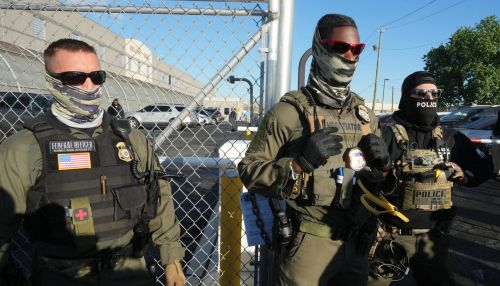
The staggering increase in government surveillance abilities has come with warnings.The Trump administration is being open about its plans to violate Americans’ First and Fourth Amendment rights.

By Faiza Patel, J.D.
Senior Director, Liberty & National Security
Brennan Center for Justice

By Matthew Ruppert
Special Assistant, Liberty & National Security
Brennan Center for Justice
Introduction
U.S. Immigration and Customs Enforcement has embarked on a spending spree, signing contracts worth up to $25 million for a smorgasbord of spy technology: social media monitoring systems, cellphone location tracking, facial recognition, remote hacking tools, and more.
It’s nothing new for ICE to use these to find people to deport, a practice that raises a host of concerns, including heightened surveillance of immigrant communities and the wide-ranging capture of Americans’ personal data.
What’s new is that the federal government now openly says it will use its supercharged spy capabilities to target people who oppose ICE’s actions. Labeled as “domestic terrorists” by the administration, these targets include anti-ICE protesters and anyone who allegedly funds them — all of them part of a supposed left-wing conspiracy to violently oppose the president’s agenda.
This serious threat to free speech and privacy rights protected by the First and Fourth Amendments is not hypothetical, as administration officials are making no secret of their intentions.
In September, President Trump issued a memo ordering federal law enforcement to focus on ideologies that are supposedly motivating “domestic terrorism,” including “anti-Americanism, anti-capitalism, and anti-Christianity; support for the overthrow of the United States Government; extremism on migration, race, and gender,” as well as opposition to “foundational American principles (e.g., support for law enforcement and border control).” The memo also highlights anti-ICE activities.
Acting ICE Director Todd Lyons said in a recent interview that his agency intended to probe anti-fascist and anti-ICE protesters and those that support them. “We are going to track the money. We are going to track these ringleaders.” He went on to claim, without evidence, that many of the protesters in Chicago were “professional agitators that are being brought in.”
Lyons said that ICE would be using its powerful but lesser-known Homeland Security Investigations (HSI) division for this effort. This part of ICE usually investigates transnational crimes such as drug trafficking and related money laundering, human smuggling, and customs violations.
Violence against ICE agents or facilities must be investigated, but there is no evidence of any coordinated campaign. The administration has not even provided any support for its oft-repeated claim that assaults against ICE officers have increased by 1,000 percent. Indeed, as evidenced by multiple videos, ICE officers too often use excessive force when interacting with the public. Rather than hold these officers accountable, the administration has pursued multiple cases against the victims of its agents’ violence, claiming that they are terrorists who assaulted, resisted, or impeded federal agents.
In any event, it is unlikely that ICE will restrict itself to investigating physical attacks on its facilities and personnel. Homeland Security Secretary Kristi Noem has said that revealing the identities of agents and videotaping them on operations constitutes “violence.” Court documents reportedly show that Border Patrol chief Gregory Bovino believes that all protesters are “violent rioters” and has instructed officers to arrest protesters “who make hyperbolic comments.”
Over the past two decades, the staggering increase in government surveillance abilities has come with warnings that this power could be used to run roughshod over Americans’ free speech and privacy rights. With the Trump administration’s explicit campaign of using federal law enforcement — including ICE — to target its political opponents, that time has come.
Social Media Monitoring
Social media provides government agencies with a wealth of information about Americans: political and religious views, personal and professional connections, health and sexuality, and more. ICE has been acquiring social media surveillance tools for years and has a track record of monitoring protests against its operations.
Homeland Security Investigations recently signed a multimillion dollar contract for a social media monitoring platform called Zignal Labs that claims to ingest and analyze more than 8 billion posts a day. The agency is also paying millions to Penlink for monitoring tools that gather information from multiple sources, including social media platforms, the dark web, and databases of location data. According to the contracts, HSI will use these tools to gather intelligence for investigations into organized crime, trafficking, and terrorism — categories newly expanded by the president’s recent memo to include potentially anyone expressing views the administration dislikes.
ICE’s August 2025 privacy impact assessment for social media monitoring analytic tools says that they will be used to track threats to the agency. But a recent press release shows that the agency is searching not for threats but for any anti-ICE statements. The release proclaims that “ICE law enforcement is now facing an 8,000% increase in death threats,” backed up by a mere four examples to demonstrate this claim. One Spanish-language TikTok is unclear but could conceivably be construed as a death threat. Another poster calls ICE officers Nazis and states that he will start “observing, tailing, recording and reporting” them — all of which would fall squarely within the ambit of the First Amendment. The poster goes on to agree with a commenter who hopes that the country gets back to hanging “traitors,” which could arguably be construed as a death threat. The two expletive-laced voicemails listed don’t seem to rise to the level of death threats: one expresses the hope that all ICE officers get doxed, and the other wishes that the ICE officer’s children get deported by mistake and references “what happened to the Nazis after World War II.”
This handful of examples — presumably the best the government has — hardly add up to a dramatic surge of violent threats against those working for the agency. They do demonstrate that for ICE, hyperbolic words can easily be regarded as a serious threat. And reports are emerging of FBI agents going to the homes of people who took part in anti-ICE demonstrations and asking questions about who paid for protest signs.
Location Tracking
Several of the new contracts boost ICE’s location tracking capabilities. Penlink’s social media software can monitor which devices have been at a certain location and how often and creates “day-in-the-life” profiles of targets based on social media, location data, and any other online information. This adds to the agency’s cellphone-tower simulator equipment — bolstered by an $800,000 delivery order in May — which is capable of identifying cellphones in the vicinity and intercepting their communications.
The enforcement arm of ICE is also seeking to set up round-the-clock social media monitoring teams to sift through law enforcement and commercial databases, as well as social media and other sources. They will look for leads “to locate individuals who pose a danger to national security, public safety, and/or otherwise meet ICE’s law enforcement mission.” “Domestic or international terrorism” are listed among the most urgent category of cases.
ICE is also obtaining location information from the nationwide web of license plate readers. Researchers found “4,000 nation and statewide lookups by local and state police done either at the behest of the federal government or as an ‘informal’ favor to federal law enforcement.” In addition to queries related to immigration enforcement, many listed HSI as the reason for the lookup. Even police departments that are not supposed to share information for immigration enforcement purposes may be inclined to provide location information to HSI for its criminal investigative mandate.
ICE is also developing an app to allow its agents to scan license plates to instantly determine where a vehicle has been. Data accessed via a recent $4.9 million contract with Thomson Reuters reportedly feeds into this app.
The Supreme Court has held that police must have a warrant to obtain cellphone location records extending over a period of days. The Department of Homeland Security and other agencies, however, take the position that this rule does not apply if the information is purchased from a data broker instead of obtained directly from the communications company through a government request. The risks of allowing this workaround are now plain, as ICE can now more easily track protesters and anyone else it regards as opposing its policies.
Facial Recognition
ICE is expanding its already robust facial recognition capabilities. HSI can request surveillance drones from U.S. Customs and Border Protection. These are meant to be used for border security but have repeatedly been used to monitor protests. The agency recently posted drone footage of anti-ICE protesters who it said were “obstructing the duties” of its officers.
Images and video captured by the high-resolution cameras on surveillance drones can be run through facial recognition tools. This year, HSI signed a contract for Clearview AI’s facial recognition software worth up to $9.2 million, the purpose of which includes investigating “assaults against law enforcement officers.” As discussed above, the agency takes an extremely expansive view of assaults and isn’t hesitant about pursuing criminal charges, even baseless ones.
Hacking Phones
HSI recently reactivated a $2 million contract with Paragon Solutions. Although publicly available documents provide few details, the company sells a tool that can remotely hack into cellphones, which would give the agency secret access to the device’s location data as well as messages and photographs on the phone — potentially in real time and for months at a time.
Paragon’s tools have already been used to spy on journalists and activists. In January 2025, WhatsApp announced that it had disrupted a hacking campaign linked to the company that had targeted 90 people. Several Italian journalists, refugee rights activists, and associates of Pope Francis were later found to have been among those hacked, resulting in the cancellation of Paragon’s contract with the Italian government.
The Supreme Court has ruled that the Fourth Amendment requires the government to obtain a probable cause warrant from a judge to search a cellphone. There is no information on whether ICE intends to follow this rule when accessing phones remotely. When asked about privacy concerns, an administration official said only that “the President’s actions are focused on entities and individuals engaged in organized political violence and domestic terrorism.” Given the administration’s unsubstantiated claims of a vast left-wing conspiracy that includes protests, political funding, and doxing, this is hardly reassuring.
Conclusion
ICE has powerful tools to crack down on people opposing the administration’s policies. It can trawl the internet for people holding anti-ICE views. It can track the locations where protesters and activists gather and identify their networks of friends and family. It can identify protesters using facial recognition. It may even be able to hack into phones. Information collected through these tools will be added to the Department of Homeland Security’s vast stores of information for potential future use. And all these data streams can be combined to develop detailed dossiers on people who are not suspected of any crime.
For too long, laws have failed to keep up with surveillance technology. Many are decades old and designed to prevent the government from listening to landline phone calls or reading emails. They do not protect free speech and privacy rights against persistent surveillance through social media monitoring, facial recognition, and location tracking. As a result, the government can easily turn these tools against anyone and everyone, with scant safeguards. Now, ICE is announcing that it plans to make this risk a reality for the swath of Americans who oppose the Trump administration’s agenda.
Originally published by the Brennan Center for Justice, 11.21.2025, under the terms of a Creative Commons Attribution-No Derivs-NonCommercial license.
About the Author